


Some assignments are too dangerous for the law. Some enemies are too powerful for ordinary men. And some heroes have to die before they can begin.
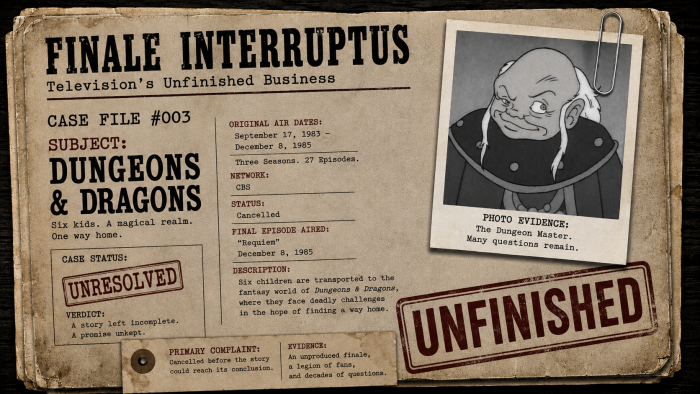
Finale Interruptus: Case File #003 - Dungeons & Dragons
FTC Statement: Reviewers are frequently provided by the publisher/production company with a copy of the material being reviewed.The opinions published are solely those of the respective reviewers and may not reflect the opinions of CriticalBlast.com or its management.
As an Amazon Associate, we earn from qualifying purchases. (This is a legal requirement, as apparently some sites advertise for Amazon for free. Yes, that's sarcasm.)
Submitted by Bill Casticart on Tue, 08/11/2026 - 19:39
Every television series begins with a promise.
Give us your time. Your attention. Your imagination. Invite these characters into your home, follow their lives, and return each week to see what happens next.
In return, we'll tell you a story. And when it's over, we'll bring it to its proper end. We'll answer the questions, settle the conflicts, and give the characters—and the audience—a chance to say goodbye.
Most series keep that promise.
Some don't.
Some disappear between seasons, leaving their characters suspended in place and their audiences waiting for a conclusion that never arrives.
Some endings are still missing.
These are their case files.
CASE FILE #003
SUBJECT: DUNGEONS & DRAGONS
Original Run: 1983–1985
Network: CBS
Episodes: 27
Final Episode: “The Winds of Darkness”
Follow-up: "Requiem (unproduced finale)
Case Status: Partially Resolved
The Promise
Every episode of Dungeons & Dragons began with one of the most efficient origin stories Saturday morning television ever devised.
Six kids go to an amusement park. They climb aboard a Dungeons & Dragons ride. Something goes terribly wrong, and Hank, Eric, Diana, Sheila, Presto and Bobby find themselves deposited in another world — a place of dragons, magic, monsters and apparently very lax regulations concerning unaccompanied minors.
There they meet Dungeon Master, a diminutive and maddeningly cryptic guide who gives each of them a magical weapon and offers advice that usually becomes useful approximately five minutes after everyone wishes he'd simply spoken English. They also acquire Uni, a baby unicorn who becomes Bobby's companion, and attract the attention of Venger, the winged sorcerer who wants their weapons and has no particular objection to killing children to get them.
The premise was simple enough for a child to understand before finishing a bowl of cereal. The kids were lost. They wanted to go home. That gave Dungeons & Dragons something many cartoons of its era didn't have: an ending built into the premise. Skeletor could attack Castle Grayskull forever. Cobra Commander could hatch another plan to conquer the world next Saturday. The Decepticons would always find another source of energon. Those shows could theoretically continue as long as somebody was willing to order more episodes. Dungeons & Dragons was different. Every adventure existed beneath the shadow of a destination.
Home.
Dungeon Master would occasionally offer the children hope that this particular quest might provide a way back. Portals appeared. Opportunities presented themselves. More than once, home seemed close enough to touch, only for circumstances — sometimes Venger, sometimes the needs of someone else, sometimes the children's own choices — to take it away again.
That repetition could have become a gimmick. Instead, it gradually changed the meaning of the quest. These weren't the same frightened children who had arrived in the Realm. They formed friendships there. They saved people who had no one else to save them. They accepted responsibilities they hadn't asked for and repeatedly sacrificed opportunities to help themselves because someone else needed them more.
The Realm stopped being merely the place they were trying to escape. It became a place where their decisions mattered. That distinction is important, because Dungeons & Dragons never promised its audience that Venger would finally be defeated or that Dungeon Master would eventually explain everything he knew. Its most fundamental promise was much simpler: six children had been taken away from their families, and the story would continue until we discovered whether they could find their way home.
Across the 27-episode 1983 Dungeons & Dragons animated TV series, CBS kept asking children to come back Saturday morning and follow them a little farther. Then, in 1985, the adventures stopped. Hank, Eric, Diana, Sheila, Presto and Bobby were still in the Realm. Venger was still out there. Dungeon Master still knew considerably more than he was telling anyone. And an entire generation of viewers was left waiting for the next episode.
There wasn't one.
Welcome to the Realm
For a series built around a role-playing game notorious for rulebooks, character sheets and twenty-sided dice, Dungeons & Dragons made the smart decision not to spend much time explaining Dungeons & Dragons.
The six children weren't presented as experienced players who understood the Realm because they'd studied the game. They were archetypes an audience could understand immediately. Hank was the Ranger and natural leader. Eric was the Cavalier, armed with a shield and an apparently inexhaustible supply of complaints. Diana was the Acrobat, Sheila the Thief, Presto the Magician, and Bobby the Barbarian. Their magical weapons gave each child a recognizable function without requiring viewers to know the difference between an armor class and a saving throw.
That simplicity disguised a surprisingly well-balanced ensemble. Hank could fire arrows made of energy from his bow, but being the leader meant he was usually responsible for deciding when not to use it. Diana's staff and athletic ability made her one of the group's most capable fighters. Sheila's cloak could make her invisible, an ability that was considerably more useful than the word "Thief" might suggest. Bobby carried a club capable of producing tremendous force, which was exactly the sort of weapon you'd expect someone named "the Barbarian" to receive.
Then there were Eric and Presto, whose limitations made them arguably more interesting. Presto had a magic hat capable of producing almost anything, provided the magic cooperated. Sometimes it saved everyone. Sometimes it produced exactly the wrong thing. His power wasn't mastery of magic so much as the possibility of it, leaving an insecure kid repeatedly forced to attempt something he wasn't certain he could do.
Eric's shield was even more revealing. The loudest, most argumentative and frequently most self-interested member of the group had been given a weapon designed almost entirely to protect people. He could complain about danger all he wanted, but when danger actually arrived, Eric was repeatedly placed between it and his friends.
The writers understood the irony. They also understood that Eric's objections weren't always unreasonable. Dungeon Master had a habit of appearing from nowhere, delivering a riddle, assigning a potentially lethal task and disappearing before anyone could ask the obvious follow-up questions. Eric was the character willing to point out that perhaps the mysterious wizard who claimed to be helping them could occasionally provide directions that didn't require interpretation.
For a children's cartoon, that skepticism was useful. Dungeon Master wasn't simply the benevolent adult whose instructions must always be obeyed. The children trusted him, but the series allowed them — and particularly Eric — to question him. As the mythology developed, those questions became increasingly justified.
On the opposite side stood Venger. With his horned head, enormous batlike wings and Peter Cullen's imposing voice, Venger looked like exactly what Saturday morning television required from a fantasy villain. He wanted the children's weapons because their combined power could help him conquer the Realm, which provided an easy reason for him to pursue them from episode to episode.
But Venger was never quite as simple as he looked. There were hints of history between him and Dungeon Master that the children didn't understand. Venger knew things about their guide that they didn't. Dungeon Master, for his part, treated Venger less like an unknowable embodiment of evil than someone whose choices he found personally painful.
The show didn't immediately explain why. That mystery mattered because the Realm itself was more than a collection of fantasy obstacles. The children encountered kingdoms, villages and people whose lives continued whether or not six kids from Earth happened to be passing through. Some inhabitants were trustworthy, others weren't, and occasionally the distinction wasn't obvious until the children had already made a decision.
That gave the series room to tell stories instead of merely stage adventures. Getting home remained the objective, but increasingly it wasn't the only thing that mattered. If a portal to Earth opened while someone in the Realm needed their help, the children had a choice to make. If escaping Venger required abandoning someone else to him, escape suddenly came with a price.
Again and again, they chose the harder path. For viewers, that changed the stakes. We weren't merely waiting to see whether Dungeon Master would finally reveal the correct doorway home. We were watching six children gradually become the heroes their magical weapons suggested they could be.
And sometimes Dungeons & Dragons asked those heroes to make decisions considerably darker than Saturday morning cartoons were supposed to make.
A Children's Cartoon With Teeth
The easiest way to misremember Dungeons & Dragons is to remember only what it looked like. There was a baby unicorn. Presto pulled ridiculous objects from his hat. Eric complained. Dungeon Master spoke in riddles. The children encountered the assortment of dragons, monsters and magical creatures promised by the title, all rendered in the bright colors expected of a Saturday morning cartoon in the early 1980s.
But the stories could become remarkably grim. The children weren't tourists in the Realm. They were stranded there, separated from their parents with no reliable way home, while being hunted by a villain who wanted the weapons that represented their best means of survival. The series couldn't dwell realistically on what that would do to six children without becoming something very different from Saturday morning entertainment, but it didn't entirely ignore the implications either.
Fear mattered. Homesickness mattered. Failure mattered. So did temptation. The series repeatedly put its characters in situations where simply defeating the monster wouldn't solve the problem. Hank's leadership could become a burden when everyone else's safety depended on his judgment. Sheila's concern for Bobby complicated decisions because she wasn't merely another member of the party; she was an older sister trying to protect her younger brother in a world neither of them understood. Presto's insecurity made every failure of his magic personal. Even Eric's cowardice was treated with more nuance than the label suggests, because the show occasionally allowed the complainer to be the person asking the question everyone else should have considered.
Then there was Venger, who became more disturbing whenever the series allowed him to be something other than the villain of the week.
One of the show's most memorable episodes, "The Dragon's Graveyard," pushes the children to a point that would have been difficult to imagine from the opening credits. After Venger repeatedly threatens them and their chances of returning home, Hank decides that running is no longer enough. The children seek out a place where they believe they can gain the power necessary to destroy him.
Not defeat him. Destroy him. For a series aimed at children, the distinction is enormous. The episode forces Hank and his friends to confront what their desperation is turning them into, while Dungeon Master is placed in the uncomfortable position of watching the children he has guided consider killing someone he knows far more intimately than they realize. The story doesn't abandon the morality expected of children's television, but it earns that morality by allowing its characters to approach the edge first.
Other episodes played with similar anxieties. The possibility of getting home could be used against the children because Venger understood how desperately they wanted it. Allies could betray them. Apparently frightening creatures could prove sympathetic, while seemingly helpful characters could have motives of their own. The Realm operated according to fairy-tale logic, but fairy tales have never necessarily been safe places.
That helps explain why the series remained lodged in the memories of children who watched it. The animation wasn't revolutionary, and the basic structure still had to satisfy the demands of network Saturday mornings. Nobody was going to mistake Dungeons & Dragons for adult television. Yet within those boundaries, its writers treated young viewers as capable of understanding regret, sacrifice, divided loyalties and moral ambiguity without requiring every difficult idea to be sanded smooth.
Most importantly, the children changed because of what happened to them. Their original objective never disappeared. They still wanted to go home, and every lost opportunity hurt. But after enough adventures, the question wasn't merely whether they could escape the Realm. It was what obligations they had acquired by living there.
That evolution is what makes the show's unfinished ending sting. If Dungeons & Dragons had been nothing more than an episodic adventure series, cancellation after 27 episodes would have been disappointing but uncomplicated. The heroes would simply have stopped having adventures because CBS stopped ordering them.
Instead, the series had spent three seasons changing the meaning of "home." Then it disappeared before the children could tell us what that word meant to them.
And Then It Just Stopped
There is no great final image from Dungeons & Dragons to blame for traumatizing a generation of viewers. No title card announces that the children never made it home. Venger doesn't triumph. The amusement-park portal doesn't slam shut forever while Hank and the others watch their last chance disappear.
The series simply runs out of episodes. "The Winds of Darkness," the 27th and final produced installment, aired in 1985 without pretending to be a series finale. The children face another threat to the Realm, Venger remains their enemy, Dungeon Master remains their frustratingly enigmatic guide, and the continuing quest for home remains exactly that: continuing. Nothing about the episode tells viewers they are watching the end because, creatively, they weren't supposed to be.
That's an important distinction in the Finale Interruptus case file. Some television shows know they're ending and gamble on a cliffhanger anyway. Others attempt a finale and simply don't resolve everything viewers wanted resolved. Dungeons & Dragons belongs to the crueler category: a serialized premise was interrupted while everyone involved was still behaving as though another chapter would follow.
CBS didn't order that chapter. For the children watching at home, there wasn't much reason to understand what had happened. Television schedules changed. Cartoons disappeared. New shows took their places. Unless you were following the television business — an unlikely hobby for the elementary-school demographic — there was no announcement explaining that the quest had been canceled along with the series.
You simply waited. Maybe next Saturday would be the one where they got home. Then maybe the show would return later in the season. Maybe there would be another batch of episodes. Maybe you'd missed one. In an era before streaming libraries, episode guides and instant access to production information, it could take a surprisingly long time to realize that a television series hadn't merely disappeared from your local schedule.
It was over. That made Dungeons & Dragons different from many cartoons that vanished during the same period. If G.I. Joe stopped producing episodes, Cobra Commander was presumably still scheming somewhere. If He-Man ended, Eternia didn't cease to exist. Their premises were cyclical enough that viewers could imagine another adventure occurring immediately after the last one they happened to see.
Hank, Eric, Diana, Sheila, Presto and Bobby had a destination. The entire premise pointed toward a moment when their journey would end, and 27 episodes had taught viewers to expect that moment eventually. Every failed portal and every sacrificed opportunity reinforced the promise that there would be another chance. The children hadn't failed to get home yet; they simply hadn't gotten home yet.
Cancellation changed the meaning of that word. "Yet" became "never." At least, that was how the story appeared to end for years. Six children remained stranded in another dimension while generations of fans debated whether Dungeon Master was actually helping them, whether Venger could ever truly be defeated and whether the kids were somehow being prevented from leaving the Realm for reasons nobody had bothered to explain.
The unanswered questions became part of the show's mythology. So did increasingly elaborate fan theories attempting to solve them, because an unfinished story invites audiences to manufacture endings of their own.
But Dungeons & Dragons had something most canceled television series don't. There really was another episode. It had a title. It had a script. It was written by series developer Michael Reaves, and it was intended to resolve some of the show's oldest mysteries while potentially pointing toward an entirely different future.
The episode was called "Requiem." And had CBS produced it, our memory of Dungeons & Dragons might be very different.
The Missing Episode: "Requiem"
For years, the unfinished ending of Dungeons & Dragons seemed straightforward. The series had been canceled, the children were still trapped in the Realm, and whatever ending the writers might have imagined disappeared along with the fourth season CBS never ordered.
Except an ending had been written. Series developer and writer Michael Reaves wrote "Requiem," an unproduced episode designed to do something unusually ambitious for a Saturday morning cartoon: resolve the central conflict of the series while leaving enough room for the story to continue if another season happened. It wasn't simply another adventure with a portal home conveniently waiting at the finish line. Reaves went directly after the questions the series had spent three seasons teaching viewers to ask.
Why was Venger so obsessed with the children and their weapons? What exactly was Dungeon Master's relationship with him? Could Venger ever truly be defeated? And after everything the children had experienced in the Realm, was getting home still as simple a goal as it had seemed when they first arrived?
The story begins with Venger offering the children a deal. There is a key capable of opening a gateway that could send them home. Dungeon Master has sent them to retrieve it, but Venger wants it for himself. If the children give him the key, he promises to use its power to return them to Earth.
That proposition attacks the group at precisely its weakest point. After everything Venger has done, trusting him should be absurd. Yet the possibility of going home is the one temptation none of them can dismiss completely. They've spent three seasons following Dungeon Master's instructions, risking their lives on quests and watching potential routes home disappear. Venger, of all people, now offers them the thing Dungeon Master has repeatedly failed to provide.
The argument that follows isn't merely about whether Venger can be trusted. It's about whether Dungeon Master can. Eric, predictably, is the one willing to say it. That matters because Eric's skepticism has always been treated partly as comic relief. He complains about Dungeon Master's riddles, questions dangerous missions and frequently suggests that everyone might be better off ignoring whatever mysterious assignment they've just been given. In "Requiem," those tendencies stop being punchlines. After 27 episodes of promises and near misses, Eric has evidence for his frustration.
The group fractures over what to do. For a series whose heroes have survived largely because they remained together, that division raises the stakes more effectively than another monster ever could. The question isn't whether Hank can fire enough energy arrows or Bobby can swing his club hard enough. The children have to decide whom they believe, and for once Dungeon Master isn't going to make the decision for them.
Eventually, Eric takes control of the key. In another episode, this might have been the moment when Eric's selfishness endangered everyone and Hank had to repair the damage. "Requiem" refuses that familiar route. Eric makes his choice, uses the key and discovers that what everyone thought they understood about the conflict in the Realm was incomplete.
The result isn't Venger's destruction. It's his redemption. The evil that has pursued the children since their arrival isn't defeated by a magical weapon or thrown into an abyss. Venger is restored, and the revelation that follows explains why Dungeon Master's relationship with him has always seemed strangely personal.
Venger is Dungeon Master's son.
Suddenly, three seasons of cryptic behavior look different. Dungeon Master hasn't merely been guiding six children through a dangerous world while an evil sorcerer tries to steal their weapons. He has also been living with the corruption of his own child. His reluctance to treat Venger as something that simply needs to be destroyed wasn't weakness or another unexplained rule of the Realm. He was still hoping Venger could be saved.
And the person who ultimately makes that possible is Eric. The complainer. The coward. The kid most likely to challenge Dungeon Master and least likely to accept that an authority figure must be right simply because he says so.
It's difficult to imagine a more satisfying payoff for the character. But Reaves had one more piece of business to resolve. With Venger redeemed and the immediate conflict over, Dungeon Master finally gives the children what they have been seeking since they stepped off that amusement-park ride.
A way home. Not another quest that might lead to a portal. Not another riddle. Not another opportunity that can be snatched away before they reach it. A choice. They can return to Earth.
Or they can remain in the Realm. And that's where "Requiem" ends. We don't see Hank, Eric, Diana, Sheila, Presto and Bobby step through a portal. We don't see them reunited with their families. We don't see them decide to stay, either. Reaves deliberately stops before the decision is revealed, allowing the episode to function as a conclusion if the series ended there or as the foundation for a changed fourth season if production continued.
At first glance, that may sound like yet another refusal to give viewers an ending. It isn't. For three seasons, the children had been asking, "How do we get home?" "Requiem" finally changes the question.
"Do we still want to?" That's an ending. Maybe not the one an eight-year-old watching CBS in 1985 would have demanded, but it's an ending to the story the series had actually been telling. The tragedy is that almost nobody watching at the time ever got to see it.
The Truth About Venger
The revelation that Venger is Dungeon Master's son isn't merely a twist inserted into "Requiem" to reward longtime viewers. It changes the meaning of nearly everything that came before it.
For three seasons, Dungeon Master had been sending the children on missions while withholding information that might have helped them understand the Realm and their place within it. His evasiveness was practically a character trait. Eric complained about it constantly, and he wasn't wrong: when six children are stranded in a hostile dimension, "solve my riddle and perhaps you'll understand later" is not necessarily the most reassuring form of adult supervision.
"Requiem" finally gives some context to that behavior. Dungeon Master isn't observing the struggle with Venger from a comfortable distance. He has a personal stake in it that he has never explained to the children, and his apparent unwillingness simply to destroy their enemy takes on an entirely different meaning once we understand who that enemy is.
Venger isn't merely the villain Dungeon Master cannot defeat. He's the son Dungeon Master has never stopped hoping to save. That makes Eric's role in the resolution particularly satisfying. Throughout the series, Hank is the obvious hero. He's brave, responsible and usually willing to follow Dungeon Master's guidance even when the destination isn't clear. If Dungeons & Dragons had followed the safest possible storytelling formula, Hank would have been the character who solved the final problem, defeated Venger and led everyone home.
Instead, the crucial decision belongs to Eric. The Cavalier has spent three seasons questioning Dungeon Master, complaining about the danger and occasionally suggesting that everyone would be better off looking after themselves. Those traits frequently made him the group's comic irritant, but they also gave him a perspective the others lacked. Eric didn't automatically accept that Dungeon Master knew best, and "Requiem" finally puts him in a situation where skepticism isn't a character flaw.
He has to make a choice without knowing whether he's right. When that choice ultimately helps restore Venger rather than destroy him, Eric becomes instrumental in resolving a conflict far older than the children's arrival in the Realm. The kid most frequently accused of selfishness becomes the one whose decision makes reconciliation possible.
That's not just clever irony. It's character development paying off. Venger's redemption also reframes the series' central conflict. The children had spent years believing they were caught between two opposing forces: Dungeon Master represented good, Venger represented evil, and their own task was to survive long enough to escape the battlefield. "Requiem" reveals something considerably more complicated. The conflict they've wandered into is also a broken family, and Dungeon Master's ultimate objective was never necessarily to destroy his enemy.
It was to bring his son back. Once that happens, the children's relationship with the Realm changes as well. They are no longer simply victims waiting for Dungeon Master to solve their problem. They've altered this world. They've saved people, defeated threats, formed relationships and, finally, helped resolve the struggle that has defined much of their time there.
Only then does Dungeon Master offer them the choice to leave. That timing matters. Had the children been given a portal home in the first episode, there would have been no decision to make. They would have run through it without looking back. By "Requiem," however, home is no longer just a geographical destination. Earth represents the families and lives they lost, while the Realm represents the people they've become and the responsibilities they've accepted.
The series therefore arrives at a surprisingly mature conclusion for a cartoon built to sell fantasy adventure to children. Growing up isn't simply finding your way back to where you started. Sometimes experience changes what returning to the starting point even means, especially when the door is finally open.
Reaves wisely refuses to decide for them. That may frustrate anyone who waited decades to learn whether the children got home, but showing Hank and his friends walking through the portal would actually answer the less interesting question. The important resolution is that they are no longer trapped.
For the first time since the amusement-park ride, they control what happens next. If they choose Earth, they're going home because they want to. If they choose the Realm, they're staying because they want to.
Either way, Dungeon Master's quest is over. And that creates an unusual problem for this particular investigation. Finale Interruptus exists to examine television stories that were denied their endings, but Dungeons & Dragons presents us with something much harder to classify.
The finale was never produced. The ending, however, exists.
Case Status: Partially Resolved
So does Dungeons & Dragons actually belong in Finale Interruptus? Yes. But this may be the strangest case we've opened so far. ALF received a cliffhanger that was eventually followed by a television movie. Profit was canceled while its story was still unfolding. Dungeons & Dragons occupies an uncomfortable space between those outcomes because its creators did write a conclusion. They simply never got to put it on television.
For anyone watching CBS in 1985, there was no ambiguity. The series ended without an ending. "The Winds of Darkness" was another adventure, not a farewell, and nothing about it resolved the promise established in the opening credits. The children entered the Realm wanting to get home, and when the last produced episode ended, they were still there.
On that evidence alone, the verdict would be easy. Case Status: Unfinished. "Requiem" complicates the ruling. Michael Reaves didn't merely leave behind notes describing what might have happened in another season. He wrote the episode. The story exists, and in later years fans were finally given access to it through official home-video material and other presentations of the script. We therefore know considerably more about the intended resolution than viewers of most prematurely canceled television series ever get to know.
More importantly, "Requiem" resolves the right things. Venger's story has an ending. Dungeon Master's strange relationship with him finally makes sense. Eric receives an unexpectedly appropriate payoff to three seasons of skepticism. The children complete a journey that changes them from passengers desperate to escape the Realm into people capable of deciding for themselves where they belong.
What "Requiem" doesn't tell us is which choice they make. I'm willing to acquit it on that charge. A finale doesn't have to answer every question to provide an ending. Sometimes answering the question destroys the point. If the final shot had shown all six children running through a portal to Earth, we'd know where they went, but the series would have ended with essentially the same objective it began with: escape the Realm.
"Requiem" offers something better. They don't need to escape anymore. They're free to leave. That is a resolution, even if it denies us the comforting image of six children running back into the arms of parents who presumably spent the previous three years having the worst experience imaginable.
The problem is that none of this absolves CBS. Television isn't a collection of scripts. It's a performed medium, and audiences who invested three seasons in Dungeons & Dragons were entitled to see the conclusion rather than discover years later that somebody had written one. An unproduced finale can tell us what the creators intended, but it can't retroactively become the episode viewers should have received. That leaves us with a split verdict.
CASE STATUS: PARTIALLY RESOLVED
The story has an ending. The television series does not. Normally, that would be where we'd close the file. We'd acknowledge "Requiem" as the lost conclusion, lament the episode that CBS never made, stamp the folder and move on to Case File #004.
Except something very strange happened 34 years after Dungeons & Dragons disappeared from television. Somebody finally got the kids home. Not CBS. Not Marvel Productions. Not even Dungeon Master.
A car company.
And if you're wondering how Hank, Eric, Diana, Sheila, Presto, Bobby, Venger and a Renault all ended up in the same story, there is one final piece of evidence we need to enter into the record.
One More Ending... Courtesy of Renault
By 2019, Dungeons & Dragons had been off the air for 34 years. "Requiem" had given fans the ending the writers intended, but it still hadn't provided the image many of us had been waiting for since Saturday mornings in the 1980s.
The kids actually going home. Enter Renault. Yes, Renault. The French automobile manufacturer. Renault's Brazilian operation was preparing an advertising campaign for the Kwid Outsider and somehow arrived at the entirely reasonable conclusion that the best way to sell automobiles was to spend a couple of minutes making a live-action finale to an American cartoon that had been canceled during the Reagan administration.
More remarkably, they didn't cheap out. The commercial recreates the characters in live action, with Hank, Eric, Diana, Sheila, Presto and Bobby recognizable as the kids we remember rather than six random attractive people wearing vaguely fantasy-inspired costumes. Uni is there. Dungeon Master is there. Venger is there, looking like somebody actually cared about getting Venger right. The production treats the source material with considerably more affection than anyone had a right to expect from an advertisement for a compact crossover.
And then it does the one thing the television series never did. It sends them home. The group battles Venger and his forces before piling into the Renault Kwid Outsider, because sooner or later a commercial does have to remember what it's selling. The vehicle becomes their means of escape, racing toward the portal as Venger pursues them. They make it through and emerge into the modern world, where the six adventurers discover that decades have passed while they've been away.
Is it canon? Of course not. At least not in any useful storytelling sense. Renault wasn't secretly commissioned to produce episode 28, and a car commercial cannot override Michael Reaves' deliberately open-ended conclusion to "Requiem."
But I'm not sure canon matters here. Hasbro approved the campaign narrative and character portrayals, and the people making the advertisement understood what made the idea work. They weren't simply borrowing recognizable characters from an old cartoon. They were answering a question that had followed those characters for more than three decades, and they knew the audience watching would understand exactly what that portal represented.
There's a wonderful absurdity to it. CBS couldn't give Dungeons & Dragons enough time to produce its finale. The actual finale script couldn't tell us whether the children chose to leave. Generations of fans debated what happened next.
Then Renault showed up with the keys. For the purposes of this investigation, "Requiem" remains the ending that matters. It resolves the characters rather than merely relocating them, and its refusal to reveal their final choice is part of what makes it such an unexpectedly thoughtful conclusion. The Renault film is something else: an unauthorized-by-continuity but officially licensed little gift to everyone who spent decades wanting to see six familiar kids finally cross that last threshold.
Maybe that's why it works so well. It doesn't replace the ending. It gives us the curtain call. So we'll close Case File #003 with two verdicts. The television series remains unfinished because its final episode was never produced. The story itself is partially resolved because "Requiem" survives and tells us what its creators wanted the ending to mean.
As for whether Hank, Eric, Diana, Sheila, Presto and Bobby ever made it home? Thirty-four years later, we finally got to watch them do it.
All they needed was a ride.
The Renault commercial wasn't even the last time we'd see them. Four years later, Dungeons & Dragons: Honor Among Thieves slipped another surprise into the High Sun Games. Competing alongside the movie's heroes was another adventuring party: Hank, Eric, Diana, Sheila, Presto and Bobby, recreated in live action right down to their familiar costumes. The film doesn't explain how they got there, nor should it. It's a cameo, not episode 29. But after spending decades wondering whether these six kids ever escaped the Realm, there's something wonderfully perverse about Hollywood finally putting them on the big screen — and trapping them in another dungeon.
CASE STATUS: PARTIALLY RESOLVED
Finale produced: No
Intended finale exists: Yes
Central story resolved: Yes — with the children's ultimate choice deliberately left open
Children shown returning home: Eventually, in a Renault commercial
And because this particular piece of evidence really needs to be seen rather than described:


FEATURED ALBUM

Songs of faith, family and moving forward.


