


Some assignments are too dangerous for the law. Some enemies are too powerful for ordinary men. And some heroes have to die before they can begin.
Finale Interruptus: Cold Cases - Case File #004: Land of the Giants
FTC Statement: Reviewers are frequently provided by the publisher/production company with a copy of the material being reviewed.The opinions published are solely those of the respective reviewers and may not reflect the opinions of CriticalBlast.com or its management.
As an Amazon Associate, we earn from qualifying purchases. (This is a legal requirement, as apparently some sites advertise for Amazon for free. Yes, that's sarcasm.)
Submitted by Bill Casticart on Sun, 09/20/2026 - 05:00
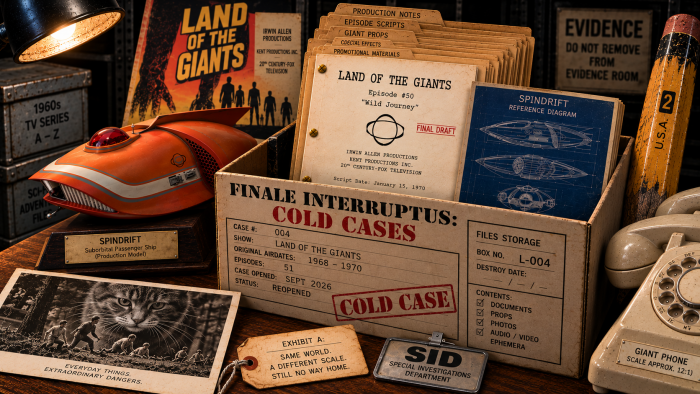
Every television series begins with a promise.
Give us your time. Your attention. Your imagination. Follow these characters wherever their story takes them, and return each week to see what happens next.
In return, we'll tell you a story. And when it's over, we'll bring it to its proper end. We'll answer the questions, settle the conflicts, and give the characters—and the audience—a chance to say goodbye.
Most series keep that promise.
Some don't.
And some broke it so long ago that their unfinished stories have been gathering dust for decades.
Heroes were left lost in time. Families remained stranded on distant worlds. Fugitives kept running. Invaders were never defeated. Quests begun in black and white—or in the first years of color television—simply stopped when the network turned out the lights.
The evidence is old now. The videotapes are fading. The film cans are rusting. The witnesses have scattered. But the questions remain.
Some endings have been missing for a very long time.
These are the Cold Cases.
THE FLIGHT THAT NEVER LANDED
In 1968, Irwin Allen found a new way to lose people. He had already sent the Robinson family hopelessly off course in Lost in Space and dropped Tony Newman and Doug Phillips into an endless succession of historical disasters in The Time Tunnel. This time, he didn't send his characters thousands of light-years away or centuries into the past. He just made everybody else bigger.
Land of the Giants premiered on ABC on September 22, 1968, and began in the then-future year of 1983. The suborbital passenger ship Spindrift is making a routine flight from Los Angeles to London when it encounters a strange disturbance in space. Captain Steve Burton tries to avoid it. He can't. The ship is pulled through, loses contact with Earth and eventually crashes on what initially appears to be a very familiar world: roads, cars, houses, cities. Then the passengers meet the locals.
Everything on this world is approximately twelve times larger than it should be. A house cat is a predator. A telephone is machinery. An ordinary drain can become a tunnel. The seven survivors of the Spindrift have landed in a civilization populated by human beings who tower over them like giants.
Those seven are Captain Steve Burton, copilot Dan Erickson, stewardess Betty Hamilton and passengers Mark Wilson, Valerie Scott, Alexander Fitzhugh and young Barry Lockridge.
Fitzhugh, incidentally, has brought along a suitcase containing a million dollars in stolen money.
It's nice to have priorities.
The premise gave Allen another enormous toy box. Almost anything from everyday life could become a threat simply by changing the scale. Scissors, pencils, laboratory equipment, household appliances, animals and children's toys could become enormous props around which an episode could be constructed. The castaways could hide inside walls, climb furniture and crawl through ventilation systems while trying to avoid the enormous people living around them.
But Land of the Giants wasn't merely a weekly exercise in figuring out how Gary Conway could escape from an oversized mousetrap. There was a continuing problem built into the premise.
They wanted to go home.
The Spindrift hadn't simply crashed somewhere unexplored on Earth. Whatever phenomenon caught the ship had transported it to another world—or perhaps another place in space-time entirely. The series remained deliberately slippery about exactly where the Giant planet was and how the Spindrift had reached it. What mattered to the passengers was considerably simpler: repair the ship, find another spacecraft, find somebody who understood how they arrived, find some technology capable of reversing the trip—find anything that could get seven stranded people back to Earth.
There was another complication. The Giants weren't simply oversized suburbanites who might help the little people repair their spaceship if everybody sat down and talked things over. Their society was authoritarian, and its Special Investigations Department—usually called the SID—wanted the Earth people and, especially, their technology. That turned the Spindrift crew into fugitives.
They had to survive without allowing themselves or their equipment to become useful prizes for the Giant government. Friendly Giants occasionally helped them, but discovery could mean capture, interrogation or experimentation. Every attempt to find a way home therefore carried another risk: the same technology that might save them could also expose them.
For 51 episodes across two seasons, that was the bargain Land of the Giants offered its audience. The Spindrift was lost, its passengers were stranded, and somewhere, somehow, there might be a road home.
Unlike plenty of television premises, however, this one gradually began producing actual roads.
By the second season, the series wasn't merely teasing the possibility that the castaways might someday escape. It was putting technology capable of doing it directly into their hands. And on December 21, 1969, two of them finally made it back to Earth. There was only one problem.
They were 83 years early.
HOME SWEET HOME—WRONG CENTURY
For most of Land of the Giants, getting home was an aspiration.
Then somebody found a spaceship.
In the second-season episode "A Place Called Earth," the castaways encounter two men who are, astonishingly, from Earth. Not the Earth Steve Burton and his passengers left behind, however. Olds and Fielder come from Earth's distant future—the year 5477—and have traveled into the past on what is supposed to be an observation mission.
Their arrival confirms something enormously important: travel between Earth and the Giants' world is possible. Whatever happened to the Spindrift wasn't necessarily a one-way cosmic accident. Other human beings had crossed the same gulf, and they had technology capable of doing it deliberately.
Unfortunately, Olds and Fielder aren't exactly the rescue party everybody has been waiting for.
They have their own agenda, and by the end of the encounter the castaways are still exactly where they started. But the future Earthmen leave something behind.
Their spacecraft.
A few episodes later, in "Home Sweet Home," Steve and Fitzhugh decide to use it. This is the kind of decision television characters make because there is no television series if everyone sensibly agrees that climbing into an unfamiliar time-traveling spacecraft sounds dangerous. Steve and Fitzhugh launch.
And it works.
They reach Earth.
After more than a season of watching the passengers of the Spindrift run from giant cats, giant scientists, giant policemen and whatever enormous household object Irwin Allen's prop department had constructed that week, two of our heroes have finally accomplished the thing the entire series has been promising might someday happen. They're home.
Almost.
The spacecraft hasn't simply carried them across space. It has carried them backward through time, depositing them on Earth in the year 1900. For Steve, who left Earth in 1983, that's an 83-year navigational error. Fitzhugh probably should have asked whether his million dollars was legal tender yet.
The episode becomes a different sort of survival story. Two men from the future have suddenly appeared in turn-of-the-century America with technology and knowledge nobody around them can reasonably understand. Their explanations aren't particularly successful, and the locals come to regard them as something closer to sorcerers than stranded astronauts. More importantly, staying isn't really an option.
This may be Earth, but it isn't their Earth. Everyone they know either hasn't been born yet or won't be born for decades. Even if Steve and Fitzhugh could build comfortable lives there, the other five members of the Spindrift party would remain stranded on the Giants' world.
So they go back.
That makes "Home Sweet Home" one of the strangest almost-endings in the entire series. Steve and Fitzhugh don't merely discover a theoretical means of escape. They don't see Earth through a telescope or receive a radio transmission from home. They stand on it.
The series has demonstrated, beyond any remaining doubt, that the distance between the two worlds can be crossed. It has also quietly changed the mystery. The question is no longer simply where the Giants' world is.
Time is involved.
That matters because Land of the Giants had never provided a particularly satisfying astronomical explanation for where the Spindrift went. The ship encountered a strange space phenomenon and emerged somewhere else. Now a spacecraft traveling between the same two worlds has deposited its passengers more than eight decades before they left. Whatever road connects Earth and the Giants' planet doesn't appear to obey an ordinary map. And "Home Sweet Home" wasn't the last time the series would hand its characters a possible ticket home.
As the second season continued, escape routes began appearing with surprising frequency: another machine, another opportunity.
And eventually, Steve Burton would get something even better than a spacecraft capable of returning him to Earth. He would get the chance to make sure the Spindrift never became lost in the first place.
SO MANY WAYS HOME
By this point, Land of the Giants had established something that made the castaways' predicament considerably more frustrating. They weren't trapped because getting home was impossible. They were trapped because every possible way home went wrong.
The Giants' world was technologically uneven. Much of it looked like a slightly distorted version of contemporary America, complete with cars, telephones, laboratories and government agents. But every so often, somebody would produce a device capable of doing something far beyond anything available to the Spindrift crew. That included moving people from one world to another. In "Panic," which aired January 25, 1970, the castaways encounter a Giant inventor named Professor Kirmus who has developed a teleportation device.
And Kirmus is friendly. That combination alone should have set off alarms. Friendly Giants had appeared before, but helping the Earth people was always dangerous. It meant defying the authorities, and the Special Investigations Department had spent much of the series trying to capture the "little people" and acquire their technology.
Kirmus nevertheless offers something the castaways desperately need: another technological path home.
His machine can transport matter over enormous distances, and the possibility emerges that it might be capable of sending the Earth people all the way back to their own world. Once again, the series has moved beyond wishful thinking. There is a machine, a plan and a chance.
And once again, the SID gets involved.
The authorities learn what Kirmus is doing, and what might have become an escape route instead becomes another danger. The castaways have to survive the immediate crisis rather than use the technology to end their exile. Back where they started. Seen individually, episodes like "Home Sweet Home" and "Panic" are simply variations on the basic Land of the Giants formula: give the castaways something they need, put it just within reach, introduce a Giant-sized complication and take it away again before the closing credits.
Seen together, however, they begin to look like something else. The show was accumulating solutions. A spacecraft had already carried Steve and Fitzhugh from the Giants' world to Earth, although it deposited them in 1900. Now Giant technology offered another means of transporting people across extraordinary distances.
The mechanics were different, but the implication was becoming difficult to ignore.
Earth was reachable.
That makes the second half of Season 2 particularly interesting in retrospect, because the series was running out of excuses for keeping its characters stranded. Television didn't necessarily consider that a problem in 1970. The central predicament was the series.
Richard Kimble couldn't find the one-armed man too soon. David Vincent couldn't defeat the Invaders in the middle of a season. Gilligan couldn't flag down a passing freighter and have everybody back in Honolulu by Thursday.
And the passengers of the Spindrift couldn't simply repair the ship and fly home if ABC wanted another 26 episodes of Land of the Giants.
The reset button was part of television.
But there is a difference between maintaining a premise and repeatedly demonstrating how that premise might eventually be resolved. Land of the Giants was doing the latter. By early 1970, the castaways had encountered future Earth travelers, obtained a spacecraft capable of crossing between the worlds, actually reached Earth and encountered teleportation technology that presented yet another possible escape route.
The writers didn't have to keep showing us doors. They could have confined the series to survival stories indefinitely. Instead, they kept opening them—and then slamming each one shut.
With only two episodes remaining, Land of the Giants opened the biggest door of all. This time Steve Burton wouldn't merely be offered a way home.
He would go home. He would arrive in 1983. And he would have the opportunity to stop the Spindrift from ever taking off.
THE JOURNEY THAT ALMOST ENDED THE JOURNEY
On March 8, 1970, Land of the Giants aired "Wild Journey." If you watched it today without knowing there was another episode coming, you could easily mistake it for the series finale.
Steve and Dan encounter Thorg and Berna, two human-sized extraterrestrial travelers possessing a device called a Space-Time Manipulator.
At this point, the passengers of the Spindrift have learned to be suspicious whenever somebody shows up carrying a machine capable of violating the laws of physics.
This one works.
The device can transport its users through both space and time, and Steve and Dan realize what that means almost immediately. They don't have to repair the Spindrift, persuade a Giant scientist to help them or even figure out precisely where the Giant planet is. They can simply go home. Better yet, they can go home before they left.
Steve and Dan use the device to return to Los Angeles in 1983, shortly before the Spindrift is scheduled to depart on the flight that will strand everyone on the Giants' world. For the first time, somebody has an opportunity to solve the entire series.
Don't take off.
Prevent the flight, and the Spindrift never encounters the space warp. Betty, Mark, Valerie, Fitzhugh and Barry never become castaways. Nobody spends two seasons being chased by house cats. All Steve and Dan have to do is convince their earlier selves that the flight must not happen. That proves considerably harder than it sounds.
Imagine walking into an airport and telling a professional pilot that you're him from the future, you've just returned from a planet populated by sixty-foot people, and he needs to cancel his scheduled flight because otherwise he'll eventually become you. There isn't really a version of that conversation that ends with, "Well, you've convinced me." Steve and Dan try anyway.
What follows is the closest Land of the Giants ever comes to confronting its own beginning. The heroes aren't looking for another escape route anymore. They're standing on Earth with the opportunity to erase the need for one.
And they fail.
Their attempts to change events become part of the events they were trying to change. The Spindrift still departs, the strange phenomenon still appears, and history refuses to cooperate.
The trap closes again.
It's difficult not to read "Wild Journey" as an ending because structurally it behaves like one. Returning characters to the moment where everything began is one of the oldest ways to close a story. The journey becomes a circle. The heroes discover that the past cannot be changed, and the audience leaves them where it first found them.
That interpretation becomes even more tempting when you know Land of the Giants had only one episode left to air. But there's a problem.
"Wild Journey" wasn't the finale.
In fact, surviving production information makes the situation stranger. The script for "Wild Journey" is dated January 15, 1970. The script for the episode that eventually followed it, "Graveyard of Fools," is dated December 9, 1969.
In other words, the episode that feels like a series finale was written after the episode that actually became the series finale.
That doesn't prove anyone intended "Wild Journey" to end the show. Broadcast order and production order are different things, and there is no reliable evidence we've found that Irwin Allen or the writers designed it as a secret conclusion. Quite the opposite: the production still expected Land of the Giants to continue. But the coincidence is remarkable.
After two seasons of almost getting home, Steve Burton finally stands on Earth in the correct year with the ability to prevent the entire disaster.
He can't.
The Spindrift takes off anyway. Two weeks later, ABC broadcasts one more adventure.
There is no return to Earth, no final attempt to repair the Spindrift, no resolution to the mystery of the Giants' world. There isn't even a farewell.
There is simply another episode. And then Land of the Giants disappears.
AND THEN: NOTHING
Two weeks after "Wild Journey" sent Steve Burton and Dan Erickson back to Earth and gave them a chance to prevent the Spindrift disaster entirely, ABC aired "Graveyard of Fools" on March 22, 1970. This was the last episode of Land of the Giants. You wouldn't know it from watching.
There is no sense of approaching a conclusion: no final repair attempt, no discovery about the space phenomenon that brought the Spindrift to the Giants' world, no gathering of the seven castaways for one desperate attempt to get home.
Instead, Steve, Dan, Valerie and Fitzhugh become involved with a Giant named Melzac, his twin brother Bryk and a mysterious alien device capable of producing strange space-time effects. Which, considering everything we've just discussed, sounds promising. A space-time device has appeared in the final episode of a series about people stranded on another world because of a mysterious space-time phenomenon.
Surely we're going somewhere with this.
We aren't.
The device belongs to the adventure of the week. The immediate crisis is resolved, our heroes survive, and nothing fundamentally changes. The Spindrift is still there. So are the castaways.
Earth is still somewhere else.
Roll credits.
After 51 episodes, Land of the Giants ends exactly the way an ordinary episode of Land of the Giants ends because, as far as the people making it were concerned, they weren't necessarily making the ending.
Art director William Creber later recalled that the production expected the series to return for a third season. According to Creber, they were initially told that the show had been picked up, only to learn roughly a week later that it hadn't. More tantalizingly, Creber said work had already begun. "We had already started to work on a set of scripts for the following season and formulate new plans and new ideas."
That's about as close as Finale Interruptus ever gets to finding fingerprints at the crime scene.
Land of the Giants wasn't a series whose creators reached the end of the story and simply chose not to show the characters returning home. At least some of the production team was already preparing more stories when the continuation disappeared. Unfortunately, this is where the evidence gets frustrating. We have not found a surviving Season 3 plan that tells us what those scripts contained, an Irwin Allen document laying out the next year's direction or a proposed series finale in which the Spindrift finally takes off for Earth.
We know they were planning. We don't know what they were planning, although there are glimpses.
Deanna Lund, who played Valerie Scott, later recalled that Irwin Allen was interested in capitalizing on her real-life relationship with Don Matheson, who played Mark Wilson. The two actors eventually married, and Lund remembered Allen wanting to develop a romance between Valerie and Mark on the series.
That's an intriguing indication that the character relationships might have evolved in Season 3. It isn't a Season 3 outline, and it certainly isn't an ending.
What happened instead appears considerably more mundane. Land of the Giants was expensive.
Very expensive.
The series was reportedly budgeted at approximately $250,000 per episode, an extraordinary amount of money for television at the end of the 1960s. The premise demanded giant props, oversized sets, elaborate optical effects and complicated compositing simply to put the regular cast in the same shot with the Giants. A telephone wasn't a telephone anymore; it was a set.
A pencil wasn't a prop; it was practically lumber. Production could economize by designing episodes around expensive oversized objects that could be reused, but there was no inexpensive version of Land of the Giants. The visual gimmick that made the series distinctive was also built directly into its production costs.
Lund later remembered that the show was cancelled because it was too expensive to mount. Creber, meanwhile, remembered the ratings as good and the loss of the expected third-season pickup as abrupt.
Without ABC's decision-making paperwork in front of us, we shouldn't pretend we know exactly what happened in the room where the decision was made. But the evidence points toward a fairly ordinary television execution. The audience apparently wasn't the problem.
The Giants were.
And somewhere in that cancellation were scripts, plans and ideas for a third season that never reached television. Maybe one contained another way home. Maybe the series would have kept finding new ways to strand the castaways for years. Maybe Irwin Allen eventually would have let the Spindrift take off.
Maybe Irwin Allen eventually would have let the Spindrift take off.
We don't know.
Because on March 22, 1970, "Graveyard of Fools" ended. This time, when the credits finished rolling, there wasn't another episode.
THE CASE REMAINS OPEN
There is a temptation with an unfinished television series to go looking for the ending somewhere else. Maybe somebody wrote a novel or a comic book. Maybe a producer gave an interview twenty years later and finally explained what would have happened.
Land of the Giants gives us plenty to search through. Murray Leinster wrote three tie-in novels—Land of the Giants, The Hot Spot and Unknown Danger. Other licensed novels followed, and Gold Key published five issues of a Land of the Giants comic book from November 1968 through September 1969, extending the franchise beyond what viewers saw on ABC.
But none of the contemporary tie-ins we've found provides what we're looking for. There is no equivalent of the unproduced "Requiem" script from Dungeons & Dragons. In the material we could locate, no documented Irwin Allen treatment sends the Spindrift home, and no surviving Season 3 outline tells us whether Steve, Dan, Betty, Mark, Valerie, Fitzhugh and Barry were ever supposed to escape. The television story simply stops.
That's what makes Land of the Giants such a pure Cold Case. The objective was there from the beginning, and by the second season the writers had demonstrated repeatedly that it wasn't impossible. Steve and Fitzhugh reached Earth.
Wrong year.
Professor Kirmus offered another possible route through teleportation.
Didn't work.
Steve and Dan reached Earth again, this time in 1983, before the Spindrift ever left.
Still didn't work.
Over 51 episodes, the passengers of the Spindrift found at least three ways they might have gotten home. The one thing they never found was a third season. Perhaps that's also why "Wild Journey" feels so much like the ending Land of the Giants should have had.
Not necessarily the ending we would have wanted. But an ending. It returned Steve and Dan to 1983, put them in position to prevent the flight, and then let fate close the loop. Change one final turn and the series could have ended there in any number of ways.
But that's us writing Land of the Giants in 2026, not evidence.
The evidence ends much less satisfactorily: with "Graveyard of Fools," an ordinary adventure made by people who had reason to believe there would be more adventures afterward.
There weren't.
And unlike some of our other cases, there isn't even a later television reunion to muddy the verdict. No decades-later special brings the surviving castaways home, and we found no canonical screen continuation that finishes the journey. ABC simply stopped showing us what happened next. That leaves seven people aboard a damaged spacecraft on a hostile world, surrounded by a civilization twelve times their size.
Steve Burton never got his passengers home. Fitzhugh never got his million dollars home. Barry never got home.
None of them did.
Fifty-six years later, that's still where television left them. Somewhere on the Giants' world, the Spindrift is still sitting in the forest.
The engines never start. The passengers never board for one last flight. And Earth remains impossibly far away.
CASE STATUS: REOPENED
ORIGINAL OBJECTIVE: Return the passengers and crew of the Spindrift to Earth.
LAST KNOWN STATUS: Stranded on the Giants' world following the events of "Graveyard of Fools," March 22, 1970.
EVIDENCE OF INTENDED CONTINUATION: Production personnel recalled that work on Season 3 scripts and plans had already begun.
KNOWN CANONICAL RESOLUTION: None.
VERDICT: UNRESOLVED.
COLD CASE CONFIRMED.


FEATURED ALBUM

Songs of faith, family and moving forward.


