
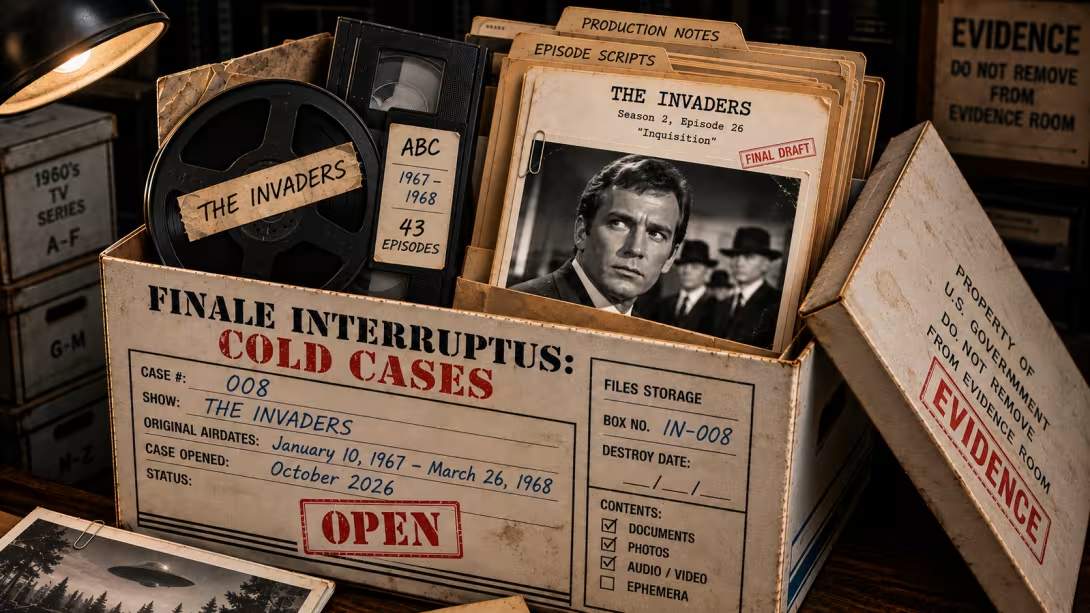
Finale Interruptus: Cold Cases - Case File #008: The Invaders
Every television series begins with a promise. Give us your time. Your attention. Your imagination. In return, we’ll tell you a story. And when it ends, we’ll bring it to its proper conclusion.
Most do.
Some don’t.
Some endings are still missing.
These are their case files.
A Wrong Turn on a Lonely Road
It began, as so many unfortunate journeys do, with a man who should have stopped for the night. Architect David Vincent was driving along a deserted country road when fatigue persuaded him to pull into an abandoned diner and get some sleep. What happened next would change his life, although convincing anyone else of that fact would prove considerably more difficult than surviving the encounter itself. A flying saucer descended nearby.
Vincent witnessed something that shouldn't have existed, and when he attempted to report what he had seen, he discovered that the greatest obstacle to stopping an alien invasion wasn't necessarily the aliens. It was getting anyone to believe there was an invasion in the first place.
On January 10, 1967, ABC introduced television audiences to The Invaders, a science-fiction drama created by Larry Cohen and produced by Quinn Martin. Starring Roy Thinnes as David Vincent, the series took a premise that might easily have become another parade of flying saucers and ray guns and transformed it into something considerably more unsettling.
The aliens weren't arriving in enormous fleets to announce their intentions to a terrified humanity. They were already here, disguised as ordinary people, infiltrating institutions, and preparing to seize control of a planet whose inhabitants remained largely unaware of the danger. And the one man who knew the truth couldn't prove it.
The opening narration, delivered by William Woodson, established the predicament with the solemn authority that had become a hallmark of Quinn Martin productions. Vincent had seen the visitors, but his evidence was elusive, his credibility was fragile, and his determination to expose the conspiracy would place him in constant danger.
The premise owed something to the alien-invasion films of the 1950s, particularly those in which extraterrestrial threats operated through deception rather than open warfare. But it also borrowed heavily from another successful television formula: the solitary fugitive traveling from place to place, encountering new dangers while pursuing an objective that remained tantalizingly out of reach.
Quinn Martin had already demonstrated the effectiveness of that structure with The Fugitive, which followed Richard Kimble across America as he searched for the one-armed man who could establish his innocence. The Invaders gave David Vincent a similarly impossible mission, except that his quarry was not one murderer but an entire clandestine extraterrestrial operation.
There was an important difference, however. Richard Kimble knew that somewhere in the world existed a single man who could clear his name. David Vincent had no reason to believe that exposing one alien would bring him any closer to defeating the invasion. For every impostor he identified, there might be dozens more.
The series developed several distinctive characteristics that made its extraterrestrial enemies particularly effective. The invaders could assume human appearances, although certain physical imperfections sometimes betrayed them. One of the most recognizable was an oddly extended little finger, a detail that could transform an otherwise unremarkable handshake into evidence of something monstrous.
Their bodies also tended to disintegrate after death, frequently depriving Vincent of the physical proof he desperately needed. The aliens' technology was formidable, but their greatest advantage was the ease with which they could exploit ordinary human skepticism. After all, what would you think if a stranger approached you with the claim that your employer, neighbor, or local government official was secretly an extraterrestrial?
That question gave The Invaders a psychological dimension that distinguished it from more straightforward science-fiction adventures. The threat wasn't simply that aliens might conquer Earth. It was that the invasion could proceed while reasonable people dismissed the warnings of the one person trying to stop it.
Vincent's profession was also an interesting choice. He wasn't a military officer, intelligence agent, or scientist assigned to investigate unusual phenomena. He was an architect, an ordinary professional whose life was abruptly consumed by extraordinary circumstances.
His transformation into an obsessive investigator wasn't the fulfillment of some heroic destiny. It was the consequence of witnessing something he couldn't ignore, even when ignoring it would have allowed him to resume a normal existence.
Roy Thinnes played Vincent with a tightly controlled intensity that suited the character's predicament. He was rarely given the luxury of appearing relaxed, and his encounters with potential allies were complicated by the knowledge that any seemingly helpful stranger might be working for the enemy. The result was a television hero who often seemed more exhausted than triumphant.
That was entirely appropriate. Vincent wasn't fighting a war in which victories could be measured by territory captured or enemy forces destroyed. He was fighting a war over the truth, and every apparent success risked disappearing along with the evidence.
For viewers accustomed to science-fiction adventures in which an alien threat could be identified, confronted, and defeated within an hour, The Invaders offered something different. Its central mystery was not designed to be solved at the conclusion of each episode.
The audience knew Vincent was right. The suspense came from wondering whether anyone else would ever accept it.
That distinction would become increasingly important as the series progressed. What began as one man's seemingly hopeless campaign against an invisible enemy would gradually develop into a larger struggle involving allies, organized resistance, and the possibility that humanity might finally recognize the danger. But there was a problem built into the premise, one that would become particularly troublesome when the network decided the series had run its course.
David Vincent's mission could not truly end simply because he survived another encounter with the invaders. The story demanded something more substantial: exposure of the conspiracy, defeat of the invasion, or at least a decisive change in humanity's ability to resist it. Until one of those things happened, the aliens would remain on Earth, and Vincent would remain the man who knew they were here. The television audience, meanwhile, would be left waiting for someone to believe him.
The Man Nobody Believed
There is a fundamental problem with being the only person who knows the world is being invaded by extraterrestrials. Even when you're right, you sound remarkably like someone who isn't.
David Vincent spent much of the first season of The Invaders confronting that problem. He could identify the enemy, uncover its operations, and occasionally disrupt its plans, but establishing the existence of the invasion to anyone with the authority to do something about it proved maddeningly difficult.
The aliens had designed their infiltration to exploit precisely that weakness. Their human disguises allowed them to occupy positions within ordinary society, while their ability to eliminate evidence made Vincent's accusations appear increasingly irrational. Witnesses disappeared, physical proof disintegrated, and people who initially seemed willing to help sometimes revealed themselves as members of the conspiracy.
Vincent was trapped in a peculiar form of television purgatory. He could save individual lives and prevent particular disasters, but the larger threat remained untouched. Every victory returned him to essentially the same predicament: a man with an extraordinary story that nobody wanted to believe.
This was an effective formula for episodic television, particularly during an era when networks expected audiences to follow programs without necessarily watching every installment. A viewer could miss several weeks of The Invaders and return to find David Vincent still pursuing aliens, still struggling for credibility, and still discovering that seemingly ordinary Americans might be something else entirely. But a formula that sustains a series can also become a prison for its protagonist.
The longer Vincent pursued the invaders without making meaningful progress, the harder it became to believe that his campaign could ever succeed. His enemies possessed superior technology, an extensive network of operatives, and the considerable advantage of operating within a society that didn't believe they existed. Vincent, by comparison, had determination, intelligence, and a remarkable capacity for surviving situations that should have killed him. Eventually, the writers had to give him something more.
The second season introduced an important change in the series' underlying structure. Rather than continuing indefinitely as an isolated crusader, Vincent began acquiring allies who recognized the extraterrestrial threat and were prepared to help him fight it.
The most significant development came with the episode “The Believers,” broadcast in November 1967. Vincent became involved with a small group of influential individuals who accepted that the invasion was real and possessed resources beyond anything he could command alone.
Among them was industrialist Edgar Scoville, played by Kent Smith, who would become an important recurring ally. Scoville brought financial resources, connections, and organizational capability to a struggle that had previously depended upon Vincent's ability to persuade one skeptical stranger at a time. The existence of the Believers fundamentally changed the possibilities for the series.
For the first time, Vincent's campaign could develop into something resembling organized resistance. Instead of merely exposing isolated alien operations, he now had the potential to coordinate investigations, protect evidence, and bring the invasion to the attention of people whose influence might eventually matter. It was a logical evolution of the premise, and arguably one the series needed. There was, however, a corresponding change in the dramatic tension.
The original appeal of The Invaders rested heavily upon Vincent's isolation. He was a man whose knowledge had separated him from ordinary society, and whose attempts to warn others frequently made him appear more dangerous than the people he was accusing. Once he acquired a network of allies, the story became less about whether anyone would believe him and more about whether the Believers could defeat the enemy.
That was not necessarily a weakness. Indeed, it provided an opportunity to move the series toward the resolution its premise had always implied. But it meant that The Invaders could no longer rely exclusively upon the lonely-man-against-the-world formula that had defined its earliest episodes. The conflict was becoming a war, and wars eventually demand some accounting of who is winning. The writers also began exploring the possibility that the extraterrestrials were not entirely united in their objectives.
In “The Life Seekers,” broadcast during the second season, Vincent encounters aliens whose interests differ from those of the invaders conducting the occupation. Rather than supporting the conquest of Earth, these visitors seek a way to return to their own world and oppose the invasion. This was a significant development because it complicated the previously straightforward division between humanity and its extraterrestrial enemies.
If some aliens opposed the invasion, then Vincent's struggle might not require the defeat of an entire civilization. It could involve exploiting political divisions, forming unexpected alliances, or finding a way to persuade the invaders' own people to abandon their plans. Such possibilities offered the writers avenues toward a conclusion that did not depend upon David Vincent somehow defeating an interplanetary military operation with a handful of sympathetic businessmen. They also raised questions the series never had the opportunity to explore fully.
How much authority did the invaders possess within their own civilization? Were they representatives of a united government, or members of a faction pursuing its own objectives? Could opposition from within their society bring an end to the occupation? And perhaps most importantly, what would happen if the truth finally became impossible for Earth's governments to deny?
The second season increasingly suggested that Vincent was approaching that point. His allies were growing more capable, the aliens were encountering greater resistance, and the possibility of official recognition no longer seemed entirely beyond reach. Yet the series remained cautious about allowing its protagonist a decisive victory.
That caution was understandable from a production standpoint. If the invasion were publicly exposed and governments mobilized against it, the fundamental premise would change. David Vincent would no longer be the isolated witness desperately trying to convince humanity of a hidden danger. He might become a leader in an organized defense of Earth, or perhaps find himself pushed aside by military and political authorities better equipped to conduct such a campaign. Either direction could have produced an interesting television series, but neither would have been quite the same program that premiered in January 1967.
The writers were therefore approaching a crossroads. They could preserve the existing formula by allowing Vincent to make only limited progress, or they could advance the story toward a confrontation that might permanently alter the show's structure. For viewers invested in the larger mystery, the second option was becoming increasingly necessary.
The Believers had changed the balance of power. The existence of dissenting aliens had suggested that the enemy might possess vulnerabilities beyond the occasional crooked little finger. And Vincent himself had accumulated enough evidence and experience that his continued inability to secure broader recognition was beginning to strain credibility. The series was finally developing the machinery necessary to move beyond its original premise. Unfortunately, it was also running out of episodes.
By the time The Invaders approached the conclusion of its second season, David Vincent was no longer entirely alone. He had allies, resources, and a growing understanding of the enemy's operations. What he still lacked was the one thing that had driven him from the moment he witnessed that flying saucer beside an abandoned diner. An ending. And the final episode would bring him tantalizingly close to one without actually delivering it.
The Invasion That Almost Succeeded
On March 26, 1968, David Vincent made his final appearance in the original run of The Invaders. After forty-three episodes of alien infiltration, disappearing evidence, and desperate attempts to convince humanity that it was under attack, the series had reached a point where its central conflict might finally change. Unfortunately, the episode was not designed to bring that conflict to an end. The final installment, appropriately titled “Inquisition,” concerned an increasingly dangerous alien operation and a government investigator whose determination to expose David Vincent and his associates threatened to accomplish what the invaders themselves had repeatedly failed to do.
The investigator was Andrew Hatcher, played by Mark Richman, a federal prosecutor examining the activities of Vincent and the Believers. From Hatcher's perspective, the organization presented a legitimate concern. A private group of influential individuals was conducting secret operations, making extraordinary accusations, and apparently interfering with matters that could have serious national-security implications. The fact that the Believers were correct about the alien threat did not automatically make their activities look reasonable to someone examining them from the outside.
That was one of the cleverer elements of the episode. For most of the series, Vincent had struggled to persuade ordinary citizens that the people around them might be extraterrestrial impostors. Now he faced a government official whose professional responsibilities required him to investigate the very organization that had finally given Vincent the means to fight back. The aliens, meanwhile, were preparing an operation far more ambitious than the isolated conspiracies Vincent had disrupted in earlier episodes.
Their plan depended on three synchronized transmitters capable of unleashing a lethal ultrasonic attack on life across the planet. The precise technology was less important than the scale of the threat. The invaders were no longer merely positioning operatives within human society; they were preparing to exploit their clandestine presence to launch an attack that could fundamentally change the balance of power.
For Vincent and the Believers, the stakes had become unmistakable. Failure would mean more than the loss of another potential witness or the destruction of another piece of evidence. It could allow the aliens to move from covert infiltration toward open domination. The difficulty was that their own government was investigating them at precisely the moment when they most needed official assistance.
Hatcher initially approached Vincent's claims with understandable skepticism. He was dealing with people who insisted that extraterrestrials had infiltrated Earth, that seemingly ordinary citizens were alien agents, and that the government itself might have been compromised. Those were extraordinary allegations, and the Believers' secrecy did little to make them more convincing.
But the investigation gradually placed Hatcher in contact with evidence that could not be comfortably explained away. The same pursuit that threatened to expose the Believers' activities also brought him closer to discovering why those activities had become necessary.
As Vincent and his allies attempted to disrupt the alien operation, the danger became increasingly immediate. The struggle cost the resistance dearly: James Boland died helping Vincent reach the transmitter, while reporter Joan Seeley was fatally injured diverting the police so the two men could escape. Their sacrifices made the last-minute victory possible. Vincent ultimately destroyed the transmitter concealed in a Washington hotel, preventing the three-part system from operating as intended.
It was a genuine victory, and an important one. The aliens had been preparing an operation of considerable scope, and Vincent's intervention prevented them from carrying it out as intended. But it was not the defeat of the invasion.
The aliens remained on Earth. Their organization had not been dismantled, their leadership had not surrendered, and the broader population still had no general understanding of the threat. What changed was Andrew Hatcher.
By the conclusion of “Inquisition,” after Seeley's death, the prosecutor had come to recognize that Vincent's extraordinary claims were true. Rather than continuing to regard the Believers as a suspicious private organization, he acknowledged the reality of the extraterrestrial conspiracy and offered his assistance. For David Vincent, that represented a remarkable development. The architect who had spent much of the series being dismissed as a crank or a dangerous obsessive had finally persuaded a government official with the authority and connections to make his testimony matter.
The closing narration went further, identifying Vincent, the recovering Scoville, and Hatcher as the nucleus of the continuing defense. It was not public exposure of the invasion, but it was a meaningful step toward that possibility. And it was precisely the sort of development that could have supported a third season.
Imagine the possibilities created by Hatcher's conversion. Vincent and the Believers might have gained access to government resources, official investigations, or the means to protect evidence from the aliens' familiar habit of making it disappear. The struggle could have expanded beyond clandestine encounters into a larger conflict involving institutions that had previously refused to acknowledge the enemy.
Of course, the same development might also have created new problems. The invaders had already demonstrated their ability to infiltrate positions of influence, and involving the government more directly could have exposed the Believers to enemies occupying offices far more dangerous than those of an ordinary small-town official. The potential for additional stories was considerable. But potential is not resolution.
“Inquisition” concluded with Vincent having prevented a major alien operation and gained an important new ally. Those developments gave the episode a sense of accomplishment, but they did not resolve the question that had driven the series since its premiere. Were the invaders going to conquer Earth, or could David Vincent and his allies stop them? The answer remained unknown.
There was no revelation of the aliens' ultimate leadership, no decisive confrontation with the forces directing the invasion, and no moment when humanity collectively learned the truth. The enemy had suffered a setback, but its campaign continued. The series had effectively ended at the point where its protagonist was finally acquiring the resources necessary to pursue the larger victory he had been seeking.
That makes “Inquisition” a particularly interesting example of an unfinished television story. It does not end in the middle of an action sequence, nor does it leave Vincent facing an immediate threat from which the audience never sees him escape. Instead, it completes the immediate adventure while leaving the overarching conflict intact.
In conventional episodic television, that might have been sufficient. Many series of the period ended without a formal farewell, simply because their final broadcast installment was produced as another adventure in an ongoing run. But The Invaders was built around a continuing objective that made its lack of resolution more conspicuous.
David Vincent wasn't merely traveling from town to town encountering unrelated extraterrestrial threats. He was trying to expose and defeat a single invasion that connected the entire series. Every successful investigation, every rescued witness, and every new ally was supposed to bring him closer to that goal. By the final episode, he had made progress, but the mission remained unfinished.
There is a certain irony in the fact that the series ended with a skeptical government prosecutor finally becoming a believer. For two seasons, Vincent had struggled to find someone in authority who would take him seriously. Just as that breakthrough occurred, the audience was denied the opportunity to discover what he might accomplish with official support. The aliens had not won. But neither had David Vincent. And after March 26, 1968, the television cameras simply stopped following the war.
The Network Pulled the Plug
There is a certain irony in the fate of The Invaders. David Vincent spent two seasons trying to expose an enemy that could make people disappear without leaving evidence, only to have his own television series disappear before he could finish the job.
The cancellation came after the second season, ending the program's run at forty-three episodes. ABC did not commission a third season, and the final installment, “Inquisition,” had been produced as another chapter in an ongoing struggle rather than a definitive conclusion to the alien invasion. The question of why the network abandoned the series is considerably more complicated than the familiar explanation that its ratings simply weren't good enough.
The Invaders premiered in January 1967, arriving during a period when American television was increasingly receptive to science fiction. Star Trek was already exploring strange new worlds on NBC, while Irwin Allen had established a successful collection of fantasy and science-fiction programs built around spectacular situations and continuing danger.
But The Invaders occupied a somewhat different corner of the genre. Its stories were generally more grounded in contemporary American settings, and its suspense depended less upon elaborate futuristic environments than upon the possibility that the ordinary people encountered by David Vincent were not ordinary at all.
That approach had advantages. The series could exploit the familiar visual language of crime dramas and suspense programs while introducing an extraterrestrial threat that required comparatively little explanation from week to week. It also had limitations.
The same premise that made the early episodes compelling could become repetitive when Vincent repeatedly uncovered evidence, encountered disbelief, escaped danger, and found himself essentially back where he started. The introduction of the Believers during the second season helped address that problem, but it also demonstrated that the original formula could not remain unchanged indefinitely.
Larry Cohen, who created the series, would later express dissatisfaction with aspects of its development under Quinn Martin's production organization. Cohen's conception of an alien infiltration story had considerable potential for paranoia and social commentary, but the demands of weekly network television encouraged a more conventional adventure format.
That difference between a creator's original vision and the practical requirements of a continuing series was hardly unusual in the 1960s. Television creators frequently surrendered substantial control once a network and production company committed to bringing their ideas to the screen. The resulting programs could be successful without remaining entirely faithful to their creators' initial intentions.
In the case of The Invaders, the tension was particularly relevant because the premise seemed to promise an eventual reckoning. David Vincent wasn't investigating a different supernatural mystery each week. He was pursuing a single enemy whose presence connected every episode, and viewers had reason to expect that his efforts would eventually produce something more substantial than another temporary setback for the aliens. Whether the production team had developed a specific final resolution remains uncertain.
There is evidence that a third season was contemplated, but that is not the same as evidence that the writers had decided how the invasion would ultimately end. An ongoing series can have numerous potential storylines without possessing a predetermined conclusion. Roy Thinnes offered a particularly interesting account of the cancellation years later.
In a 1995 interview, conducted around the time the property was being revived for television, Thinnes recalled that preparations for a third season had already begun. According to his account, scripts were being written when ABC abruptly decided not to continue the program. He attributed the decision to a dispute between producer Quinn Martin and the network.
That recollection deserves attention because Thinnes was the series' star and would have been directly affected by its cancellation. But it also requires an important qualification: it is his account of events, offered more than twenty-five years afterward, rather than independent documentation establishing the precise reasons for ABC's decision.
Other retrospective accounts emphasize declining ratings, scheduling difficulties, and creative problems during the second season. Those factors provide a more conventional explanation for the cancellation, although they do not necessarily contradict the possibility of a disagreement between Martin and ABC.
A program experiencing declining audience interest could become the subject of a dispute over its future. A disagreement about production costs, scheduling, or creative direction could also influence a network's willingness to renew a series whose commercial performance was already uncertain. Without contemporary network correspondence or other definitive documentation, assigning the cancellation to one cause would be more confident than the available evidence permits. What can be established is the consequence.
The series ended without the writers being given an opportunity to transform its final episode into a genuine conclusion. Whatever plans existed for additional stories were abandoned, and David Vincent's increasingly organized resistance never reached the decisive confrontation toward which the premise appeared to be moving. There was also a structural problem that would have complicated any attempt to finish the story.
The Invaders was built around the existence of a hidden enemy. Exposing that enemy to the entire world would have fundamentally changed the program. Instead of a suspense drama about one man's struggle to convince a skeptical society, it might have become a story about humanity's organized resistance to extraterrestrial occupation. That could have been an exciting development, but it would also have required the producers to reconsider much of what made the original series recognizable.
Alternatively, the writers could have allowed Vincent to defeat a particularly important alien operation while leaving the larger conspiracy intact. That approach would have provided a measure of victory without permanently closing the door on future adventures. The final episode effectively followed that second model, although without presenting its limited victory as the culmination of the entire series. Vincent stopped an immediate threat and gained a powerful ally, but the aliens remained free to continue their campaign. For a program whose central premise involved an ongoing invasion, that was an especially unsatisfying place to stop.
The cancellation also occurred before the television industry had developed the modern expectation that serialized dramas should receive a deliberately constructed series finale. Networks in the 1960s were often willing to end programs without providing any narrative closure, particularly when their stories were considered episodic enough to survive in reruns. Even Star Trek, which would become one of television's most influential science-fiction franchises, ended its original network run in 1969 without resolving the Enterprise's five-year mission. But The Invaders presented a more pointed problem.
The Enterprise could continue exploring the galaxy beyond the final broadcast episode without leaving a specific enemy undefeated. David Vincent, on the other hand, had been pursuing the same enemy since the premiere.
The invasion was not merely a backdrop for his adventures. It was the reason the series existed. And while the program's cancellation may have been an ordinary business decision from ABC's perspective, it had an extraordinary fictional consequence. The aliens were still here. The Believers were still fighting them. David Vincent had finally convinced a government official that the danger was real. And the audience would never learn what happened next. Or so it appeared. Because twenty-seven years after the original series disappeared from ABC, David Vincent would return to television with an alarming piece of information. The invasion had never ended.
Twenty-Seven Years Later, They Were Still Here
For twenty-seven years, David Vincent's war against the invaders existed primarily in reruns and the memories of viewers who had watched him struggle to convince the world that extraterrestrials were living among them. The aliens had never been defeated, their conspiracy had never been publicly exposed, and the architect who stumbled upon their arrival had simply disappeared from television. Then, in November 1995, the invasion resumed.
FOX broadcast a two-part television movie titled The Invaders, reviving the property with Scott Bakula in the leading role. Bakula, already familiar to science-fiction audiences from Quantum Leap, played Nolan Wood, a new protagonist who discovered that the extraterrestrial conspiracy was still operating on Earth. Roy Thinnes made a brief return as David Vincent, passing the burden of the investigation to Wood and establishing a direct connection to the original series rather than treating the familiar title as an excuse to begin an entirely unrelated story.
For longtime viewers, Vincent's return carried an intriguing implication. The man who had spent the 1960s trying to expose the invasion was still alive, still aware of the enemy, and still involved in the struggle against it. Apparently, saving the world from a secret alien occupation was not the sort of assignment that came with a retirement plan.
The decision to introduce Nolan Wood as the central character made commercial sense. A revival produced nearly three decades after the original series needed to attract viewers who might never have encountered Roy Thinnes or David Vincent. Bakula brought an established television audience and the familiarity of an actor already associated with science-fiction storytelling. But the presence of Vincent offered something more valuable to those interested in the original series' unfinished narrative. It provided an opportunity to discover what had happened after “Inquisition.”
Had the Believers succeeded in bringing the invasion to the attention of the government? Had Vincent's new allies made any meaningful progress? Had the aliens adapted their plans in response to the growing resistance, or had they simply continued their infiltration while humanity remained largely unaware? The revival's central premise supplied a discouraging answer to the most important question. The aliens were still here.
Whatever David Vincent and his allies had accomplished since 1968, they had not eliminated the extraterrestrial threat. The conspiracy remained active, and a new generation was about to discover that the world was considerably less secure than it appeared.
In that respect, the 1995 production did something unusual for a television revival. It implicitly acknowledged the unfinished business of its predecessor.
Many revivals return to familiar characters and situations while quietly ignoring the circumstances in which the earlier program ended. The Invaders instead treated the continued existence of the alien threat as the foundation for another story. Unfortunately, acknowledging an unresolved mystery is not the same as resolving it.
The television movie concentrated upon Nolan Wood's discovery of the conspiracy and his growing involvement in the struggle against the invaders. As David Vincent had done decades earlier, Wood found himself confronting an enemy capable of passing for human and manipulating events from within ordinary society.
The similarities were deliberate. The production sought to reintroduce the essential premise of The Invaders to a contemporary audience, complete with the familiar tension between extraordinary evidence and widespread disbelief. The result was a continuation that also functioned as a potential new beginning.
That dual purpose created an obvious difficulty for anyone hoping the revival would finally close the original case. A television production designed to launch further adventures had little incentive to eliminate the enemy whose existence made those adventures possible. If Nolan Wood were to become the David Vincent of the 1990s, the aliens would need to remain sufficiently dangerous to justify his continuing campaign. And so the revival preserved the central conflict rather than ending it. The extraterrestrial conspiracy survived, the struggle against it continued, and the story concluded without delivering the decisive victory that the original series had withheld. The two-part revival was not followed by an ongoing television series, leaving its new protagonist with much the same problem that had confronted Vincent in 1968. He had discovered the truth, but the larger war remained unfinished. There is something almost comically appropriate about that outcome.
In 1967, David Vincent encountered an alien invasion that television audiences would never see defeated. In 1995, Nolan Wood encountered what was effectively the same problem, and television audiences were once again denied the opportunity to watch the conflict reach its conclusion.
The aliens had survived twenty-seven years of fictional resistance and an equally long absence from network television. They then survived their own revival.
For viewers who regarded the 1995 production as an opportunity to revisit a beloved science-fiction property, the lack of a definitive conclusion may not have been particularly troubling. The familiar premise had returned, Roy Thinnes had reprised his role, and the story offered a new variation on the paranoia that made the original series memorable. But for anyone approaching the revival as a possible conclusion to David Vincent's unfinished mission, the result was considerably less satisfying.
The television movie confirmed that Vincent's warnings had been justified and that his struggle had continued. What it did not establish was that the world had finally recognized the invasion or found a way to defeat it. Nor did it provide a final accounting of the Believers' efforts or the broader consequences of the government contacts Vincent had begun establishing at the conclusion of the original series.
Those omissions matter because the unresolved questions were not incidental details. They concerned the central objective that had defined the entire property.
David Vincent wanted humanity to recognize and resist an extraterrestrial invasion. The revival demonstrated that the enemy remained active nearly three decades later, but it offered no final resolution to that objective. There is, of course, a perfectly reasonable explanation for this approach. The producers were attempting to revive The Invaders, not bury it.
A definitive victory over the aliens might have satisfied longtime viewers, but it would also have eliminated the principal threat needed to support a continuing series. By introducing a new protagonist and preserving the conspiracy, the production kept open the possibility of additional stories. The problem was that those stories never arrived. Once again, the commercial future of the property and the narrative needs of its characters were moving in different directions.
The original series had ended while David Vincent was finally developing the resources to challenge the invasion more effectively. The revival returned to that unfinished conflict but chose to introduce another man into essentially the same predicament. Instead of completing the story, it extended the question.
And while the return of Roy Thinnes provided a welcome connection to the past, his presence also underscored the passage of time. The once-young architect had spent a substantial portion of his life fighting an enemy that most of humanity still did not understand. One might reasonably wonder whether he ever regretted stopping at that abandoned diner.
The 1995 revival therefore occupies an unusual position in the history of The Invaders. It is evidence that the original series' central conflict remained unresolved within the fictional continuity, but it is not the missing finale that audiences might have hoped to receive. It reopened the case without closing it. And when FOX declined to continue the revived property, the invaders were left in possession of perhaps their greatest strategic advantage. The networks had stopped watching them again.
Bill's Bottom Line: Earth Was Never Declared Safe
There is a certain unfairness in the way television history remembers David Vincent. For two seasons, the architect traveled across America attempting to warn humanity that extraterrestrial invaders were living among them. He sacrificed his professional life, endangered himself repeatedly, and endured the skepticism of nearly everyone he encountered. When the series finally ended, he had succeeded in persuading a handful of influential people that his extraordinary claims were true. And then ABC canceled his investigation. That is not quite the same thing as saying David Vincent failed.
In fact, the final episode of The Invaders demonstrated that his campaign was beginning to produce meaningful results. The Believers had developed into an organized resistance, an important alien operation had been disrupted, and government prosecutor Andrew Hatcher had finally accepted the existence of the extraterrestrial conspiracy.
Those developments represented genuine progress toward the objective established in the premiere. Vincent was no longer entirely alone, and the possibility of broader official recognition had become considerably more plausible. But progress is not victory, and “Inquisition” did not provide the resolution that the series' overarching premise demanded. The aliens remained on Earth, their infiltration continued, and humanity as a whole remained largely unaware that its future was being threatened by an enemy already operating within its institutions. The series ended with the war still underway.
That distinction is important because The Invaders was not necessarily canceled in the middle of an immediate cliffhanger. Its final episode resolved the particular crisis confronting Vincent and his allies, allowing the program to conclude without leaving its protagonist in an obviously inescapable predicament. A casual viewer could reasonably regard “Inquisition” as another completed adventure.
But anyone who had followed the larger story understood that the fundamental problem remained unsolved. Vincent had not been pursuing a series of unrelated alien encounters; he had been attempting to expose and defeat a single, continuing invasion. The program had promised a struggle against an enemy whose existence connected every episode, and that struggle never reached its conclusion. The circumstances surrounding the cancellation make the absence of resolution understandable, though not particularly satisfying.
Roy Thinnes later recalled that preparations for a third season were underway when ABC unexpectedly declined to continue the series. He attributed the decision to a disagreement between Quinn Martin and the network, while other accounts have emphasized declining ratings and the creative difficulties associated with maintaining the show's original formula.
Those explanations deserve consideration, but the available evidence does not establish a single definitive cause. Nor have we established that Larry Cohen or the production team had developed a specific ending in which Vincent would finally defeat the aliens. It would be tempting to imagine an abandoned final episode involving the exposure of the invasion, the mobilization of Earth's governments, or the discovery of a vulnerability that would force the extraterrestrials to withdraw. But those possibilities belong to speculation, not documented television history.
Our investigation can establish what viewers received and what remained unresolved. It cannot manufacture a missing conclusion simply because the story seems to demand one. And then there is the matter of the 1995 revival.
The return of Roy Thinnes as David Vincent offered a rare opportunity to revisit the unfinished business of the original series. With Scott Bakula assuming the leading role as Nolan Wood, the new production introduced another protagonist to the same extraterrestrial conspiracy that Vincent had spent the 1960s attempting to expose.
The revival confirmed that the invasion remained active decades after the original series ended. Whatever progress Vincent and his allies had made, they had not succeeded in eliminating the threat.
But the new production was conceived as a possible beginning rather than a definitive farewell. Its story preserved the alien conspiracy and left open the possibility of further adventures, none of which materialized as an ongoing series. The result was an unusual double interruption.
The original Invaders ended without defeating the aliens. The revival brought them back, acknowledged the continuing danger, and then ended without defeating them either. It was as though David Vincent had finally convinced someone to reopen the investigation, only to discover that the new investigators were about to lose their funding. There is a larger television-history lesson here.
Modern audiences have become accustomed to serialized programs in which an overarching mystery, conspiracy, or conflict is expected to reach some form of conclusion. Even when a series ends tragically or ambiguously, viewers generally expect its creators to acknowledge the central question that has sustained their investment. That expectation was far less firmly established in the 1960s.
Network television depended heavily upon self-contained episodes that could be broadcast in different orders and eventually sold into syndication. A continuing premise could provide the foundation for a series without obligating its producers to construct a definitive final chapter. But The Invaders occupied an uncomfortable position between those approaches.
Its individual episodes often functioned as complete suspense adventures, yet its central conflict was cumulative. Every alien exposed, every witness persuaded, and every new member of the resistance seemed to bring Vincent closer to an eventual reckoning. The show could repeat that pattern for only so long before viewers began asking whether the invasion was ever going to end.
The introduction of the Believers suggested that the writers understood the need for development. The existence of extraterrestrials who opposed the invasion opened additional possibilities, while Hatcher's conversion in the final episode created a potential bridge between Vincent's private investigation and the institutions capable of mounting a larger response. Those were promising developments, and they made the cancellation especially unfortunate. The series was beginning to move beyond the limitations of its original formula just as the network decided it had no future. Yet there is another way to consider the ending, one that may explain why The Invaders has retained its appeal.
The central horror of the program was never simply that extraterrestrials possessed superior technology or intended to conquer Earth. It was that an enemy could infiltrate ordinary society so successfully that even convincing people of its existence became an almost impossible task.
David Vincent's greatest obstacle was not always the invaders themselves. It was the reassuring human assumption that the world could not possibly be as dangerous or deceptive as he claimed. That anxiety did not require a definitive alien defeat to remain effective.
Indeed, the absence of resolution may have made the premise more enduring. The series left its viewers with the unsettling possibility that the conspiracy continued after the cameras stopped recording, concealed within the same ordinary world that Vincent had struggled to convince everyone was compromised.
The 1995 revival reinforced that interpretation, whether intentionally or not. Nearly three decades later, the invaders were still operating, and another man was discovering that knowing the truth did not guarantee anyone would believe him. For our purposes, however, the verdict is straightforward.
The Invaders belongs in the Cold Case files because its central narrative objective was never achieved on screen. The original series concluded an individual adventure without resolving the larger invasion, and its later television continuation failed to supply the missing ending. We cannot establish that a completed final storyline was discarded, and we should not confuse a planned third season with a documented plan for the ultimate defeat of the aliens. What we can say is that David Vincent's mission remained unfinished.
He had found allies. He had disrupted enemy operations. He had finally persuaded people with influence that the extraterrestrial threat was real. But he had not saved Earth from the invasion. And perhaps that is the cruelest irony of all.
For forty-three episodes, David Vincent struggled to make humanity believe that the invaders existed. Twenty-seven years later, television brought him back to confirm that he had been right all along.
For anyone wanting to examine the evidence firsthand, the original forty-three episodes are available in The Invaders: The Complete Series DVD collection. Revisiting the complete run makes the distinction particularly clear: the final broadcast supplies a victory against one operation, not a victory over the invasion. The aliens were still here. The war was still being fought. And somewhere, one imagines, David Vincent was still trying to convince somebody to listen.
CASE FILE #008: THE INVADERS
STATUS: OPEN — INVASION UNRESOLVED.