
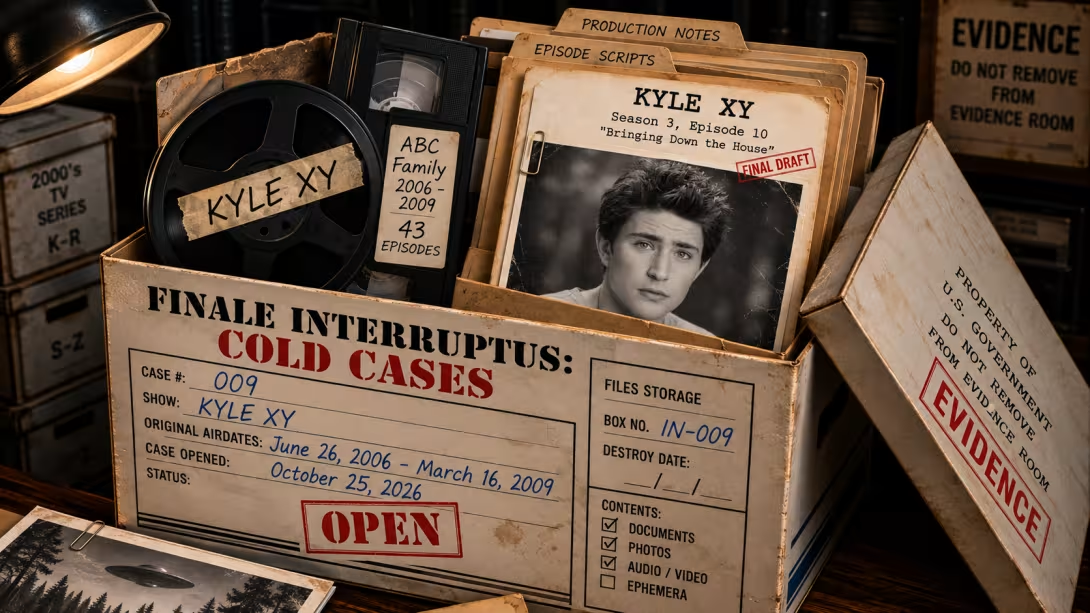
Finale Interruptus: Cold Cases - Case File #009: Kyle XY
Every television series begins with a promise. Give us your time. Your attention. Your imagination. In return, we’ll tell you a story. And when it ends, we’ll bring it to its proper conclusion.
Most do.
Some don’t.
Some endings are still missing.
These are their case files.
The Boy Without a Belly Button
A naked teenage boy awakens in a forest outside Seattle. He has no identification, no apparent memory, and no understanding of the world around him. He cannot explain who he is, where he came from, or why he seems to possess abilities that no ordinary human being should have. There is also one small but unmistakable physical detail that suggests something profoundly unnatural about his existence: he has no belly button.
That was the mystery ABC Family presented to audiences when Kyle XY premiered on June 26, 2006. At first glance, the series appeared to be another science-fiction puzzle about a young man whose origins were being deliberately concealed. But its creators had built something more complicated beneath the premise. The central question was not simply where Kyle came from. It was whether a person who had never experienced an ordinary childhood could nevertheless become a fully realized human being.
The boy, played by Matt Dallas, is initially taken into police custody after his strange behavior draws attention. Unable to communicate normally and apparently lacking even the most basic social knowledge, he is eventually placed in the care of Nicole Trager, a psychologist played by Marguerite MacIntyre. Nicole brings him into her household, where her husband Stephen and their teenage children, Lori and Josh, find themselves sharing their lives with a young man who is physically their contemporary but emotionally and socially resembles a newborn.
It is an arrangement that could easily have been played entirely for comedy. Kyle does not understand everyday customs, social boundaries, or the unspoken rules governing human relationships. Ordinary experiences become extraordinary discoveries when viewed through his eyes. Yet the Tragers' reactions give those discoveries their emotional weight. They are not simply teaching Kyle how to behave. They are gradually deciding whether this stranger belongs to their family. That distinction is what made Kyle XY more than a collection of science-fiction clues.
The show's early episodes repeatedly contrast Kyle's extraordinary intelligence with his complete lack of ordinary experience. He demonstrates remarkable mathematical ability, an unusual capacity to learn, and physical talents that suggest his body and mind operate beyond normal human limits. But he cannot draw on the emotional history that most people take for granted. Every encounter with affection, jealousy, embarrassment, loyalty, and fear becomes part of an education no laboratory could provide.
His relationship with Amanda Bloom, the girl next door played by Kirsten Prout, adds another dimension to that education. Kyle's attraction to Amanda introduces him to the uncertainties of romantic affection, while his developing bonds with Lori and Josh give him something resembling the sibling relationships he never had. Nicole and Stephen, meanwhile, confront the responsibilities of parenting someone whose needs cannot be measured by his apparent age. The science-fiction premise may have brought viewers to the series, but the Trager family gave them a reason to stay.
There was, of course, another story unfolding beyond the family's suburban home. Kyle's unusual abilities were not random gifts, and his missing navel was more than a visual gimmick. The circumstances surrounding his appearance pointed toward a hidden scientific program, people who knew considerably more about him than they admitted, and a history that threatened to overturn his understanding of himself.
The series initially presented these elements as fragments. A suspicious observer, an unexplained memory, a startling demonstration of Kyle's abilities, or a clue about his physical development could suggest an answer while raising several more questions. Rather than immediately explain the machinery behind its central mystery, Kyle XY allowed audiences to discover its world at approximately the same pace as its protagonist.
That approach made the show's title particularly effective. The designation XY suggested biology, genetics, and the reduction of a human being to scientific characteristics. Yet Kyle's daily life with the Tragers insisted that a person could not be adequately defined by the circumstances of his creation. The Tragers do more than teach Kyle how to behave; they gradually decide that this stranger belongs to their family. But those developments were still ahead when viewers first encountered the boy in the forest.
What mattered in the beginning was the contrast between the questions Kyle could answer and the ones he could not. Mathematics and complex patterns came naturally to him. Human relationships did not. He could accomplish things that astonished the people around him, yet the simplest expressions of love and belonging remained mysteries he had to solve through experience.
In that respect, Kyle XY belonged to a familiar tradition of speculative fiction. Like Frankenstein's creature, Kyle entered the world without the benefit of a normal human upbringing, possessing unusual abilities but lacking the social and emotional experiences necessary to understand the society around him. Unlike many stories about artificially created beings, however, Kyle XY initially approached that predicament through the warmth and disorder of family life rather than through horror.
The Tragers were not merely protecting Kyle from the people searching for him. They were giving him an identity that had nothing to do with the laboratory.
That emotional foundation would become increasingly important as the series expanded its mythology. Each revelation about Kyle's origins threatened to redefine him according to the intentions of the people who created him. Each new relationship offered a competing answer: Kyle was also the person he had chosen to become.
It was a compelling arrangement for an ongoing television series, particularly one aimed at an audience accustomed to stories about adolescents discovering who they were. Kyle's circumstances were extraordinary, but his fundamental struggle was recognizable. He wanted to know where he came from, why he was different, and whether the people he loved would continue to accept him once they understood the truth.
The irony, as this investigation will demonstrate, is that Kyle XY would eventually confront its audience with a version of the same uncertainty. The series encouraged viewers to invest in Kyle's search for identity, promised that the answers existed somewhere within an expanding mythology, and then disappeared before that mythology could reach its intended conclusion.
Before examining how those promises went unfulfilled, however, we need to understand how a science-fiction family drama about a boy without a belly button became one of ABC Family's defining original programs. For a time, Kyle XY was an ABC Family success story, which makes its eventual disappearance all the more striking.
When Kyle XY premiered on ABC Family in the summer of 2006, the network was still establishing an identity distinct from the family-oriented programming associated with its earlier incarnations. The channel was increasingly courting teenagers and young adults with original scripted entertainment, particularly stories built around relationships, personal discovery, and the complications of growing up.
A science-fiction mystery about an apparently parentless teenage boy might seem an unusual fit for that strategy. Yet Kyle XY succeeded precisely because it combined a fantastical premise with the emotional concerns of its intended audience. Kyle's extraordinary origins gave the series its mystery, but his struggle to understand friendship, romance, family, and identity made that mystery accessible to viewers who had never opened a comic book or watched a conventional science-fiction drama.
Created by Eric Bress and J. Mackye Gruber, Kyle XY became one of ABC Family's early original-programming successes. Its first season consisted of ten episodes, a relatively compact introduction that allowed the writers to establish Kyle's mysterious appearance, his integration into the Trager household, and the increasingly troubling evidence that someone knew exactly where he had come from.
The network's confidence was reflected in its decision to bring the series back for a substantially longer second season. Rather than allowing the initial mystery to conclude and moving on, ABC Family invested in the idea that Kyle's story could support an expanding mythology and a growing ensemble of characters.
The show's early ratings demonstrated that the unusual combination of science fiction and family drama could attract a sizable audience. Contemporary coverage reported that the first season averaged approximately 2.6 million viewers, making Kyle XY an important performer for a network seeking to establish itself through original scripted series. It also found viewers beyond its initial broadcasts, benefiting from repeat airings and the broader distribution opportunities that helped cable programs develop loyal followings.
For ABC Family, the appeal was straightforward. Kyle XY offered a recognizable teenage protagonist whose experiences were simultaneously familiar and extraordinary. It delivered suspense without abandoning the network's emphasis on personal relationships, and its mysteries encouraged viewers to return each week in search of answers.
For the writers, however, success created a new challenge. A mystery that could sustain ten episodes needed additional dimensions if it was going to sustain several seasons.
The first season had already begun answering the question of Kyle's origins through the shadowy Zzyzx organization and the revelation that his remarkable abilities were connected to scientific experimentation. The introduction of Adam Baylin, whose work was central to Kyle's existence, gave the mythology a more substantial foundation. Kyle was not simply an unexplained anomaly. His appearance was connected to people, institutions, and experiments with purposes of their own.
Perhaps the most important addition was Jessi, played by Jaimie Alexander. Like Kyle, Jessi possessed extraordinary abilities rooted in an unconventional origin, but her circumstances and emotional development were markedly different. Where Kyle had been welcomed into a household that encouraged compassion and responsibility, Jessi's experiences exposed her to manipulation, isolation, and competing demands from people who viewed her abilities as something to exploit.
The contrast was more than a convenient way to introduce another superpowered character. Jessi functioned as a reflection of Kyle, demonstrating how similar beginnings could produce different outcomes when the surrounding human relationships changed.
Her arrival also complicated the series' emotional structure. Kyle's growing relationship with Amanda Bloom had provided one of the show's central romantic threads, but Jessi understood aspects of his existence that Amanda could never fully share. The result was a triangle that was not simply about competing romantic interests. It reflected Kyle's divided identity: the ordinary life he wanted and the extraordinary circumstances he could never entirely escape.
Meanwhile, the Trager family continued to provide the show's grounding influence. Nicole's professional understanding of psychology and her increasingly maternal attachment to Kyle made her especially important as the mythology grew more complicated. Stephen, Lori, and Josh faced their own problems, ensuring that the series remained a family drama even when its larger conspiracies threatened to dominate the story.
That balance was one of Kyle XY's defining strengths. The series could introduce secret research facilities, genetic experimentation, and characters with abilities far beyond ordinary human limits, then return to the comparatively mundane problem of whether Kyle understood how to behave at a school dance or navigate a disagreement with someone he loved.
The contrast occasionally strained credibility, but it also made the extraordinary material more effective. Kyle's powers were not merely devices for escaping danger. They created situations in which his moral judgment mattered, and the Tragers supplied the values against which those judgments could be measured.
As the mythology expanded, so did the number of people and organizations with an interest in Kyle. The series moved beyond the initial mystery of his creation toward questions about what his abilities might make possible, who had the right to control them, and whether the research responsible for his existence had ever truly ended.
A self-contained mystery can survive by answering its central question. A continuing mythology must persuade viewers that every answer leads toward something meaningful rather than merely another postponement. By the end of its second season, Kyle XY had accumulated enough relationships, rivalries, scientific revelations, and unresolved agendas that its audience had reason to expect a substantial conclusion somewhere down the road.
The second season ultimately ran for twenty-three episodes, more than twice the length of the first. That expansion was evidence of the network's earlier confidence in the property, but it also represented a significant creative commitment. The writers were no longer managing a brief summer mystery. They were maintaining a serialized world whose emotional and scientific storylines depended on continued development.
By then, ABC Family's programming environment was changing. The network was cultivating other original series, including Greek and The Secret Life of the American Teenager, while continuing to develop a brand increasingly associated with relationship-driven dramas and younger audiences. Kyle XY still belonged to that environment in some respects, but its expanding science-fiction mythology made it a distinctive offering within the schedule.
The problem was not necessarily that the show had abandoned its original appeal. Rather, the audience that had once made it a breakout success was no longer turning out in the same numbers.
Contemporary reports placed the third season's audience at approximately 1.5 million viewers, a substantial decline from the program's earlier performance. That figure did not mean Kyle XY had ceased to have fans. It meant that, from the network's perspective, the series was no longer delivering the audience it had previously demonstrated it could attract.
Television networks routinely make decisions based on a combination of ratings, production costs, advertising considerations, scheduling needs, and expectations for future growth. Without access to ABC Family's internal deliberations, it would be irresponsible to attribute the cancellation to any single factor. The ratings decline, however, was real, and the network was actively investing in other programming.
There was another problem, one that would become painfully apparent when the final episodes aired. The show's creative team had not been building toward a definitive conclusion. The third season continued to introduce complications, develop relationships, and advance the larger conspiracy as though the story would have additional time to unfold.
That distinction matters because it separates the eventual finale from the endings of shows whose writers knew they were approaching their final season. Kyle XY did not deliberately choose an ambiguous conclusion after completing its central story. It was continuing a narrative whose participants expected—or at least hoped—that another chapter would follow.
When ABC Family finally announced that the series would not return, the consequences extended beyond the loss of another television program. The network had invested three seasons in a mystery about Kyle's identity, his origins, and his future, then withdrew the opportunity to bring those questions to their intended conclusion.
The cancellation became public while the third season was still airing, leaving the producers and viewers with an ending that had not been designed to finish the story.
The decision became public in early February 2009, barely three weeks after the third season premiered on January 12. The timing was especially unfortunate because the series was still unfolding on television. Viewers were following Kyle's latest discoveries, his increasingly complicated relationships, and the continuing activities of Latnok, the secretive organization whose interest in his abilities threatened everything he had built with the Trager family.
Behind the scenes, however, the program's future had already been decided. The network would not order a fourth season, and the episodes remaining on its schedule would be the last.
What makes this cancellation particularly significant is that ABC Family did not pretend the series had been designed to end there. In a statement reported by TV Guide in February 2009, a network representative acknowledged that the producers had not prepared a series finale. Some storylines would receive resolution, but a cliffhanger would remain.
That admission is central to the case. Networks frequently cancel programs with unresolved plots, sometimes leaving viewers to discover the bad news only after the final episode has aired. Here, ABC Family acknowledged the problem while the season was still being broadcast. The network knew its audience was approaching an ending that had never been intended to function as an ending.
The cancellation did not occur in isolation. ABC Family was reassessing its programming lineup and committing resources to other original productions. The network had found success with relationship-driven series such as Greek and The Secret Life of the American Teenager, and its development slate included new projects aimed at the younger audiences it was cultivating.
Contemporary coverage of the network's programming decisions placed the cancellation alongside renewals and new series orders. The broader pattern suggested a channel refining its identity as its original-programming ambitions expanded. That context is important, although it does not establish that ABC Family rejected Kyle XY specifically because it was science fiction or because executives wanted to abandon male viewers. Those explanations have circulated among disappointed fans, but they should not be confused with documented reasons for the decision.
The clearest measurable problem was declining viewership. Kyle XY had emerged as a strong performer during its first season, with contemporary reporting placing its average audience around 2.6 million viewers. By its third season, reported viewership had fallen to approximately 1.5 million.
That represented a substantial reduction from the show's earlier audience, although comparing season averages cannot tell us everything about the network's financial calculations. Ratings were only one component of a cancellation decision that might also have involved production costs, advertising revenue, contractual obligations, and expectations for future performance.
There was also the matter of the show's structure. Its first season had consisted of ten episodes, introducing the mystery and developing Kyle's relationship with the Tragers. Its second season expanded to twenty-three episodes, giving the writers considerable room to develop the conspiracy, introduce Jessi, and complicate Kyle's personal life.
The third season returned to a ten-episode order. That shorter commitment was not itself proof that the network intended to cancel the show, but it did leave the writers with far less room to develop and resolve the storylines they had accumulated.
A serialized mystery depends on the expectation that today's unanswered questions will eventually receive meaningful answers. The longer that expectation continues, the greater the obligation becomes. By the time Kyle XY entered its third season, its audience was no longer waiting for a simple explanation of the boy without a belly button. It was following an increasingly elaborate story involving Kyle's creation, the purposes of Latnok, the people responsible for the experiments, and the futures of several characters whose lives had become inseparable from his.
Those threads could not easily be tied together in a single episode, particularly when that episode had already been conceived as the conclusion to another season rather than the conclusion to the series.
The series was not a completed mystery with an unpopular resolution. Its writers had prepared a season finale, only to lose the chance to follow it.
The producers had prepared a season finale. ABC Family declined to provide another season. The resulting gap between those decisions became the audience's problem.
The final broadcast was scheduled for March 16, 2009. By then, viewers who followed entertainment news knew the series was ending. Those who watched without knowing about the cancellation would encounter the last episode as they might any other season finale, expecting that its unanswered questions were intended to bring them back for another year.
For informed viewers, the remaining episodes became an exercise in watching a story approach an unavoidable interruption. Every new revelation raised the question of whether the writers had enough time to address it. Every developing relationship carried the knowledge that the characters might never receive a proper resolution.
For viewers unaware of the cancellation, the ending would be more abrupt. What appeared to be another invitation to return next season would turn out to be the last invitation the series could offer.
The network's acknowledgment of the impending cliffhanger makes the situation more troubling from an editorial standpoint. ABC Family was under no obligation to renew a program whose performance no longer justified the investment. Television production is a business, and no creative team can reasonably expect an unlimited commitment regardless of audience response.
But the decision to discontinue a serialized mystery creates a different responsibility from canceling a procedural whose individual episodes are largely self-contained. The audience has invested in a continuing narrative, and the network has encouraged that investment by presenting unresolved questions as reasons to keep watching.
Ending a serialized mystery carries different consequences from canceling a largely self-contained procedural. The audience has been encouraged to invest in answers that will arrive later, and in this case the network acknowledged that some of those answers would never air.
There was no surprise rescue by another network, no eleventh-hour order for additional episodes, and no televised epilogue designed to settle the outstanding mythology. The ten episodes of Season 3 would constitute the final chapter of the series, whether or not the writers had intended them to serve that purpose.
The irony is difficult to overlook. Kyle XY had spent three seasons asking whether a person could transcend the circumstances of his creation and determine his own future. Its creators, meanwhile, discovered that the future of their creation belonged to someone else.
On March 16, 2009, the series aired “Bringing Down the House,” an episode that confronted some immediate dangers while introducing a revelation capable of transforming everything viewers believed they knew about Kyle.
The final episode of Kyle XY aired on March 16, 2009, under a title that promised considerably more destruction than closure. “Bringing Down the House,” the tenth episode of the third season and the forty-third episode overall, was directed by Peter DeLuise and written by Julie Plec and Brian Young. By the time it reached television, ABC Family had already announced the series' cancellation, turning what had been conceived as a season finale into an involuntary conclusion.
The episode's central conflict involved Latnok, the secretive organization whose involvement in the experiments that produced Kyle had become increasingly disturbing. Michael Cassidy, the organization's representative, had been cultivating Kyle's cooperation while concealing the full extent of its plans. In the preceding episode, Kyle and Jessi had helped stage Jessi's apparent death, hoping to convince Cassidy that she was no longer a threat and allow Kyle to learn what Latnok was doing.
That deception became a dangerous complication rather than a simple solution. Kyle was attempting to outmaneuver an organization that understood his abilities, possessed considerable resources, and had demonstrated its willingness to manipulate the people closest to him. Every move required another lie, and every lie threatened the relationships that had defined his life since his arrival at the Trager home.
The episode concentrates on stopping Latnok while Kyle struggles to protect Jessi and maintain his deception. His tactics also test the values he learned from the Tragers.
An Experiment That Would Not Stay Buried
Cassidy finally exposes the scale of Latnok's ambitions. The organization intends to revive Adam Baylin's work, using artificial gestational chambers to produce more individuals like Kyle. What began as an extraordinary experiment is being transformed into something resembling a production program, with little indication that the people responsible are troubled by the ethical implications.
For Kyle, the discovery changes the nature of the threat. He is no longer simply protecting himself or Jessi from people who want to exploit their abilities. He is confronting the possibility that Latnok will manufacture other human beings whose lives could be controlled from the moment of their creation.
The implications strike directly at the premise of the series. Kyle's humanity has never depended on whether he was born in the conventional manner. His experiences with the Tragers have demonstrated that compassion, loyalty, and moral responsibility are learned through relationships rather than dictated by biology. Latnok's ambitions threaten to strip those qualities away by treating extraordinary people as the products of a scientific process.
Cassidy attempts to offer Kyle a way out. If Kyle accepts the arrangement, he may be permitted to leave the organization behind. But freedom purchased by allowing Latnok to continue its experiments is not a compromise Kyle can accept.
The resulting operation requires cooperation from the people who have become his family and friends. Kyle works to eliminate the records and experimental materials that would allow Cassidy to continue, while Jessi and Amanda become involved in recovering information and navigating the dangers inside Latnok's operation. Mark, who has been working within the organization, also becomes an important ally.
It is a fitting culmination of one of the show's recurring ideas: Kyle may possess abilities that set him apart from everyone else, but his greatest successes depend on trusting ordinary people.
Kyle’s Changing Moral Compass
Nicole Trager recognizes something troubling in Kyle's determination. The boy she welcomed into her home once approached the world with extraordinary innocence, struggling to understand why people lied or hurt one another. Now he is deliberately deceiving his enemies, concealing information from his family, breaking into private property, and accepting risks that would once have seemed contrary to his nature.
His reasons are understandable. Latnok presents a genuine danger, and Cassidy has repeatedly demonstrated that he cannot be trusted. But Nicole's concern is not simply whether Kyle's mission will succeed. She fears what the struggle is doing to the person he has become.
That concern provides the finale with an emotional conflict more substantial than the destruction of laboratory equipment. Kyle has spent three seasons learning how to be human, only to discover that defending the people he loves may require him to behave in ways that threaten the values they taught him.
The distinction is important because Kyle XY never needed to prove that its protagonist was physically powerful. His extraordinary capabilities had been established almost from the beginning. The more interesting question was whether he could preserve his compassion while confronting people who regarded compassion as a weakness.
Nicole's objections do not prevent Kyle from continuing his mission, but they remind viewers that stopping Latnok is not the only measure of his success. Even if he destroys the experiment, he still has to live with the person he has become.
Nicole’s objections leave Kyle facing a conflict more personal than the destruction of a laboratory. Protecting the people he loves now requires deception and risk, methods that sit uneasily beside the compassion she taught him.
While Kyle's confrontation with Latnok drives the principal action, the finale also continues several personal storylines that had occupied much of the third season.
Josh Trager is devastated by Andy's departure. Their relationship has been complicated by the news that she is moving away, and the final episode deals with the emotional consequences of a separation neither teenager wanted. Declan recognizes Josh's distress and attempts to help him cope, giving the family-drama side of the series a quieter counterpoint to Kyle's increasingly dangerous activities. Kyle's romantic situation is considerably less settled.
Amanda and Jessi have become central figures in his emotional development, although their relationships with him are fundamentally different. Amanda represents much of the ordinary life Kyle has struggled to build, while Jessi shares an understanding of his origins and abilities that no one else can fully possess.
Jessi's feelings for Kyle have grown increasingly difficult to ignore, and the finale forces her to confront the possibility that he may not return them in the way she hopes. Amanda, meanwhile, begins to recognize that her own feelings for Kyle have not disappeared.
Their involvement in the operation against Cassidy briefly places them on the same side, but cooperation does not eliminate their romantic rivalry. Amanda indicates that she intends to pursue Kyle again, leaving Jessi facing another emotional complication just as the larger crisis approaches its conclusion. That is not the resolution of a love triangle. It is the continuation of one.
The writers were clearly preserving relationships that could develop in another season, rather than arranging the characters into permanent pairings for a final farewell.
The Secret Inside Cassidy's Apartment
The most consequential discovery comes not from Latnok's laboratory but from information Kyle uncovers while investigating Cassidy.
Kyle and Declan break into Cassidy's apartment in search of evidence that might help stop the experiments. Among the materials they discover are identity documents indicating that Cassidy's full name is Michael Cassidy Kingsley. His mother is identified as Grace Kingsley, a name Kyle recognizes from Adam Baylin's research. The discovery expands the conspiracy at the very moment a series finale would ordinarily be bringing it to a close.
The immediate effort to disrupt Latnok's experiments moves toward its conclusion, but Cassidy's connection to Grace Kingsley remains a source of unanswered questions. The organization has not been comprehensively explained, and the people directing its activities have not been fully exposed. Kyle has prevented an immediate danger without eliminating the larger conspiracy.
That would have been a perfectly reasonable situation at the end of a season, particularly one intended to launch another chapter. But it was not the only revelation the writers had reserved for their closing moments.
The Brother Kyle Never Knew
The final confrontation culminates in Cassidy’s claim that he is Kyle’s brother, forcing Kyle to reconsider the scientific and biological story he has been told about his own creation. Cassidy reveals that he is Kyle's brother.
It is an extraordinary claim, not simply because Kyle has never known a conventional family history, but because the entire series has treated his origins as the product of scientific experimentation. If Cassidy is telling the truth, Kyle's understanding of his creation—and of the people responsible for it—must be reconsidered.
The episode does not explain how Grace Kingsley, Adam Baylin, and Cassidy are connected to Kyle. Its final revelation was intended to carry viewers into another season, not resolve the series.
This is the decisive evidence in the Cold Case. The final episode does not merely leave a villain at large or suggest that new adventures might follow. It introduces information that fundamentally changes the audience's understanding of the protagonist, then denies viewers the opportunity to see him investigate it. For a series whose central mystery began with a boy who did not know where he came from, that is a particularly cruel place to stop.
It would be inaccurate to claim that “Bringing Down the House” resolves nothing. Kyle and his allies act against Latnok's immediate plans, several characters make meaningful emotional decisions, and the episode develops themes that have been present since the series began.
Nor is the ending entirely without dramatic purpose. The revelation about Cassidy is designed to provoke curiosity, alter the stakes, and encourage viewers to return for the next chapter. As a season finale, it performs precisely the function its writers intended. The problem is that no next chapter was coming.
According to the finale's production and broadcast record, the episode was the last installment of the third season. ABC Family's cancellation transformed that position in the schedule into the end of the series, without transforming the episode into a conclusion. They had prepared another invitation to continue. The network simply refused to send it.
Those revelations provide our next investigative challenge. A creator's description of an intended storyline is valuable evidence, but it is not the same as a completed episode, an approved screenplay, or a finished ending. We must therefore determine how much of Kyle's missing future can actually be reconstructed—and how much remains an outline of possibilities. The television series ended with Cassidy's claim of brotherhood. The investigation did not.
When Kyle XY disappeared from ABC Family's schedule in March 2009, the series left behind something more tantalizing than an ordinary cliffhanger. Its writers had answers to at least some of the questions raised by the final episode, and they were willing to share them. The problem was that those answers would never become television. Then, in September 2009, writer and executive producer Julie Plec offered fans a small measure of hope.
Responding to a question on Twitter about whether the series would receive any kind of resolution, Plec confirmed that the forthcoming third-season DVD would contain a miniature wrap-up. As CliqueClack reported at the time, she described it as the best the producers could accomplish under the circumstances.
It was not a promise of another episode, much less a revival. But it established that the people responsible for the series recognized the unfinished story and intended to provide some explanation.
On December 22, 2009, Walt Disney Home Entertainment released Kyle XY: The Complete Third and Final Season. Among the supplemental features was a presentation titled Kyle XY: Future Revealed, running approximately twelve and a half minutes.
Twelve Minutes to Finish Three Seasons
The DVD featurette brought together members of the creative team, including executive producers Eric Tuchman and David Himelfarb, co-executive producer Julie Plec, and star Matt Dallas. Rather than presenting a newly filmed conclusion, they discussed directions the story might have taken if ABC Family had renewed the series.
The distinction was apparent to reviewers examining the release. DVD Talk's contemporary review characterized Future Revealed as a hypothetical discussion about the show's continuation, while DVDizzy's examination of the set challenged the packaging's suggestion that the supplement completed the story. Nevertheless, the featurette preserved several significant pieces of the missing narrative.
Most importantly, the revelation about Cassidy was not intended to be a meaningless deception. The writers planned to explore his genetic relationship to Kyle and the identity of Grace Kingsley, whose name had surfaced in the final episode.
The Family Kyle Never Knew
A discussion of abandoned plans cannot supply the scenes, performances, and character development that would have turned those plans into a season of television. Cassidy's claim threatened to complicate that understanding.
That relationship would have supplied a powerful new conflict. Kyle had spent years learning that biology alone did not determine who someone became. Now he would have encountered a genetic family whose interests and values might be fundamentally opposed to his own.
Cassidy, in particular, offered the writers an opportunity to contrast two men connected by their origins but divided by their choices. One had found a home with people who taught him compassion; the other operated within an organization prepared to exploit extraordinary human beings for its own purposes.
The DVD material confirms that the producers wanted to explore Cassidy, Grace, and Kyle's genetic family. More elaborate descriptions of the proposed conspiracy have circulated in subsequent retrospectives, but those accounts should be treated as reconstructions of abandoned plans rather than scenes that were ever filmed.
The Experiment Wasn't Really Over
But an ongoing science-fiction conspiracy requires a threat that survives the destruction of a laboratory.
Accounts of the proposed fourth-season storyline describe the formula for Kyle's creation as remaining accessible through information stored in his extraordinary memory. In this version of the continuation, Kyle himself would become the means by which Latnok might recover knowledge he believed had been destroyed.
The idea follows logically from abilities established throughout the series. Kyle's remarkable memory and capacity to process information had repeatedly allowed him to accomplish things ordinary people could not. Turning those gifts into a vulnerability would have given the writers a way to make his greatest advantage the source of his greatest danger.
It also would have reinforced a recurring question about his autonomy. If Kyle's mind contained information that could be used to create others like him, did anyone have the right to extract it? Would the people who developed the original experiment regard his memories as their property? Could he protect the world without sacrificing his own freedom? No fourth-season episodes were produced. What survives is evidence of the creative direction, not a completed televised narrative.
Amanda, Jessi, and the Cost of Growing Up
The third-season finale left that triangle unresolved. Amanda still had feelings for Kyle, while Jessi's emotional connection to him had become increasingly difficult to separate from their shared origins. Both relationships offered something different, and neither could be reduced to a simple choice between an ordinary girl and an extraordinary one.
The producers' discussions indicated that this situation would not have been settled immediately. The proposed continuation included further development of Kyle's relationship with Jessi, with Amanda remaining an important part of his emotional future.
Later descriptions suggest that a relationship between Kyle and Jessi would ultimately prove destructive, while Amanda might return to his life after gaining greater independence and maturity. These possibilities suggest that the writers were interested in letting the characters grow beyond the circumstances that originally brought them together.
The proposed romantic developments might have allowed the series to examine whether sharing an origin was sufficient to sustain a relationship, or whether love depended on the same ordinary experiences that had made the Trager household so important. Yet the DVD could offer only a description of that journey.
A Destiny Beyond the Trager Household
According to a contemporary review of the featurette, the producers envisioned Kyle eventually leaving the familiar world of the Trager household and becoming an inspirational leader.
At the beginning of the series, Kyle's story was about entering the human world. He needed protection, guidance, and a family willing to accept him despite his differences. By the proposed end of his journey, he would have moved beyond dependence on that family and taken the lessons he learned into a much larger world.
The concept has an almost mythic quality. Kyle would begin as an apparent outsider, learn humanity from ordinary people, and eventually use his extraordinary abilities and moral understanding to influence others.
It is easy to see why the writers found that trajectory appealing. It would have transformed the original premise into a story about the responsibilities that accompany exceptional gifts.
The featurette does not establish whether Kyle would have become a public figure or how his influence might have worked. It identifies a destination without detailing the route.
The available accounts do not establish a complete final sequence answering those questions. They identify a destination the creators had in mind, not the precise route by which Kyle would have reached it.
The Limits of a DVD Epilogue
For some viewers, hearing the producers discuss Cassidy, Grace Kingsley, the romantic triangle, and Kyle's eventual destiny provided more satisfaction than the televised cliffhanger had offered. At least the unanswered questions were not entirely abandoned. The people who had created the mystery were willing to explain something about the solution.
Other reviewers were considerably less impressed. The Gamers' Temple's assessment criticized the supplement for offering ideas rather than the satisfying conclusion its promotional material implied. DVDizzy reached a similar judgment, arguing that the featurette did not genuinely complete the story.
As historical evidence, Future Revealed is valuable. It preserves creative intentions that might otherwise have disappeared with the cancellation, and it helps distinguish the writers' developing plans from fan speculation.
A story is not merely a collection of answers. It is the process by which characters discover those answers, respond to them, and change because of what they have learned. Knowing that Kyle might have become an inspirational leader does not allow viewers to experience the decisions that would have brought him there. Learning that Cassidy's family connection was intended to matter does not replace watching Kyle confront that discovery.
The most revealing fact may be that the producers attempted this unusual form of closure at all. They understood that Kyle XY had ended before its central narrative could be completed, and they recognized that its audience wanted more than silence.
The result is an unusual piece of television history: a canceled series whose intended future survives in interviews and supplemental material, but whose characters remain stranded at the precise moment the broadcast story stopped.
Kyle learned that Cassidy was his brother. The audience learned that the writers had ideas about what that meant. Neither discovery amounted to a finished ending.
Some television mysteries deliberately leave room for interpretation; others conclude after their central story has been told. Kyle XY was still developing its central mystery when ABC Family canceled it.
On March 16, 2009, ABC Family broadcast the final episode of a series whose central mystery was still developing. Kyle had spent three seasons discovering the circumstances of his creation, learning what it meant to belong to a family, and confronting people who viewed his extraordinary abilities as something to control. He had survived experiments, conspiracies, betrayals, and the ordinary emotional hazards of adolescence.
It is difficult to imagine a more pointed interruption for a series fundamentally concerned with identity. Kyle's first mystery was the absence of a belly button, a physical indication that his origins differed from those of everyone around him. His final mystery was the sudden appearance of a biological relationship that threatened to redefine everything he believed about those origins.
What the Finale Resolved
The evidence does not support the claim that Kyle XY ended without resolving anything. Its final episode brought the immediate conflict with Latnok's experimental program to a turning point, and Kyle succeeded in disrupting the organization's attempt to reproduce the work responsible for his creation.
The Trager family's emotional significance was also firmly established. Whatever mysteries remained about Kyle's biological origins, three seasons had demonstrated that Nicole, Stephen, Lori, and Josh were his family in the ways that mattered most. The series did not need a final revelation about his genetics to validate those relationships.
Latnok's wider organization remained a threat. Grace Kingsley's role in Kyle's creation was not fully explained. Michael Cassidy's claim of brotherhood introduced an entirely new dimension to the mythology. Kyle's relationships with Amanda and Jessi were still changing, and his eventual place in the world remained uncertain.
The Evidence That Survived
The producers did not disappear into silence after the cancellation. Their December 2009 DVD supplement, Kyle XY: Future Revealed, discussed several directions they had envisioned for the unproduced fourth season. Viewers learned that the Cassidy revelation was intended to lead into a deeper investigation of Kyle's genetic family, that his romantic relationships would continue to evolve, and that his ultimate development might take him far beyond the sheltered world of the Trager household.
There is a difference between a proposed storyline and a completed screenplay. There is an even greater difference between a screenplay and a finished television episode. The DVD featurette preserved intentions, possibilities, and creative ambitions, but it did not supply the dramatic execution necessary to transform those ideas into an ending.
That distinction is particularly important when evaluating retrospective accounts of the abandoned fourth season. The more elaborate the descriptions become, the easier it is to mistake a proposed development for something that was definitively planned, approved, and ready to film.
The Network’s Decision
The network had every right to evaluate the program's declining ratings and decide that another season was not financially justified. Kyle XY had enjoyed considerable early success, but its reported audience had diminished by its third season. Renewal was not guaranteed, and the network was under no obligation to sustain the series indefinitely.
What distinguishes this case is the network's acknowledgment that the episodes already produced would not provide a complete conclusion. As TV Guide reported during the cancellation, ABC Family understood that the writers had prepared a season finale rather than a series finale, and that viewers would be left with a cliffhanger.
The network therefore did not discover the problem after the final broadcast. It knew the story was incomplete before the audience reached its last episode.
That does not mean a satisfactory alternative was necessarily available. Producing additional episodes would have required money, contracts, schedules, and the cooperation of cast and crew. A special concluding installment might have presented its own financial and creative complications.
The producers' subsequent DVD supplement represented an effort to address that deficiency, but it also demonstrated why such substitutes rarely satisfy everyone. An explanation can answer a question about a story. It cannot entirely replace the experience of watching the story reach its conclusion.
The Human Story Beneath the Science
For all its scientific mythology, the show's most important question was never simply how Kyle had been created. That question supplied the conspiracy, the villains, and the revelations that kept the plot moving. But the emotional center of the series concerned what Kyle would become after his creation.
He entered the world with extraordinary intelligence and almost no human experience. The Tragers taught him that people could love one another without understanding everything about them, that mistakes carried consequences, and that belonging was something built through shared lives rather than established by a laboratory record.
His extraordinary abilities allowed him to solve problems that ordinary people could not. His ordinary relationships taught him which problems were worth solving.
The unproduced fourth-season ideas suggest that the writers intended to carry this theme toward a larger conclusion. Kyle would eventually move beyond the family that had protected him, perhaps becoming an inspirational figure whose influence extended to people he had never met.
But it also would have required a difficult transition. Kyle's growth could not be measured solely by his increasing independence or the development of his powers. The series would have needed to show whether he could preserve the humanity he had learned while accepting responsibilities beyond the Trager household.
The Possibility of a Return
As of this investigation, there has been no produced fourth season, concluding television movie, or canonical continuation that resolves the original cliffhanger. The existence of the DVD featurette does not change that status.
A revival would also face a different creative challenge from the one the original writers anticipated in 2009. The actors and audience have aged, the television landscape has changed, and the story of an apparently teenage boy discovering the world could not simply resume as though no time had passed.
That does not make a continuation impossible. The original premise contains an obvious opportunity to explore what Kyle might have become after years of living beyond the Trager household. An older Kyle, confronting the consequences of the experiments that created him, could provide the foundation for a substantially different series. But such a production would be a new creative undertaking, not the missing fourth season finally arriving on schedule.
Final Disposition
The case against Kyle XY is not that every loose end required an answer. The problem is that the writers were still actively developing its central narrative when the network stopped the series.
The case is that its central narrative was interrupted while the writers were actively developing it, that the network acknowledged the impending cliffhanger, and that the subsequent attempt to provide closure consisted of interviews about unproduced material rather than a dramatic conclusion.
The DVD supplement offers useful testimony about the intended future, but testimony is not the event itself. The proposed developments involving Cassidy, Grace Kingsley, Jessi, Amanda, and Kyle's eventual destiny remain fragments of a story that was never completed for television.
Kyle XY began with a young man who did not know who he was. Over three seasons, he learned that his identity could not be reduced to his genetics, his abilities, or the ambitions of the people who created him. At the moment Kyle was prepared to confront the deepest questions about his past, the series lost its future.
COLD CASE VERDICT: UNRESOLVED.
Cause of interruption: Network cancellation following declining viewership.
Final televised evidence: “Bringing Down the House,” March 16, 2009.
Outstanding mysteries: Cassidy's relationship to Kyle, Grace Kingsley's full role, Latnok's larger plans, and Kyle's ultimate destiny.
Supplemental evidence: Kyle XY: Future Revealed, a DVD featurette discussing proposed developments without providing a completed ending.
Disposition: The creators revealed portions of the intended future, but the story itself remains unfinished.
What he never found was an ending.