
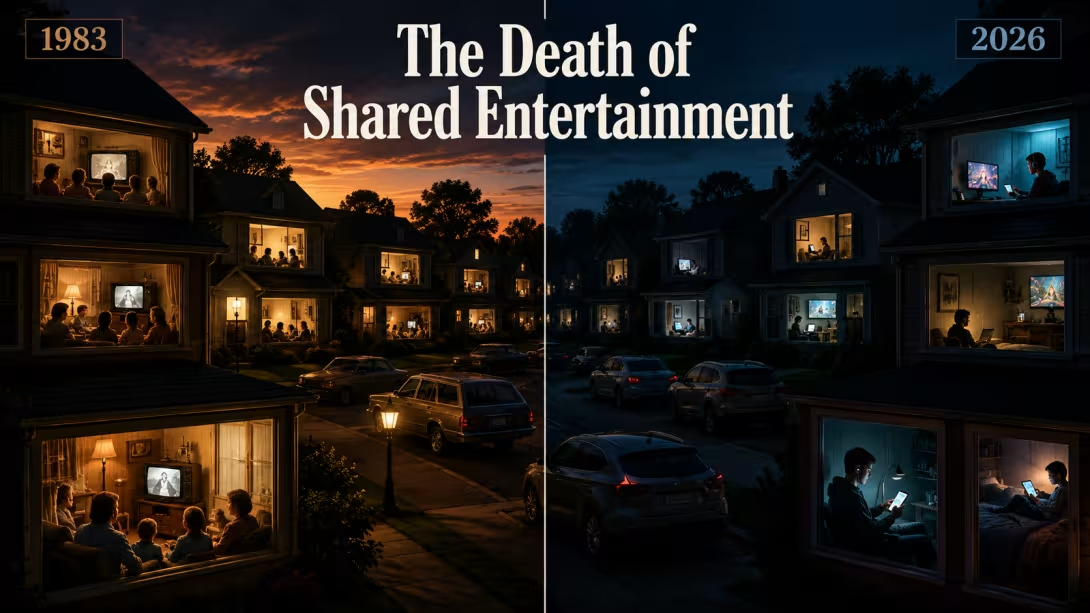
The Death of Shared Entertainment
"Did you see it last night?"
For a generation of Americans, that may have been the most powerful sentence in entertainment.
It wasn't merely a question. It was an invitation into a conversation that millions of people were already having.
Those of us who grew up during the era of three television networks didn't simply consume entertainment—we experienced it together. Friday morning meant the school cafeteria buzzing about the latest sitcom. Monday at work began with somebody leaning over the break-room coffee pot and asking whether you'd seen last night's episode. Even the people who had missed it usually knew enough to smile politely while everyone else replayed their favorite scenes.
Television wasn't just filling an hour.
It was creating common memories.
Today we live in the golden age of entertainment. We carry more movies, television shows, music, and documentaries in our pockets than an entire video store stocked in 1985. Thousands of streaming titles are available with a few taps of a screen. If someone had described this future to viewers half a century ago, they'd have assumed we'd reached paradise.
And, in many respects, they would have been right.
The quality of today's entertainment is extraordinary. Television has never looked better. Independent filmmakers can find audiences that would have been impossible to reach forty years ago. Entire genres that once struggled to survive now flourish because they no longer have to appeal to everyone. By almost every measurable standard, we've never had it so good.
In almost every measurable way, we've won.
Which makes what we've lost all the easier to overlook.
Unlimited choice has carried an unexpected price.
Not better stories.
Not better technology.
We've gained both.
What we've slowly surrendered is the experience of discovering those stories together.
Shared entertainment didn't disappear overnight.
It simply became optional.
Those of us of a certain age remember when television schedules weren't suggestions; they were appointments. If your favorite show aired at eight o'clock, you were in front of the television at eight o'clock. Miss it, and you might wait months before the network decided to rerun the episode—assuming it reran it at all.
By today's standards, that sounds hopelessly inconvenient.
Oddly enough, those limitations created something we've since lost.
When nearly everyone was choosing from the same small menu, nearly everyone had something in common the next morning.
There were only three major broadcast networks competing for the country's attention, and they weren't chasing carefully segmented demographics. They were trying to attract everybody.
That meant parents and teenagers often watched the same programs. Neighbors watched the same programs. Coworkers watched the same programs. Even if your tastes differed, your choices inevitably overlapped because there simply weren't that many alternatives.
None of this is to suggest America was somehow more united. We argued about politics then, too. About religion. About sports. About everything people have always argued about.
But every so often, television gave us a temporary cease-fire.
For one evening, we were all watching the same thing.
The clearest example remains the finale of M*A*S*H. Historical ratings
When "Goodbye, Farewell and Amen" aired in February 1983, more than 100 million Americans tuned in, making it one of the most-watched television broadcasts in history. Families planned their evenings around it. Restaurants noticed business slow. Friends agreed not to call during the broadcast. Even people who weren't regular viewers understood they were witnessing a cultural event, not simply the conclusion of a television series.
The following morning, nobody had to ask what everyone had watched.
Everybody already knew.
The question wasn't what you watched.
It was what you thought about it.
And M*A*S*H wasn't unique.
Who shot J.R.?
The final episode of Cheers.
The original broadcast of Roots.
The moon landing.
The explosion of the Space Shuttle Challenger.
Even the verdict in the O.J. Simpson trial.
Some of those were entertainment.
Some were history unfolding in real time.
Yet they all shared one remarkable characteristic.
America experienced them together.
It's tempting to blame technology for bringing that era to an end, but history is more complicated than that.
Take the VCR.
When videocassette recorders first appeared in living rooms, critics predicted the end of appointment television. Why rush home for an eight o'clock show if you could simply press Record and watch it later?
History has largely forgotten the VCR's greatest contribution.
It didn't destroy appointment television.
It preserved it.
For the first time, life could interrupt your viewing without forcing you out of the conversation.
If your daughter's piano recital happened to fall on the same evening as your favorite sitcom, you no longer had to choose between being a good parent and staying part of the discussion. You could record the episode, watch it later that night—or first thing the next morning—and still arrive at work able to join everyone else around the coffee pot.
The goal wasn't to leave the conversation.
It was to catch up quickly enough to rejoin it.
Video rental stores extended that communal spirit in another direction. Friday-night trips to the neighborhood video store became rituals. Friends insisted you borrow the comedy you'd somehow missed or finally watch the classic they'd been quoting for years. Entire neighborhoods discovered favorite films because someone handed someone else a tape and said, "Trust me—you've got to see this."
Choice had expanded.
Community, remarkably, survived.
The first real crack in that shared experience didn't come from the VCR.
It came from cable television.
Looking back, it's easy to understand why cable felt like an unquestioned improvement. More channels meant more choices. If you loved history, there was a channel for that. Sports? Several of them. Science fiction, cooking, music, old movies, home improvement, cartoons—whatever your interest, someone was finally programming specifically for you.
Nobody complained about having too many options.
Why would they?
The hidden cost wasn't obvious because it arrived one channel at a time.
For decades, broadcast television had pursued the broadest audience possible. Cable took the opposite approach. Rather than persuading millions of people to watch the same program, it encouraged millions of smaller audiences to discover programming tailored to their own interests.
That was a tremendous victory for viewers.
It also marked the beginning of a quieter cultural shift.
The odds that you and your next-door neighbor had watched the same show the previous evening became just a little smaller.
Then they shrank again.
And again.
Nothing dramatic happened overnight. There wasn't a national meeting where America collectively decided to stop sharing entertainment.
Instead, we drifted apart by degrees.
No single invention destroyed the water-cooler conversation.
A thousand perfectly reasonable choices slowly dissolved it.
The DVR accelerated the process, but not in the way many people remember.
Its greatest gift was convenience.
Its unintended consequence was timing.
Suddenly, everyone was watching the same series on a different schedule.
One coworker had watched it live.
Another had recorded it for later that evening.
Someone else planned to catch up over the weekend.
A fourth person had half a season waiting on the hard drive.
The conversation didn't disappear.
It became a negotiation.
"Don't tell me what happened."
"I'm only on Episode Three."
"I haven't watched last night's yet."
Spoilers, once almost nonexistent, became a matter of common courtesy. We learned to speak in code, carefully dancing around plot points because everyone was living in a slightly different television timeline.
Then streaming arrived and quietly completed a journey that had begun years earlier.
Netflix deserves enormous credit for recognizing something the rest of the industry had underestimated: viewers wanted to watch on their own schedule. Entire seasons appeared overnight. "Binge-watching" entered the language, and suddenly the calendar belonged to the audience instead of the network. Netflix
That freedom was intoxicating.
It also changed the way we talked about television.
The old question had been wonderfully simple.
"Did you see it last night?"
The new question became...
"How far are you?"
It's a subtle difference.
But it's an important one.
The first assumes we're sharing the same experience.
The second assumes we're not.
Ask someone today what they watched last night and there's a good chance the first response won't be the title of a show.
It'll be another question.
"Which service?"
Today's viewers don't merely have more choices than previous generations. They have more entertainment available than they could possibly consume in a lifetime. Every streaming service isn't simply competing with another streaming service anymore. It's competing with every movie ever made, every television series ever produced, every YouTube channel, every podcast, every video game, every social-media feed, and every unread book waiting on the nightstand.
Never before have audiences enjoyed so much entertainment.
Ironically, it's never been harder for any single story to become part of the culture.
Still, every generation seems to produce one phenomenon that briefly convinces us shared entertainment has returned.
For Millennials and much of Generation Z, that phenomenon may have been Game of Thrones.
For nearly a decade, Sunday evenings became appointment television again. Friends gathered for watch parties. Social media exploded with theories before the closing credits had finished rolling. Monday mornings became dangerous territory for anyone who hadn't watched the night before.
For a little while, television felt communal again.
Yet Game of Thrones also revealed just how dramatically the landscape had changed.
Millions watched every episode.
Millions more intended to watch eventually.
Some waited until an entire season had finished before starting.
Others decided not to begin the series until it had completely ended.
The audience was enormous.
It simply wasn't synchronized.
That's an important distinction.
When the M*A*S*H finale aired, nearly everyone experienced the same emotional journey at the same moment. The conversation surrounding Game of Thrones, by contrast, unfolded across months and even years. It wasn't one national discussion so much as thousands of overlapping conversations, each taking place at a different point in the story.
Perhaps that's why the finale proved so divisive.
By the time everyone finally reached it, there was no single moment of collective reaction. The debate spread across podcasts, YouTube channels, Reddit threads, social media, and office break rooms, each running on its own timetable.
The water cooler hadn't disappeared.
There were simply millions of them now.
Oddly enough, the strongest examples of shared entertainment today are the ones that can't easily be postponed.
Live sports remain the clearest example.
The Super Bowl isn't simply a football game.
It's an appointment.
Watching it three hours later just isn't the same once your phone has already announced the final score. According to Nielsen's annual viewing data, live sports continue to dominate the list of America's most-watched broadcasts for exactly that reason: they're one of the few remaining experiences audiences still prefer to witness together, in real time. (Source: Nielsen viewing data)
The same is true of championship boxing, the Olympics, presidential debates, election nights, and even awards shows that people insist they don't watch.
People don't tune in simply because they're interested.
They tune in because everyone else is watching.
And that's a very different motivation.
Of course, shared entertainment hasn't vanished altogether.
It has simply become more selective.
Live television still has the power to stop us in our tracks because live events can't truly be time-shifted. A championship game loses much of its excitement once you already know the score. An awards show isn't nearly as interesting after every acceptance speech has been clipped into thirty-second videos. Even breaking news carries an urgency that evaporates once it becomes history.
There's another category that still manages to unite us, and it's one television executives could never have predicted.
Celebrity culture.
Whenever Taylor Swift and Travis Kelce eventually decide to get married—and yes, I'm assuming my invitation somehow got lost in the mail—it won't simply be another celebrity wedding. Morning news programs will lead with it. Entertainment websites will devote endless coverage to it. Social media will spend days analyzing every photograph, every guest, every dress, and every song played at the reception.
Millions of people who have never purchased a Taylor Swift album or watched Travis Kelce catch a football will still know it happened.
Not because they sought it out.
Because, for a brief moment, it becomes part of the national conversation.
That may sound trivial compared to the finale of M*A*S*H or the moon landing, but the underlying principle is exactly the same.
Some events transcend their subject matter.
They become experiences we expect other people to have shared.
Which brings us to the next chapter in this story.
Artificial intelligence.
Most conversations about AI focus on whether computers will someday write better screenplays, compose convincing music, or generate visual effects that rival Hollywood blockbusters. Those are fascinating questions, but I suspect they're not the ones we'll eventually consider most important.
The bigger question isn't whether AI can create entertainment.
It's whether AI will eventually eliminate the idea of a shared audience.
Streaming services already recommend programs based on what we've watched before.
Tomorrow's systems may skip the recommendation altogether.
Imagine sitting down after dinner and telling your television you're in the mood for a mystery with just enough humor to keep things from becoming too dark. You'd like a protagonist who reminds you of Humphrey Bogart, the chemistry of Cheers, and an ending that's hopeful instead of cynical.
A few moments later, the movie begins.
Not a movie selected from a library.
A movie that has never existed until that moment.
Tomorrow night's feature is different.
So is the one after that.
Every story is crafted specifically for you.
No one else on Earth sees quite the same version.
From a technological standpoint, that's astonishing.
From a cultural standpoint, it's a little unsettling.
For thousands of years, stories have been more than entertainment.
They've been our campfires.
Long before electricity, people gathered around flames to hear the same tales. Those stories became part of a family's history, a village's traditions, and eventually a civilization's identity. The campfire gave way to the radio. The radio yielded to movie palaces. Living rooms replaced theaters. Television gathered us around the same glowing screen every week at the same hour.
The screens have changed.
The reason we gather never has.
Stories are one of the ways we discover who we are.
More importantly, they're one of the ways we discover who we are together.
Perhaps that's why this isn't really an article about television.
It's an article about community.
Technology has always changed the way we communicate. The telephone made letter writing less common. Email transformed business correspondence. Social media made it possible to stay connected with hundreds of people while, in some cases, spending less time with the person sitting across the dinner table.
Entertainment followed the same path.
We've gained extraordinary convenience.
We've sacrificed a measure of common experience.
Notice I didn't say we've lost it.
Because we haven't.
Shared entertainment doesn't depend on television networks.
It depends on us.
Families can still decide that Friday is movie night.
Friends can still agree to stream the newest episode together, even if they're separated by a thousand miles and chatting through a group text.
Communities can still fill local theaters on opening weekend instead of waiting for the streaming release.
Churches still organize movie nights.
Libraries still host film clubs.
Comic shops still gather fans to celebrate the latest blockbuster.
None of those traditions disappeared because Netflix arrived.
They disappear only when we stop choosing them.
Maybe that's why today's biggest entertainment successes increasingly feel like events rather than products.
A packed opening night at the movies.
The Super Bowl.
A championship game.
A concert that fills an entire city.
A finale everyone agrees not to spoil until Monday morning.
They're reminders that our appetite for shared stories hasn't disappeared.
We've simply become more intentional about satisfying it.
Perhaps that's where the future lies.
Not in returning to the era of three television networks.
Not in abandoning streaming.
Certainly not in pretending technology should somehow run backward.
Instead, we recognize that some experiences become more valuable simply because they're experienced together.
That's a choice.
And it's one no algorithm can make for us.
Someday our grandchildren may find it amusing that entire neighborhoods once planned their evenings around the same television show.
They'll grow up in a world where every screen knows exactly what they want before they do.
I hope they'll also discover something no recommendation engine, streaming service, or artificial intelligence can manufacture.
The simple pleasure of turning to another person afterward and asking...
"Did you see it?"
...and hearing the answer, "Yes."
Because stories have never been at their best when they're merely consumed.
They're at their best when they're remembered together.