
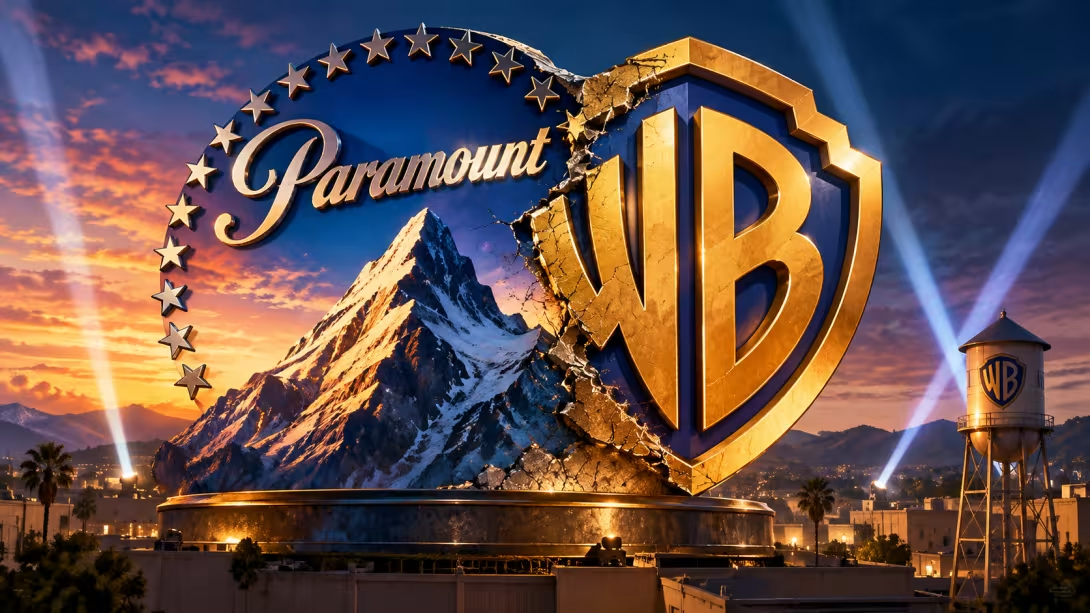
Warner Bros. Has a New Owner. Does James Gunn's DC Universe Have a New Future?
Part One: The Studio That Keeps Getting Sold
There is something almost reassuring about the Warner Bros. water tower.
It has stood over the Burbank studio lot for generations, a familiar symbol of an entertainment company that helped define Hollywood. The studio gave us Casablanca, The Maltese Falcon, The Exorcist, The Matrix, and the Harry Potter films. Its cartoon characters have entertained children who grew up to have children of their own, and its television productions have become part of the cultural vocabulary.
The water tower remains where it has always been.
The owners, on the other hand, seem to change with remarkable frequency.
Warner Bros. has survived the transition from silent pictures to sound, the rise of television, the collapse of the old studio system, the arrival of home video, and the streaming revolution. What it has apparently never managed to escape is the conviction of successive corporate executives that its future would be brighter if it belonged to somebody else.
On October 6, 2026, Paramount Skydance completed its acquisition of Warner Bros. Discovery, bringing two of Hollywood's most recognizable studios under the same corporate roof. The combined company now operates as Skydance.
For moviegoers, the implications are enormous. The combined enterprise brings together Paramount Pictures and Warner Bros., CBS and HBO, Star Trek and DC Comics, Mission: Impossible and Harry Potter. It unites libraries of films and television programs that collectively represent much of the entertainment Americans have consumed over the past century.
For comic-book fans, it raises an especially interesting question: What happens to James Gunn's still-developing DC Universe when the company financing it gets a new owner?
But before we get to Superman, Batman, and the possibility of a Justice League that actually stays together long enough to become a franchise, there's a larger question worth asking.
Why does Warner Bros. keep getting sold?
The modern history of Warner's corporate ownership reads like a succession of ambitious business theories, each presented as the solution to problems the previous owners somehow failed to anticipate.
In 2000, America Online announced its merger with Time Warner, a combination celebrated as the marriage of the internet and traditional media. The logic seemed irresistible. AOL understood the emerging digital world, while Time Warner owned the content everyone wanted to consume. Together, they were supposed to define entertainment's future.
Instead, the merger became a cautionary tale about corporate enthusiasm outrunning technological reality. The dot-com bubble burst, the promised benefits proved elusive, and AOL eventually separated from Time Warner in 2009.
Then came AT&T.
In 2018, the telecommunications giant completed its acquisition of Time Warner, convinced that owning entertainment would complement the business of delivering it. The company could provide the connection, the programming, and the platform on which audiences watched it.
That marriage lasted only a few years.
In 2022, AT&T separated WarnerMedia and combined it with Discovery, creating Warner Bros. Discovery. Once again, the argument centered on scale, efficiency, and the advantages of assembling an enormous entertainment library under one management structure.
And once again, the arrangement proved less permanent than its architects presumably imagined.
Now Paramount Skydance has arrived with another vision for the future, another collection of financial projections, and another opportunity to demonstrate that the next combination will succeed where earlier ones disappointed.
None of this necessarily means the new owners are making a mistake. The entertainment industry has changed dramatically, and traditional studios face competitors that barely existed when Warner Bros. Discovery was formed. Netflix, Amazon, Apple, Disney, and YouTube are competing for audiences who have more choices than at any previous point in history.
There is a legitimate argument that a larger company, with more intellectual property and greater distribution reach, may be better equipped to compete.
But the history of Warner Bros. suggests that assembling a bigger collection of entertainment assets is considerably easier than figuring out what to do with them. And that distinction matters.
A studio isn't valuable simply because it owns a library of familiar characters. Those characters became valuable because generations of writers, artists, actors, directors, and producers created stories audiences wanted to experience. Corporate ownership can preserve those opportunities, expand them, or quietly suffocate them beneath financial expectations.
Consider the irony facing the new owners.
They have acquired one of the most celebrated entertainment companies in history, a studio whose reputation was built on taking creative risks and occasionally discovering that audiences wanted something nobody had thought to offer them.
Now they must determine whether the best way to protect that legacy is to encourage more of those risks—or concentrate their resources on properties whose financial value is already established.
For Critical Blast readers, that isn't an abstract business question.
It's the difference between a DC Universe allowed to grow into something distinctive and another collection of superheroes required to justify their existence on a quarterly earnings report.
Before we can consider which future James Gunn might inherit, however, we need to examine the financial expectations accompanying the new ownership.
Because Hollywood's latest empire wasn't assembled simply to tell better stories.
It was assembled to make money.
And the amount of money involved may determine which stories get told next.
Part Two: The Price of Building an Empire
There is an old joke about how to make a small fortune in Hollywood.
Start with a large one.
The new owners of Warner Bros. are certainly starting with impressive numbers. The acquisition carries an enterprise value of approximately $111 billion, including debt, while the combined company faces an estimated $80 billion in net debt.
Those figures are difficult to comprehend in ordinary terms. Even by Hollywood standards, however, they represent an extraordinary financial commitment, one that will influence decisions far beyond the executive offices.
Management is targeting at least $6 billion in annual run-rate savings within three years. Corporate executives call these savings *synergies*, a wonderfully reassuring word that makes eliminating duplicate operations sound rather like discovering an unexpected discount at the supermarket.
Some of those efficiencies are perfectly reasonable.
Two major entertainment companies maintain separate administrative departments, technology platforms, marketing operations, and distribution arrangements. Combining overlapping functions can eliminate unnecessary expenses without affecting the films and television programs audiences actually see.
But there's another side to the calculation.
Writers' rooms, production departments, development executives, and creative teams also appear as expenses on corporate balance sheets. When management is expected to produce billions in savings, the distinction between eliminating waste and eliminating opportunity can become uncomfortably narrow.
And Hollywood has a long history of discovering that the easiest project to cancel is one that hasn't been made yet.
A proposed television series may have an enthusiastic creative team, a compelling premise, and the potential to become a breakout success. What it doesn't have is a proven audience. Against a familiar franchise with decades of merchandising and licensing history, that uncertainty can make an original idea look considerably less attractive to executives concerned about reducing debt.
This doesn't mean the new owners intend to abandon original programming. It means the financial incentives deserve scrutiny, particularly during the first years of integration.
There is, however, a potentially encouraging development for moviegoers.
The acquisition comes with commitments intended to preserve a substantial theatrical release schedule. Rather than treating movie theaters as an inconvenient stop on the way to streaming, the combined company has pledged to maintain a significant annual slate of films, including wide releases and independent productions.
That's important because the theatrical business needs more than the occasional blockbuster.
A healthy movie industry depends on a steady flow of pictures that give audiences reasons to visit theaters throughout the year. Horror films, comedies, thrillers, family adventures, and modestly budgeted dramas all contribute to an ecosystem that cannot survive indefinitely on superheroes and sequels alone.
Theaters also need studios willing to support films that might earn respectable profits without becoming billion-dollar phenomena.
A movie that costs $30 million to produce doesn't necessarily need to earn $800 million to be successful. It needs a business model appropriate to its audience.
And that may be one of the most promising opportunities available to the new Paramount Skydance organization.
With Warner Bros., Paramount, HBO, CBS, and multiple streaming operations under one corporate umbrella, the company possesses an unusually broad collection of distribution outlets. Not every project needs the same budget, the same audience, or even the same release strategy.
A sprawling science-fiction adventure might belong on the biggest theatrical screens available. A character-driven mystery might flourish as a limited television series. An animated comedy could find its audience through a streaming platform, while a low-budget horror film might become a profitable theatrical surprise.
The trick is recognizing that different kinds of entertainment require different definitions of success.
Unfortunately, corporate consolidation can encourage precisely the opposite approach.
When a company owns several distribution platforms, it may become tempting to organize creative decisions around the needs of those platforms rather than the needs of individual stories. A promising concept can be stretched into a series because the streaming service needs subscribers, or compressed into a movie because theatrical releases offer greater immediate visibility.
Neither decision necessarily serves the material.
We've seen what happens when studios begin treating intellectual property primarily as inventory. Familiar characters become ingredients in an endless procession of interconnected projects, each designed to support the next announcement rather than deliver a satisfying story of its own.
Audiences eventually recognize the difference.
They may not understand the corporate accounting behind a production, but they know when a movie feels like an advertisement for another movie.
And they know when a television series seems more interested in setting up its next season than resolving the story it has already asked them to follow.
For a company carrying enormous financial obligations, the temptation to lean heavily on familiar brands will be substantial.
Warner Bros. brings Batman, Superman, Wonder Woman, Harry Potter, and a remarkable collection of other established properties. Paramount contributes Star Trek, Mission: Impossible, Top Gun, and decades of television history. Together, those franchises represent a formidable competitive advantage.
They also represent a potential trap.
A company can become so concerned with protecting the value of its established properties that it forgets those properties became valuable because somebody once took a chance on an idea that wasn't established at all.
There was a time when Superman was simply a new character created by two young men from Cleveland. Batman was an unfamiliar masked detective. Star Trek was a science-fiction television series struggling to attract enough viewers to survive.
None arrived with a guaranteed audience.
Somebody had to believe in them before the audience existed.
That is the real challenge facing the new owners of Warner Bros. The financial success of this acquisition may depend on familiar franchises, but the company's creative future depends on its willingness to discover what comes after them.
Which brings us to the most immediately interesting test of that philosophy.
James Gunn and Peter Safran have already begun constructing a new DC Universe, with a long-term plan intended to bring coherence to characters who have spent years moving between reboots, abandoned projects, and competing continuities.
Their new corporate owners have inherited that plan in progress.
The question is whether they'll give it room to develop—or decide that Superman needs to start earning his keep a little faster.
Part Three: What Happens to James Gunn's DC Universe?
Somewhere in the new Skydance corporate structure, it is easy to imagine a spreadsheet assigning a value to Superman.
There are probably similar calculations for Batman, Wonder Woman, the Joker, and every other character whose appearance on a movie screen can generate ticket sales, merchandise, licensing revenue, and streaming subscriptions.
What those spreadsheets cannot measure quite so easily is the value of getting the characters right.
That's the challenge facing James Gunn and Peter Safran, the co-chairmen of DC Studios, whose ambitious reconstruction of the DC Universe is still in its formative years. After more than a decade of competing creative visions, abandoned plans, and repeated attempts to find a coherent direction, DC finally has something resembling a long-term strategy.
And now the company financing that strategy has changed hands.
The encouraging news is that Gunn and Safran remain part of the new corporate leadership structure. Their continued presence suggests that the incoming owners recognize the value of allowing the DC Universe to develop rather than immediately ordering another creative overhaul.
But surviving a corporate acquisition and retaining meaningful creative independence are not necessarily the same thing.
Gunn's greatest advantage may be that he has already begun the work. His Superman (2025), available on 4K Ultra HD established the foundation of a new cinematic continuity, while related film and television projects are intended to introduce characters who can eventually inhabit the same fictional universe. Starting over would mean sacrificing that investment and asking audiences to accept yet another version of characters they've already watched being reinvented repeatedly.
There's a practical argument for patience.
Marvel's cinematic universe didn't become a phenomenon because its executives announced an enormous interconnected franchise. It became a phenomenon because audiences first embraced individual characters and stories. The larger universe grew from that foundation, even if Marvel's later expansion sometimes made the machinery more visible than the storytelling. DC has an opportunity to learn from both sides of that experience.
And perhaps the most important test involves a character who has spent decades proving that he doesn't particularly need anyone else's help to sell movie tickets.
Batman.
Matt Reeves has established a separate cinematic interpretation of Gotham City, while Gunn's planned DC Universe requires a Batman capable of existing alongside Superman and the rest of DC's extraordinary population.
Under the previous corporate structure, maintaining those parallel approaches was already a delicate balancing act. New ownership creates an opportunity to reconsider whether two cinematic Batmen represent unnecessary duplication or an advantage other studios would envy.
The answer depends on what the company believes audiences actually want.
If every DC production must contribute to a single interconnected narrative, Reeves's interpretation becomes an inconvenience. His grounded Gotham doesn't necessarily accommodate the fantastic elements that make the broader DC Universe possible.
But if the new owners recognize that audiences can appreciate different interpretations of familiar characters, the company could enjoy the best of both worlds.
One Batman can inhabit a dark detective story, while another stands beside Superman against threats that would make Gotham's ordinary criminals seem almost quaint.
Comic-book readers have understood that distinction for decades. They have followed different interpretations, alternate continuities, and imaginative variations of beloved characters without requiring every story to occupy precisely the same fictional reality.
There's no compelling reason moviegoers cannot do the same, provided the studio communicates clearly about what each production represents.
The greater danger would be trying to force the two approaches together simply because corporate executives believe every successful property must eventually participate in a crossover.
Which raises another intriguing possibility.
The new company's expanded production and distribution resources could allow DC Studios to pursue a broader range of projects without requiring every character to carry the financial expectations of a major theatrical release.
Consider Booster Gold.
Or the Question.
Or Mister Miracle.
These are characters with established histories, recognizable personalities, and devoted readerships, but they don't necessarily require enormous budgets or worldwide theatrical campaigns to justify their existence.
A relatively modest television production could introduce the Question through a detective mystery. Booster Gold could support a science-fiction comedy that explores the absurdities of celebrity and superhero culture. Mister Miracle might work as a visually ambitious limited series built around a more personal story than the typical world-ending threat.
These are illustrations of the wider opportunity, not a list of newly greenlit projects. Some characters, including Booster Gold, have already been discussed as potential screen projects; their eventual form and fate should not be presumed.
DC's greatest untapped asset may not be another Superman movie.
It may be the hundreds of characters whose stories have never received serious attention outside comics.
The combination of HBO, CBS, Paramount+, Nickelodeon, and Warner's animation operations potentially gives those characters more places to find audiences. A character who isn't ready to anchor a theatrical franchise might become the centerpiece of an animated series, a streaming drama, or a family-oriented adventure.
And the possibilities extend beyond traditional film and television.
Ynon Kreiz, the new company's co-chief executive, brings experience from Mattel, where familiar entertainment brands have long been developed through combinations of toys, licensing, television, and theatrical projects. His background doesn't guarantee a particular direction for DC, but it suggests that the company may view its comic-book properties as opportunities across multiple forms of entertainment.
For fans, that could mean a more ambitious approach to animation, gaming, collectibles, and adaptations that don't need to resemble the main cinematic continuity.
It could also mean pressure to treat every character as a merchandising opportunity.
As always, the distinction will be in the execution.
Then there's the intriguing question of what becomes possible when Warner Bros. and Paramount begin sharing the same corporate address.
For decades, DC and Star Trek have occupied different corners of the entertainment business, even as both developed devoted audiences who enthusiastically embraced their characters through television, movies, novels, comics, and conventions.
Bringing those properties under common ownership doesn't automatically produce a crossover, nor should it. Superman doesn't need to beam aboard the Enterprise simply because a corporate organization chart makes the idea easier to discuss.
But licensing arrangements, promotional partnerships, publishing projects, and animated specials that once required negotiations between competing companies may become easier to explore.
Imagine the possibilities for DC's publishing operations, where limited crossover events have long been part of the medium's creative vocabulary. Or consider animation, where an unusual pairing can be presented as a self-contained adventure without requiring an expensive theatrical production or permanent changes to either franchise's continuity.
The opportunities are real in principle, even if no such collaborations have been announced.
And there's a broader lesson in that possibility.
The new owners don't necessarily have to choose between protecting established franchises and encouraging experimentation. They could use the security provided by familiar characters to finance projects that explore unfamiliar territory.
That's the kind of thinking that might finally distinguish this acquisition from Warner Bros.' previous corporate marriages.
Of course, there is one temptation the new leadership should resist.
Rushing toward the Justice League.
The prospect of Superman, Batman, Wonder Woman, Green Lantern, and the rest of DC's greatest heroes sharing the screen is enormously appealing. It's also the kind of event that could generate considerable pressure from executives looking for a spectacular return on their investment.
But the previous attempt to build a DC cinematic universe demonstrated the hazards of treating a team-up movie as a destination that must be reached as quickly as possible.
The Justice League should feel like the culmination of stories audiences have already embraced, not an obligation imposed by a corporate release calendar.
Gunn has an opportunity to establish a DC Universe in which the individual characters matter before the inevitable gathering of superheroes becomes the principal attraction.
The new owners have an opportunity to let him.
For all the discussion of billion-dollar transactions and intellectual-property portfolios, that may be the simplest measure of whether this merger benefits DC.
Not how quickly the company can produce another Batman film.
Not how many characters it can introduce in a single year.
And certainly not how many franchises can be combined into one spectacular corporate presentation.
The real question is whether James Gunn and his collaborators will be allowed to build something audiences want to return to because they care about the stories being told.
Because Superman doesn't become more heroic when his corporate parent becomes larger.
He becomes more heroic when the people telling his stories remember what makes him Superman.
Part Four: The Stories Are the Point
Now Skydance has its opportunity, and its first decisions will be more revealing than any merger-day promises.
Perhaps this time the combination will work. There are legitimate advantages to bringing two major studios together, particularly when traditional entertainment companies are competing against technology giants with enormous financial resources and worldwide distribution systems.
But the acquisition will ultimately be judged by something more tangible than the enthusiasm accompanying its announcement.
What happens next?
For moviegoers, the first indication will be whether the new company fulfills its theatrical commitments. A substantial annual release schedule is encouraging, but the number of films reaching theaters tells us only part of the story.
What kinds of films are being released?
Are smaller productions receiving meaningful support? Are original stories being developed alongside established franchises? Are filmmakers being given opportunities to create something audiences haven't already seen in three previous installments?
And perhaps most importantly, are those films being allowed to find their audiences without being declared failures because they didn't immediately generate blockbuster returns?
Television viewers should be watching for similar developments.
The combined company possesses an extraordinary collection of networks, streaming services, production operations, and established entertainment brands. That reach could provide homes for programs that might struggle to survive under the financial expectations of a single distribution platform.
A science-fiction series that attracts a devoted but relatively modest audience might be perfectly viable with an appropriate budget. A mystery drama could find a second life through streaming. Animation could introduce younger viewers to characters who have been largely absent from television for decades.
Those are possibilities worth encouraging.
But there is an equally plausible danger that consolidation will lead to fewer projects, fewer opportunities for creators, and an increasing dependence on properties whose financial performance can be predicted with reasonable confidence.
The first major decisions involving development budgets, production schedules, and cancellations will tell us which philosophy is taking hold.
For DC fans, the evidence may be even easier to recognize.
James Gunn and Peter Safran don't need to announce another sweeping plan for the future. They've already announced one. What they need is the opportunity to demonstrate that the plan can produce satisfying individual stories while gradually building a universe audiences want to inhabit.
The new owners have inherited something valuable in DC Studios: a creative direction young enough to develop but established enough that abandoning it would carry consequences.
Their challenge is to resist the temptation to improve that direction simply because they now possess the authority to change it.
Of course, the merger's impact extends far beyond superheroes.
The combined company controls entertainment properties that have shaped several generations of popular culture. Star Trek, Mission: Impossible, Harry Potter, the DC Universe, and countless other franchises have survived because audiences developed relationships with the characters and worlds they introduced.
Those relationships aren't guaranteed to survive indefinitely.
They must be earned again with every new production.
A familiar logo can persuade an audience to buy a ticket once. It cannot guarantee that audience will return for the sequel.
A beloved character can attract viewers to a streaming service. It cannot make them care about a story that gives them no reason to remain invested.
And no amount of corporate consolidation can manufacture the enthusiasm that develops when audiences discover something they genuinely love.
That's worth remembering at a time when entertainment companies increasingly describe their most familiar characters as assets to be leveraged across multiple platforms.
The terminology makes sense in a financial presentation.
It's considerably less inspiring when applied to the stories themselves.
Nobody fell in love with Superman because he represented a valuable licensing opportunity. Nobody became a Star Trek fan because Paramount owned an attractive collection of intellectual property. Nobody watched Casablanca and wondered whether Warner Bros. had successfully maximized the commercial potential of Rick Blaine.
They cared about the characters.
They cared about the stories.
And, in many cases, those stories became part of their lives.
Perhaps the most encouraging possibility is that Paramount Skydance will recognize that distinction.
The new company has the resources, creative talent, established brands, and distribution capabilities to become an extraordinary force in entertainment. It can finance ambitious productions, introduce neglected characters to new audiences, and support filmmakers whose ideas might otherwise struggle to find a home.
It can also become another cautionary tale about the hazards of believing that bigger companies automatically produce better entertainment.
The difference won't be determined by the size of the acquisition.
It will be determined by the decisions made after the paperwork is filed.
Bill's Bottom Line
Hollywood has spent billions acquiring the companies that tell our favorite stories. Perhaps someday it will remember that the stories, rather than the companies, are what audiences actually came to see.
Warner Bros. has survived an extraordinary succession of owners, technologies, and corporate strategies. The water tower is still standing, and the characters who helped make the studio famous remain as recognizable as ever.
The new owners have an opportunity to give those characters something more valuable than another corporate restructuring.
They can give them a future.
And if James Gunn is allowed to build the DC Universe he's envisioned, perhaps the most important thing Paramount Skydance can do for Superman is something no previous owner has quite managed to accomplish.
Leave him alone long enough to let him fly.