Science Fiction's Contract War: When a $1,200 Illustration Comes With a Price on Creative Freedom
The Dispute
For decades, the covers of science fiction magazines have served as gateways to worlds that existed nowhere else. Long before readers opened a story, an artist's interpretation of alien landscapes, futuristic civilizations, or impossible creatures established the promise of what waited inside. For illustrators, landing a cover assignment with a publication such as Asimov's Science Fiction represented more than another freelance commission. It meant contributing to a tradition that helped define the visual language of the genre.
That question erupted into public controversy on October 8, 2026, when two award-winning fantasy and science fiction artists, John Picacio and Donato Giancola, publicly rejected contract terms offered by Must Read Magazines, the company that acquired several of the genre's most recognizable publications in 2025.
As File 770 reported, both artists objected to contractual provisions they considered excessive, including demands involving copyright ownership and moral rights. Their complaints revived an earlier controversy surrounding the company's treatment of writers and raised questions about how much control publishers should demand over creative work.
In early 2025, Must Read Magazines acquired five established publications: Asimov's Science Fiction, Analog Science Fiction and Fact, The Magazine of Fantasy & Science Fiction, Alfred Hitchcock's Mystery Magazine, and Ellery Queen's Mystery Magazine. The acquisition placed a significant portion of the traditional genre-fiction magazine market under common ownership at a time when print circulation and subscriptions had already become challenging for longstanding publications.
However, as Victoria Strauss documented at Writer Beware, the publisher's initial author agreements contained provisions that alarmed professional writers. These included broad grants of rights extending into areas such as merchandising, questions about rights reversion, and waivers of moral rights.
The Science Fiction and Fantasy Writers Association became involved, and Must Read eventually revised portions of its author contracts. In subsequent updates, Strauss reported improvements that included removing moral-rights waivers from reviewed agreements and adding provisions for rights to revert under certain circumstances.
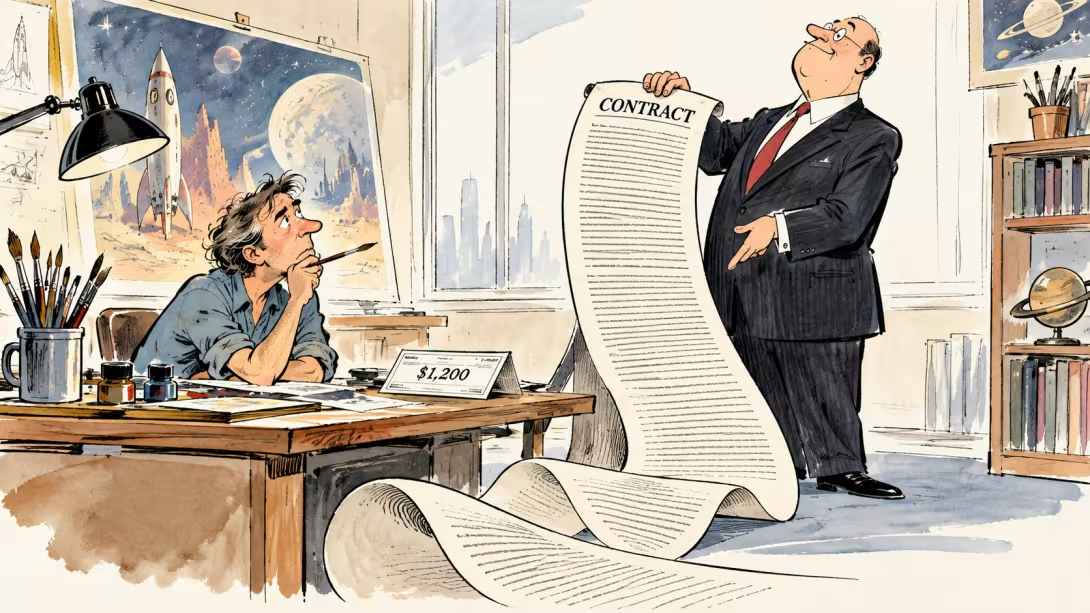
Giancola, a three-time Hugo Award winner whose work has appeared across science fiction, fantasy, and gaming, described being approached in January 2026 to create an Asimov's cover illustration based on a story scheduled for publication. The agreed commission was $1,200, an amount he said matched what he had been offered for comparable work six years earlier.
Although he considered the fee modest, Giancola accepted because of his longstanding relationship with the magazine and his commitment to the genre. He began preliminary work, including reading the manuscript, researching references, and developing concepts.
According to Giancola's public account reproduced by File 770, the agreement designated the illustration as work made for hire, a structure he said had not been required for his previous Asimov's commissions.
Under a qualifying work-made-for-hire arrangement, the commissioning party can be treated as the copyright author from the outset rather than merely receiving permission to publish an independently owned illustration.
Giancola said the proposed agreement required multiple rounds of sketch and finished-art revisions without additional compensation. It also restricted his ability to display the completed illustration in his portfolio, on his website, or through social media without permission.
Perhaps most controversially, he said the agreement required a nondisclosure commitment that could expose him to financial liability equivalent to his entire commission if its terms were violated.
What began as a relatively straightforward illustration assignment reportedly became a prolonged contractual negotiation. Giancola described five rounds of revisions over approximately three months, during which he proposed alternative language and even offered to negotiate a higher fee in exchange for the additional rights the publisher sought.
By the end of June, he had withdrawn from the project.
Picacio, meanwhile, faced a separate contract dispute involving an opportunity to illustrate the magazine's fiftieth-anniversary cover. A four-time Hugo Award winner with three decades of professional experience, he rejected terms that he said required him to surrender moral rights and waive copyright protections.
In his October 8 public statement on Bluesky, Picacio went beyond declining the assignment. He urged other writers and artists to reconsider accepting work from Must Read Magazines under its existing contractual conditions.
His concern was not simply whether an established professional could negotiate acceptable terms. It was what happened to less-experienced creators who might lack the reputation, resources, or confidence to challenge the agreement presented to them.
Both artists also made a distinction that could easily be lost in the controversy: their objections were directed at Must Read Magazines' contractual policies, not at the editors and art directors who had worked with them.
The dispute, then, was no longer about whether one illustrator should receive more than $1,200 for a magazine cover.
It had become a question of whether the contractual terms imposed by a publisher could undermine the very creative relationships that gave its publications their value.
The Publisher Responds
When two of science fiction's most respected illustrators publicly reject a publisher's contracts, the resulting controversy is difficult to dismiss as a disagreement over ordinary freelance terms. For Must Read Magazines, however, the dispute also raised a legitimate legal question: What happens when an artist creates an illustration based on a story whose copyright belongs to someone else?
On October 9, just one day after John Picacio and Donato Giancola made their objections public, Must Read publisher P. L. Stevens issued a statement addressing the company's approach to commissioning cover illustrations.
As reported by File 770, Stevens explained that Must Read had used work-for-hire agreements when illustrators were commissioned to adapt authors' original stories. The company's position was that the limited rights it acquired from fiction writers did not necessarily permit it to authorize an illustrator to retain unrestricted copyright in an adaptation of those stories.
The distinction is important. A magazine purchasing the right to publish a science fiction story does not automatically acquire ownership of the characters, settings, or fictional universe described within it. An illustration depicting those elements may qualify as a derivative work, creating additional questions about who can reproduce, license, or commercially exploit the resulting image.
A publisher therefore has a legitimate interest in ensuring that its illustration contracts do not inadvertently grant rights it does not possess.
Rather than continue commissioning story-specific illustrations under the disputed arrangements, Must Read announced that it would suspend that practice while developing an alternative. The company indicated that it could instead license existing artwork or commission original illustrations that were not adaptations of particular stories.
It also stated that licensing agreements for original artwork would no longer include moral-rights waivers.
Science fiction cover illustration has traditionally involved a close relationship between the written story and the image selected to represent it. An artist reads the manuscript, identifies its visual possibilities, and produces something intended to capture the imagination of potential readers. Replacing that process with the licensing of unrelated existing artwork may simplify the legal relationship, but it also changes the creative relationship between writer, illustrator, and publication.
On October 16, Must Read circulated another statement outlining what it characterized as revised procedures for commissioning covers and interior illustrations. The announcement described a move away from work-for-hire arrangements, toward artist copyright retention and the elimination of moral-rights waivers.
For observers who had followed the company's earlier disagreements with fiction writers, the announcement sounded familiar. Must Read had previously revised author contracts following criticism from professional organizations, including the Science Fiction and Fantasy Writers Association.
Those earlier changes were real. In her extensive examination of the company's contracts, Victoria Strauss of Writer Beware documented the removal of certain disputed provisions and improvements to rights-reversion language. She also found that individual authors continued to encounter variations in the contracts offered to them, sometimes requiring lengthy negotiations to obtain acceptable terms.
The distinction between changing a policy and changing the actual agreement offered to a creator would become central to Giancola's response.
On October 17, File 770 published Giancola's reaction. The artist acknowledged that retiring work-for-hire terms, retaining artist copyright, and eliminating moral-rights waivers sounded like progress.
Giancola argued that a statement describing a new procedure did not establish what legal obligations future illustrators would actually be asked to accept. He also observed that the work-for-hire designation in his original agreement appeared as a heading, leaving open the possibility that removing the terminology alone might not sufficiently alter the rights conveyed by the document.
More importantly, he said the publisher's announcements had failed to address the provision he found most objectionable: the separate confidentiality and nondisclosure agreement.
According to Giancola, the unsigned five-page contract included an exhibit containing confidentiality restrictions and a liquidated-damages provision potentially requiring him to surrender an amount equal to his commission for a violation.
He said the restrictions could apply to such ordinary professional activities as publicly identifying the art director involved in the assignment or discussing the project without authorization, even after publication.
The publisher's statements about copyright ownership and moral rights did not, in his view, resolve those separate concerns.
There is an important limitation to the available evidence. Giancola was describing the agreement he personally received and declined to sign. His statements do not establish that every Must Read contributor received identical provisions, nor do they prove that the same confidentiality terms remain in agreements being offered after the company's October announcements.
Nevertheless, his objection identifies a question the publisher's public assurances have not conclusively settled: What restrictions, if any, will remain on an illustrator's ability to discuss, exhibit, or promote commissioned work?
Not everyone following the controversy agrees that the artists' objections justify a broader rejection of Must Read Magazines.
In an October 20 commentary published by Fandom Pulse, the dispute was characterized as an example of ordinary publishing negotiations being elevated into an unnecessary boycott campaign. The commentary emphasized that Must Read had repeatedly revised its contracts and argued that the publisher's willingness to negotiate deserved greater consideration.
That position introduces a reasonable counterargument. Contracts are proposals until accepted, and negotiation is an established part of professional publishing. A creator who dislikes an agreement can request changes, propose alternative terms, or decline the assignment. The existence of a disputed provision does not, by itself, establish that a publisher has violated the law or that every resulting agreement is unfair.
Negotiation presumes that both parties possess sufficient knowledge and bargaining power to recognize unfavorable terms and challenge them. An illustrator with multiple Hugo Awards and decades of industry experience may be able to walk away from a prestigious assignment. An emerging artist seeking a first major magazine cover may not feel equally free to do so.
That imbalance is particularly significant when the same disputed provisions appear in a publisher's standard agreement rather than being introduced as individually negotiated exceptions.
The Science Fiction and Fantasy Writers Association has also returned to the controversy. In an update reported by File 770, SFWA president Kate Ristau emphasized that the organization had already worked with Must Read on contract concerns and urged the company to apply the lessons of those discussions consistently across its creative agreements.
The organization encouraged creators to examine their contracts carefully and seek guidance from professional associations with expertise in their particular fields.
For Must Read Magazines, the immediate controversy may eventually be resolved through revised agreements that both publisher and illustrators find acceptable. Its public statements indicate a willingness to reconsider the original approach, and that willingness should not be ignored.
The measure of a publisher's contract policy is not simply what its representatives say they intend to offer. It is what the document placed before the next freelancer actually requires that person to surrender.
And that leads to a larger question, one extending well beyond the covers of science fiction magazines: When creators are offered the opportunity to contribute to an established publication, how much of their independence should they be expected to trade for the privilege?
The Price of Getting Published
There is a fundamental difference between granting a publisher the rights necessary to publish a creative work and surrendering ownership of that work entirely. It is a distinction that can disappear beneath pages of contractual language, particularly when the person signing the agreement is more concerned with securing an opportunity than anticipating every possible consequence.
Copyright law already provides mechanisms through which publishers and creators can establish the permissions required for publication without transferring ownership. A magazine can license an illustration for a particular issue, obtain permission to reproduce it in advertising and promotional materials, and negotiate additional uses as circumstances require.
None of those arrangements automatically demands that the publisher become the copyright owner.
Under United States copyright law, a qualifying work made for hire is legally treated as having been authored by the employer or commissioning party. For specially commissioned independent-contractor work, however, the designation is not something a publisher can establish merely by placing those words at the top of a contract. The work must fall within one of the statutory categories, and the parties must expressly agree in a signed written instrument that it is a work made for hire.
A commissioned illustration may qualify under certain circumstances, but the legal analysis depends on the nature of the assignment and the applicable statutory requirements. A contractual label alone does not settle the question.
Nor is copyright ownership the same thing as ownership of the underlying fictional property.
An illustrator creating a depiction of a character from a science fiction story does not thereby acquire the right to publish unauthorized sequels, license that character for merchandise, or exploit the writer's fictional universe independently. Those underlying rights remain subject to the original copyright owner's interests.
At the same time, the existence of an underlying copyright does not necessarily mean the illustrator must surrender every copyright interest in the new artistic expression contributed to the finished image.
The parties can negotiate a license that respects both interests.
Moral rights add another layer of complexity. In the United States, protections under the Visual Artists Rights Act are narrower than the broad moral-rights protections available in some other countries. They generally concern certain qualifying works of visual art and address matters such as attribution and the prevention of specified prejudicial alterations.
Whether a particular magazine illustration qualifies for those protections depends on the statutory definition and the circumstances of its creation and use. Nevertheless, a publisher's request for a broad moral-rights waiver can reasonably prompt an artist to ask what future alterations or uses the publisher anticipates.
That is not an accusation of improper intent. It is precisely the sort of question a contract should answer.
The same principle applies to confidentiality agreements.
Publishers have legitimate reasons to protect unpublished manuscripts, editorial schedules, confidential business information, and announcements that have not yet been made public. An artist commissioned to illustrate a forthcoming story may learn details that the publisher and author reasonably expect to remain private until publication.
But confidentiality provisions should be distinguishable from restrictions on ordinary professional activity after the material has been released.
An illustrator's portfolio is not merely a collection of attractive images. It is evidence of professional experience, a means of obtaining future assignments, and often a significant component of the artist's livelihood. Restrictions that prevent a creator from displaying completed work, identifying published credits, or discussing an assignment can carry consequences extending well beyond the value of the original commission.
Those restrictions may be negotiable. They may also be commercially reasonable in particular circumstances. What matters is their scope, duration, and relationship to the legitimate interests being protected.
This is where the Must Read Magazines controversy becomes more important than a disagreement over one illustration.
John Picacio and Donato Giancola possess professional standing that allows them to question contract language publicly. They have extensive portfolios, established reputations, and the ability to decline assignments without necessarily jeopardizing their careers.
A newcomer receiving an offer from Asimov's Science Fiction might see the same opportunity very differently.
For an emerging artist, the prospect of a cover credit on a magazine with that history could appear career-defining. The artist may be unfamiliar with work-for-hire law, uncertain about the consequences of an intellectual-property assignment, or reluctant to risk losing the commission by requesting changes.
The contractual terms are no less consequential simply because the person signing does not fully understand them.
Professional organizations have long attempted to address this problem by establishing model agreements and educating creators about the rights they can reasonably expect to retain. The Science Fiction and Fantasy Writers Association's model magazine contract, although directed toward written fiction rather than illustration, demonstrates how publication rights can be defined by scope, duration, exclusivity, and permitted uses without automatically requiring wholesale copyright transfers.
Illustrators have their own professional practices and contractual considerations, but the underlying principle is similar: a publishing agreement should identify the rights actually needed to accomplish the intended publication.
Publishing depends on relationships with creators who can produce material readers want to experience. A publisher benefits when those relationships are durable, when contributors understand their agreements, and when both parties can plan future uses without uncertainty.
An excessively broad agreement may appear to protect the publisher against hypothetical disputes, yet it can also discourage experienced contributors from accepting assignments. Conversely, an agreement that fails to secure necessary permissions can expose the publisher to genuine legal and commercial difficulties.
The objective should not be to eliminate negotiation or to presume that every request for additional rights is unreasonable. It should be to establish a clear, defensible starting point that recognizes the legitimate interests of both parties.
Must Read Magazines has publicly indicated that it is revising its approach to illustration contracts. That is a development worth acknowledging. If the resulting agreements provide artists with appropriate ownership, publication permissions, portfolio rights, and narrowly defined confidentiality obligations, the controversy may ultimately produce a healthier framework for future commissions.
But the company's announced intentions and the language of its current contracts are not necessarily the same thing. Without examining those revised agreements, it would be premature either to declare the dispute resolved or to assume that every objection remains valid.
The larger lesson is one that applies across publishing, from venerable science fiction magazines to the smallest independent comic-book imprint.
Creators should understand what they are signing. Publishers should understand what they genuinely need. And neither party should confuse the prestige of a publication with the value of the rights being exchanged.
A magazine cover may be worth $1,200. The opportunity to illustrate one may be worth considerably more to an artist building a career.
But the rights attached to that illustration can endure long after the check has cleared, the magazine has left the newsstand, and the assignment has become another line in a portfolio.
And perhaps the most revealing test of any publishing agreement is not whether a four-time Hugo Award winner can negotiate acceptable terms.
It is whether an unknown artist, receiving that first important offer, can sign the standard contract without sacrificing rights they never realized they were giving away.