
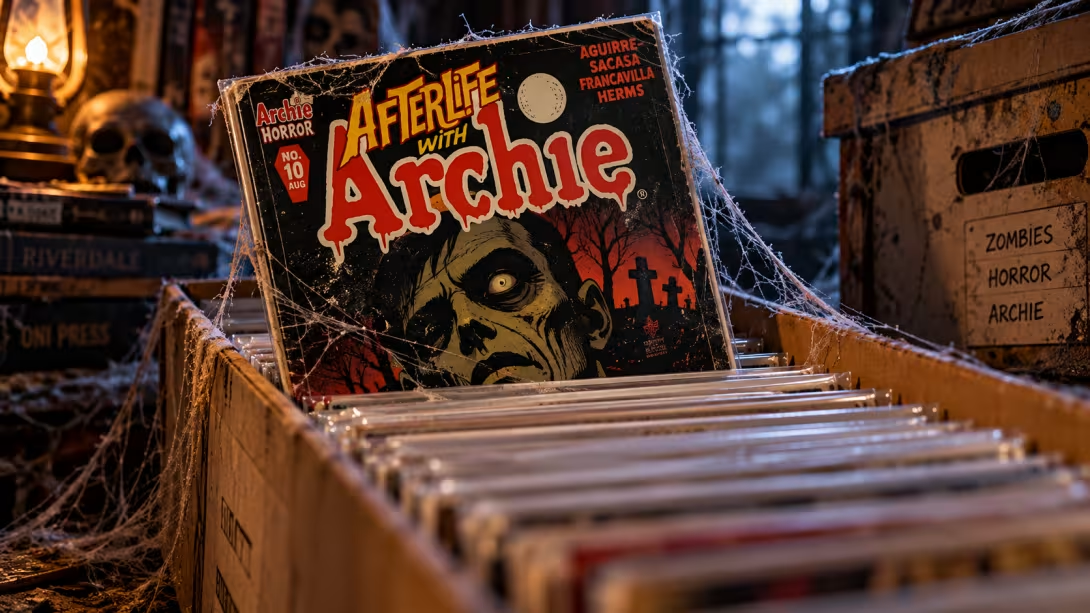
The Longbox Morgue, File #001: Afterlife with Archie
Every comic book begins with a promise. Turn the page. Follow the adventure. Come back next month. In return, we'll tell you a story. And when it's over, we'll give you an ending.
Most do.
Some don't.
Some stories are buried before the final page.
Welcome to The Longbox Morgue.
The Crime That Killed Riverdale
There are certain things readers have always been able to count on in Riverdale. Archie Andrews will never make up his mind between Betty Cooper and Veronica Lodge. Jughead Jones will never turn down a hamburger. Reggie Mantle will never pass up an opportunity to make somebody else's life miserable. And no matter how complicated things get, everybody will be back at Pop's Chock'lit Shoppe next month, ready to do it all again.
That last part is especially important. Archie Comics has spent generations rearranging the same teenage romantic entanglements, and readers have happily gone along with it. Riverdale is a place where time stands still, consequences are temporary, and the worst thing that can happen to somebody usually involves getting caught dating two girls on the same night.
In 2013, writer Roberto Aguirre-Sacasa and artist Francesco Francavilla decided to see what would happen if consequences became permanent. The result was Afterlife with Archie, a horror series that took the familiar inhabitants of Riverdale and subjected them to the George Romero treatment. People died. Friends turned on friends. Families were torn apart, sometimes literally. And the comfortable little town that had survived decades of romantic misunderstandings couldn't survive a single Halloween.
The premise sounded like the sort of novelty comic that might be amusing for an issue or two. Zombies in Riverdale! Jughead eating brains instead of hamburgers! Archie trying to decide which girl to rescue first! There was certainly room for that kind of parody, but Aguirre-Sacasa and Francavilla had something considerably more ambitious in mind.
They played it straight. Francavilla's artwork, drenched in shadow and autumnal colors, transformed Riverdale into a place that looked as though it had been waiting for something terrible to happen. Aguirre-Sacasa, meanwhile, understood that the horror would only work if the characters remained recognizable. Archie was still Archie, Betty was still Betty, and Reggie was still the sort of fellow who could turn a bad day into somebody else's tragedy.
Which brings us to Hot Dog.
One Dead Dog, One Dead Town
The apocalypse began with an automobile accident. At least, that's what everybody believed.
Jughead's beloved dog, Hot Dog, was struck and killed by a car driven by Reggie Mantle. Distraught, Jughead took his pet to Sabrina Spellman, hoping that Riverdale's resident teenage witch might know a way to bring him back. Sabrina did know a way, although it involved forbidden magic and the sort of warnings that characters in horror stories are traditionally expected to ignore.
Hot Dog returned from the grave, but the creature that came back wasn't quite the dog Jughead remembered. He bit his owner, passing along a supernatural infection that transformed Jughead into one of the walking dead. By the time the Halloween festivities were underway, the contagion was spreading through Riverdale, and the town's population was rapidly becoming its own worst enemy.
The first five issues, collected as Escape from Riverdale, established the catastrophe and followed the survivors as they tried to get away from a hometown that had become a slaughterhouse. It was a remarkably effective reinvention of characters who had spent most of their publishing history worrying about homework, football games, and who would accompany Archie to the next dance.
The really nasty twist, however, was something readers wouldn't fully appreciate until much later. Reggie hadn't accidentally hit Hot Dog. He'd done it deliberately.
And the reason was every bit as petty as one might expect from Reggie Mantle.
The Trouble with Reggie
By the time Afterlife with Archie reached issue #9, the surviving characters had escaped Riverdale, but they hadn't escaped the consequences of what happened there. Reggie, in particular, was coming apart under the weight of a secret that had been eating at him since the first issue.
In “The Trouble with Reggie,” published June 1, 2016, Aguirre-Sacasa finally revealed the truth behind Hot Dog's death. Reggie confessed to Kevin Keller that he had intentionally run down Jughead's dog after taking out his frustration over Midge Klump on an innocent animal.
Consider that for a moment. The destruction of Riverdale, the deaths of countless people, and the collapse of everything these characters had known could all be traced to one teenager throwing a tantrum because he couldn't have the girl he wanted.
A mysterious virus would have been easier to forgive. Reggie hadn't meant to end the world. He'd simply wanted to hurt something, and the world ended as a consequence.
His confession didn't bring him any relief. Believing himself beyond forgiveness, Reggie abandoned the survivors and went looking for the zombie horde, intending to surrender himself to the creatures whose existence he had made possible. He expected to be torn apart, which would have been a fitting conclusion to his story if Afterlife with Archie had been interested in letting him off that easily.
Instead, the zombies parted to let him through. Waiting for him were the undead Jughead and Hot Dog, along with Sabrina Spellman, whose dabbling in forbidden magic had long since taken her somewhere considerably darker than the Spellman household.
Sabrina had an offer. Reggie could have Midge back. Not the undead creature she had become, but the girl he wanted, restored to life. There was, naturally, a condition. Reggie would have to return to the survivors, regain their trust, and murder Betty Cooper.
For a character whose selfishness had already destroyed Riverdale, the bargain was an opportunity to demonstrate whether he had learned anything from the catastrophe he'd caused. He could refuse, accept responsibility for his actions, and perhaps begin the difficult business of becoming a better person.
Or he could kill Betty and get the girl. Reggie made his choice. “Kill Betty Cooper. No problem.”
A Cliffhanger Worth Waiting For
I was reading Afterlife with Archie when these issues were originally published, and I wasn't shy about my enthusiasm. In my May 27, 2016 review of issue #9, I welcomed the book's return after another lengthy absence. The delays were already becoming part of the experience, but the quality of the storytelling made each new installment feel worth the aggravation.
Apparently, I wasn't alone. Archie Comics announced a second printing of issue #9 after the first printing sold out at the distributor level. There were still readers willing to follow this increasingly irregular series, particularly when it delivered an installment as consequential as Reggie's confession.
And what an installment it was. Reggie Mantle, the perpetual troublemaker who had spent decades trying to steal somebody else's girlfriend, had been given an opportunity to commit an actual murder. His intended victim was Betty Cooper, one of the most recognizable characters in American comics, and his employer was a corrupted Sabrina Spellman acting on behalf of forces that had already demonstrated their ability to destroy an entire town.
The second story arc was titled Betty: R.I.P., so the possibility that Archie Comics might actually kill Betty was hardly being kept a secret. The question was whether Reggie would carry out his assignment, whether Archie and the others would discover the plot, and what further horrors might be waiting for the survivors.
Readers had every reason to expect those questions would be answered in the next few issues. What they got instead was a story about Josie and the Pussycats. And after that, nothing.
The Wedding That Never Happened
There is nothing inherently wrong with taking a break from the main storyline to explore a supporting character. Comic books have been doing it for generations, sometimes with results that prove more interesting than whatever was happening in the regular title. And when your supporting characters include Josie and the Pussycats, there are certainly worse ways to spend an issue.
But timing is everything. Afterlife with Archie #9 had ended with Reggie Mantle agreeing to murder Betty Cooper in exchange for the resurrection of Midge Klump. The second story arc was called Betty: R.I.P., and readers had just been handed a particularly nasty explanation for why that title might prove prophetic. With Reggie preparing to return to the survivors as a potential assassin, the natural expectation was that the next installment would follow him back into their midst.
Instead, issue #10, published August 31, 2016, turned its attention to three young women with musical ambitions and an unusually complicated history.
Josie and the Vampires
Titled Interlude with the Pussycats, the tenth issue revealed that Josie McCoy and her bandmates were vampires. Not metaphorical vampires, not performers adopting a fashionable gothic image, but actual creatures of the night whose supernatural existence stretched back far beyond their apparent ages.
The story explored Josie's history and the circumstances that led to the formation of the Pussycats, folding another familiar Archie property into the horror universe Aguirre-Sacasa and Francavilla had created. It was an intriguing expansion of that world, demonstrating that the zombie outbreak wasn't necessarily the first supernatural catastrophe to trouble its inhabitants.
In another publishing environment, the interlude might have been welcomed as an entertaining diversion. Readers could enjoy the vampire story, appreciate the larger mythology taking shape, and return the following month to discover what Reggie intended to do about Betty.
Unfortunately, Afterlife with Archie had already established that a month between installments was more of an aspiration than a reliable publishing schedule. The first issue had appeared in October 2013. Nearly three years later, the series had managed to produce only ten issues. Readers were accustomed to waiting, but there was still a reasonable expectation that the story would eventually continue.
Issue #10 ended up being the last one published. Here's the distinction that matters. The final published installment of Afterlife with Archie wasn't the final installment of its principal storyline. Reggie's bargain remained unresolved, the survivors' fate remained uncertain, and the ominously titled Betty: R.I.P. had not reached its conclusion.
The Pussycats had taken the stage, and the curtain never went back up on Archie and his friends.
Save the Date
Here's where the case becomes especially frustrating. We don't have to guess whether Archie Comics intended to continue the story. The publisher had already announced the next installment, complete with a cover, credits, and a description of what readers could expect.
According to Archie Comics' October 2016 solicitations, Afterlife with Archie #11 would feature a wedding.
Not just any wedding. Archie Andrews and Betty Cooper were getting married. For readers familiar with the traditional Archie universe, that announcement alone was enough to attract attention. The Betty-Veronica-Archie triangle had been one of the publisher's defining attractions for decades, with Archie's inability to make a lasting choice providing an inexhaustible supply of romantic complications.
But this wasn't the traditional Archie universe. This was a world in which Jughead had become a zombie, Riverdale had fallen to the undead, and Reggie Mantle had accepted an assignment to murder the bride.
The solicitation promised that Veronica Lodge would threaten to disrupt the proceedings, which might have sounded like an ordinary Archie wedding complication under different circumstances. It also indicated that Reggie would arrive at the reception bearing a particularly sinister gift.
Suddenly, the familiar romantic rivalry didn't seem nearly as important as the possibility that the wedding guests might include a murderer working for the forces responsible for the apocalypse.
Remember where we left Reggie. He had confessed to killing Hot Dog, accepted responsibility for the outbreak, and then surrendered himself to the undead. Sabrina offered him Midge in exchange for Betty's death, and he agreed without hesitation.
Now Archie Comics was advertising a story in which Betty would marry Archie, and Reggie would appear at the celebration with something unpleasant in store.
You didn't need a detective's badge to suspect that those developments were connected.
What we cannot say is exactly how the scene would have played out. The solicitation establishes the intended wedding and Reggie's involvement, but it doesn't reveal whether the ceremony would be completed, whether Betty would discover the plot, or whether Reggie would actually attempt to fulfill his bargain.
A wedding announcement is not a marriage certificate. And in a horror comic, it's certainly no guarantee that everybody will survive the reception.
And Then Came the Funerals
If the description for issue #11 sounded ominous, the December 2016 solicitation for issue #12 offered little reassurance.
That issue was advertised as the conclusion of Betty: R.I.P., the second major story arc. Rather than celebrating a honeymoon, Archie would be dealing with multiple funerals. The description also promised that he would face two exceptionally difficult decisions.
A wedding followed by funerals. A would-be assassin with a supernatural employer. A story arc named after Betty Cooper's apparent demise.
The implications practically write themselves, which is precisely why we need to resist writing them.
It is tempting to conclude that Reggie successfully murdered Betty, that his promised reward was delivered, and that Archie was left to bury his bride. It would certainly be consistent with the information Archie Comics had released. But consistency isn't confirmation, and the unpublished issue cannot be treated as though we've read it.
We don't know who was supposed to die. We don't know whether Betty's name in the arc title referred to her literal death, a deception, a near-death experience, or some other development. We don't know what decisions Archie would have faced, or whether either would have involved Reggie, Sabrina, or the surviving members of his extended family.
We know only what the publisher told retailers and readers to expect. And that was more than enough to make the missing issues hurt.
The Difference Between a Cliffhanger and an Abandonment
Cliffhangers are part of the language of serialized storytelling. A writer puts a character in jeopardy, closes the issue, and leaves readers eager to discover what happens next. It's a perfectly respectable arrangement, provided there's eventually a next issue.
A cliffhanger becomes something else when the promised continuation never arrives. Afterlife with Archie didn't stop because the characters had reached a natural resting place. It didn't conclude with the survivors finding sanctuary, defeating the undead, or accepting that the world they remembered was gone. It didn't even finish its second story arc.
Instead, the last main-story installment ended with Reggie agreeing to kill Betty. The publisher then advertised a wedding and multiple funerals, published an unrelated vampire interlude, and left the entire sequence unresolved.
There's another wrinkle. Issue #12 was intended to conclude Betty: R.I.P., not necessarily Afterlife with Archie itself. Even if both missing issues had appeared on schedule, readers might have received the resolution of Reggie's assassination plot without receiving a conclusion to the larger zombie apocalypse.
The comic had already established a world with enough surviving characters, supernatural threats, and unresolved relationships to sustain considerably more storytelling. The Josie interlude suggested that its creators were interested in expanding that world rather than bringing it to an immediate close.
Which makes the disappearance all the more disappointing. Readers weren't simply denied the ending of a comic book. They were denied the continuation of a universe that seemed to be growing more ambitious with every installment.
And the most maddening part is that, for a brief period in 2016, Archie Comics had already told us what was coming.
There would be a wedding. There would be funerals. And somewhere between those two events, Reggie Mantle was supposed to make good on his promise to Sabrina Spellman.
Ten years later, we're still waiting to see whether he did.
Ten Years in the Morgue
The Trouble with Waiting
By the time Afterlife with Archie disappeared in 2016, readers had already learned not to expect a new issue simply because one appeared on the publisher's schedule. Roberto Aguirre-Sacasa and Francesco Francavilla had launched the series in October 2013, and nearly three years later, they had produced ten issues. That's an average of roughly one installment every three and a half months, although the actual gaps varied considerably.
This was especially frustrating because the comic was so good. Afterlife with Archie wasn't a disposable Halloween gimmick that had somehow survived beyond its expiration date. It was an ambitious horror series featuring some of the most recognizable characters in American comics, written with genuine affection for their history and illustrated with the sort of atmosphere that made every shadow look suspicious. Francavilla's artwork was a major part of the attraction, and the prospect of replacing him merely to accelerate production would have sacrificed much of what made the book special.
But readers can appreciate the demands of quality storytelling while still wondering when they're going to get the next chapter.
By May 2016, when I reviewed issue #9 for Critical Blast, the delays were already an established concern. I was delighted to see the series return, but I was also aware that every prolonged absence raised the possibility that it might not come back at all. The issue earned an enthusiastic recommendation because the storytelling deserved it, not because its publishing schedule inspired confidence.
Three months later, issue #10 arrived with the Josie and the Pussycats vampire story. Issues #11 and #12 appeared in the publisher's advance solicitations, promising to resume the principal storyline and conclude Betty: R.I.P.
Neither was published. There was no dramatic final issue announcing the end. No hastily assembled conclusion explaining what happened to Archie and his friends. No farewell from the creators telling readers that the experiment had run its course.
The comic simply stopped appearing.
Cancelled, or Just Missing?
There's a distinction between a cancelled comic and one that has fallen into publishing limbo. A cancellation is a decision. An indefinite delay is a condition, and one that can theoretically continue forever.
For Afterlife with Archie, the observable facts are straightforward: issue #10 was published on August 31, 2016; subsequent issues were solicited but never released; and the second story arc remains unfinished.
Determining precisely why that happened is considerably more difficult. Aguirre-Sacasa's responsibilities expanded dramatically during the period when the comic was struggling to maintain its schedule. He developed Riverdale for television, with the series premiering in January 2017, and later served as the creative force behind Chilling Adventures of Sabrina. Both productions drew on the darker reinterpretations of Archie characters that had helped distinguish the publisher's horror line.
Those professional commitments provide useful context, but they shouldn't be mistaken for a definitive explanation. A writer's demanding television schedule may contribute to delays without being the sole reason a comic stops appearing. Likewise, the time required to produce Francavilla's elaborate artwork tells us something about the challenges of maintaining a regular schedule, but it doesn't establish that the artist caused the interruption.
The missing piece is a clear, documented account from the people responsible explaining why the solicited issues were never completed and published.
Without that, assigning blame would be speculation dressed up as investigation. What we can say is that the creative team moved on to other work while Afterlife with Archie remained unfinished. The property continued to exist, the published issues remained available in collected editions, and the unanswered questions accumulated another year of dust every time the calendar turned over.
The Dead May Yet Walk
There have been encouraging signs that the creators haven't forgotten the series. In October 2025, Aguirre-Sacasa reportedly discussed plans to resume Afterlife with Archie, indicating that scripts for issues #11 and #12 existed, that issue #13 was being plotted, and that Francavilla was working on artwork.
That's considerably more substantial than a vague expression of interest in revisiting the characters someday. Scripts suggest that the story has progressed beyond the original solicitations, and the mention of a thirteenth issue reinforces something we've already established: Betty: R.I.P. was intended to conclude a story arc, not necessarily the entire series.
A script, however, isn't a comic on the stands.
As of this writing, October 29, 2026, readers still have only ten published issues. Meanwhile, Afterlife with Archie is receiving more attention than it has enjoyed in years. Disney+ has ordered a live-action adaptation, with Aguirre-Sacasa returning to develop the property for television. The project is targeting Halloween 2027, potentially introducing an entirely new audience to the idea of Archie Andrews struggling to survive a zombie apocalypse.
Oni Press has also joined forces with Archie Comics to produce the Afterlife with Archie: Mausoleum Edition, an oversized hardcover presentation of Francavilla's artwork. Its Kickstarter campaign launched October 29, 2026, offering readers another opportunity to revisit the comic's earliest chapters.
And the publisher's promotional material contains a particularly intriguing tease: Afterlife with Archie isn't quite dead yet, with further news concerning the series' fate promised for 2027.
That could mean new issues. It could mean additional collected editions, announcements connected to the television adaptation, or something else entirely. Until the publisher provides details, it would be premature to declare the original comic resurrected.
Still, after ten years of silence, even the suggestion that there's news to come is enough to make longtime readers pay attention.
An Ending Is Not Too Much to Ask
There's an argument that some unfinished stories are better left alone. Readers can imagine their own conclusions, preserving the characters and possibilities without risking disappointment from an ending that fails to satisfy everyone.
That argument has never held much appeal for me. A story that ends ambiguously is one thing. A story that stops in the middle because the next installment never appears is something else entirely. Afterlife with Archie didn't invite readers to contemplate an intentionally uncertain conclusion. It promised them a continuation.
Reggie Mantle agreed to murder Betty Cooper. Archie Comics advertised a wedding at which Reggie would arrive with a sinister gift. The following issue was supposed to bring multiple funerals and two terrible decisions for Archie Andrews.
Those weren't loose threads left dangling after a completed narrative. They were the advertised events of comics that readers never received.
And perhaps the most irritating aspect of the whole business is that the creators had already demonstrated their willingness to take these characters somewhere genuinely dangerous. Nobody was guaranteed survival simply because their name had appeared on comic-book covers for decades. The stakes were real, the consequences were permanent, and the outcome was impossible to predict with confidence.
Did Reggie attempt to kill Betty? Did he succeed? Was Sabrina telling the truth about bringing Midge back, or was she manipulating the man whose cruelty had helped destroy Riverdale? Who was supposed to be buried after the wedding, and what decisions would Archie have faced?
We can construct theories from the solicitations. We can examine the clues in the published issues. We can even take some comfort from the possibility that the missing chapters have already been scripted.
But we cannot answer those questions until somebody publishes the story. The television adaptation and new hardcovers show that publishers still see an audience for Afterlife with Archie. That's encouraging for the property and its creators, but it also makes the unfinished comic increasingly difficult to overlook. If the world is ready to welcome Archie and his undead neighbors back into the spotlight, surely there's room to finish the story that made their return possible.
For now, the case remains open. Somewhere in the pages of a comic book that was supposed to arrive in October 2016, Betty Cooper is preparing to marry Archie Andrews. Reggie Mantle is coming to the wedding with a gift nobody should want to open. And somewhere beyond that reception, several graves are waiting to be filled.
We've been waiting ten years to find out whose names are on the headstones.
CASE STATUS: OPEN — CONTINUATION UNPUBLISHED.