
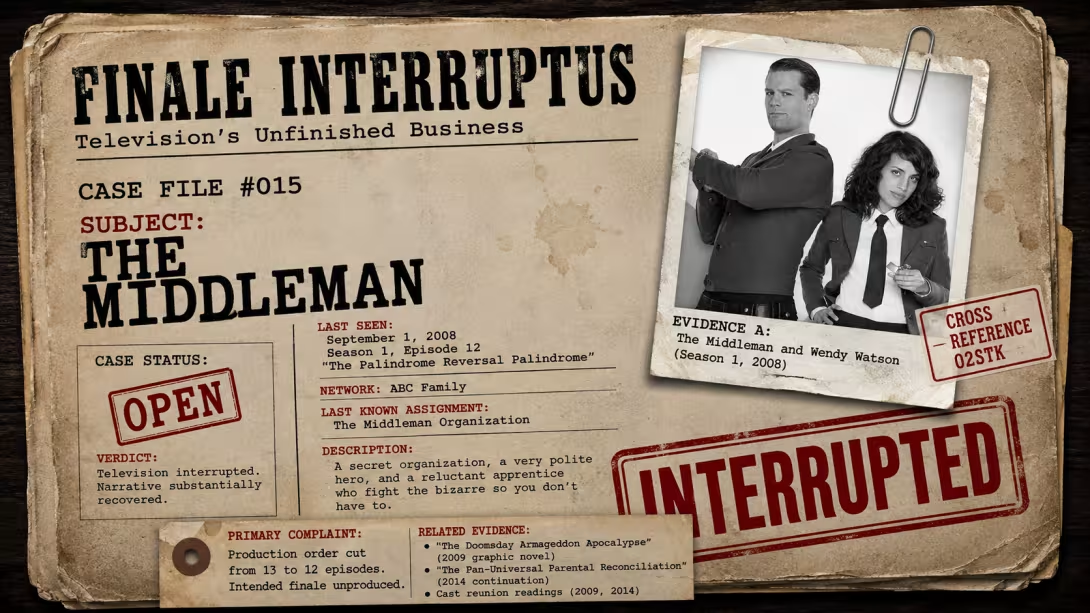
Finale Interruptus: Case File #015 - The Middleman
The Man Who Fought Evil So You Didn't Have To
Every television series begins with a promise. A premise is introduced, characters are established, and an audience is invited to invest its time in a story that will unfold over weeks, months, and perhaps years. The understanding is rarely spoken aloud, but it is there nonetheless: follow these people, care about their struggles, and eventually discover where their journeys lead.
Most television series honor that agreement, even when the ending arrives earlier than their creators intended. Others are denied the opportunity, disappearing between seasons or vanishing from the schedule before their stories have reached anything resembling a conclusion.
Some leave behind unanswered questions that can never be resolved. Others find their creators attempting to finish the story through interviews, novels, reunions, or other forms of storytelling.
And occasionally, a series finds its way back to the medium that gave it life in the first place.
This is one of those cases.
A Superhero Who Didn't Need a Cape
There are television programs that become difficult to explain because their mythology grows too complicated. Then there are programs that are difficult to explain because the explanation makes them sound considerably stranger than they actually are. The Middleman belongs firmly in the second category.
Imagine a world where alien invasions, mad scientists, genetically engineered monsters, supernatural conspiracies, and assorted threats to human civilization are not merely possible but recurring occupational hazards. Now imagine that nearly every one of those emergencies is quietly resolved by an impeccably dressed man who speaks as though he has wandered out of a wholesome 1950s adventure serial.
He does not swear. He does not drink. He does not smoke. He possesses an encyclopedic command of obscure information, maintains an almost aggressively cheerful disposition, and approaches the most ridiculous circumstances with the absolute confidence of someone who has never considered the possibility that the universe might be unreasonable. He is known simply as the Middleman. His job is to fight evil so that ordinary people do not have to know it exists.
Working alongside him is Wendy Watson, a young artist whose ambitions do not include saving civilization from bizarre threats. Wendy is sarcastic, observant, resourceful, and considerably less inclined to accept absurdity without comment. Where the Middleman approaches danger with unwavering professionalism, Wendy tends to respond the way an intelligent person might reasonably respond upon discovering that the world is considerably more ridiculous than advertised.
Their partnership supplies the central comic tension. The Middleman treats every impossible development as another day at the office, while Wendy remains fully aware that none of this should qualify as normal.
It is a familiar arrangement in adventure fiction: the experienced mentor and the inexperienced recruit, the seasoned professional and the skeptical newcomer. What distinguishes The Middleman is the cheerful determination with which it refuses to take its own absurdity seriously while simultaneously insisting that its characters take their responsibilities very seriously indeed. The threats may be ridiculous. The consequences are not.
That combination would become the show's defining characteristic, but its origins predated the television series by several years.
A Television Idea That Became a Comic Book
The history of The Middleman begins with an unusual reversal of the conventional adaptation process.
Most comic-book television adaptations begin with a published property that attracts the attention of producers looking for recognizable characters and an established audience. The Middleman followed a different path. Its creator, Javier Grillo-Marxuach, originally developed the concept for television, only to see it reach the public first through comic books.
Grillo-Marxuach was already an experienced television writer and producer whose credits included genre productions such as Charmed and Lost. He understood both the possibilities and limitations of serialized television, particularly when ambitious ideas collided with the practical realities of network development.
The Middleman was an opportunity to build something that combined his enthusiasm for science fiction, superhero adventure, espionage, and absurdist comedy without surrendering to the increasingly fashionable assumption that genre storytelling had to be dark, cynical, or emotionally punishing.
The concept was playful without being careless. Its humor depended on the audience recognizing the conventions being celebrated and gently dismantled, while its underlying dramatic structure remained surprisingly traditional.
When the television version failed to materialize immediately, Grillo-Marxuach pursued the idea through comics.
Working with artist Les McClaine, he brought The Middleman to Viper Comics, where the property debuted in 2005. The published comic established the characters, the secretive organization behind the Middleman's work, and the peculiar balance of extraordinary danger and everyday personal complications that would later characterize the television adaptation.
This is an essential distinction for our investigation. The television series was not the original public incarnation of The Middleman, even though television had been its intended destination. By the time ABC Family introduced the characters to viewers in 2008, they already possessed a history in another medium.
The comics were not merchandise produced to capitalize on a television program. They were an independent realization of the underlying concept, and their existence would eventually provide the canceled television series with an unusually appropriate escape route.
When television could no longer accommodate the Middleman's adventures, the characters would return to the printed page. That return, however, would prove more complicated than simply continuing the original comic.
The Long Road Back to Television
The comic-book incarnation of The Middleman was not simply a way to keep an abandoned idea alive. It also demonstrated that the premise could sustain an audience's attention, even if that audience was initially much smaller than the one a television network hoped to attract.
In a 2006 interview with Ain't It Cool News, Grillo-Marxuach explained that he had written the original television pilot around 1997–1998. He credited fellow writer Paul Dini, whose work included Batman: The Animated Series, with encouraging him to pursue the comic-book version. Dini helped guide the project into print, and Grillo-Marxuach subsequently described him as an important figure in the property's development.
That history adds another layer to the familiar story of a comic book becoming a television show. The Middleman was not an established superhero franchise being adapted by producers who had discovered its commercial potential. It was a television writer's long-delayed original project, transformed into comics with the assistance of creators who understood that medium, and eventually given another opportunity to become the program its creator had imagined.
The journey also shaped the material. In a 2008 interview with FanBolt, Grillo-Marxuach explained that the earliest comic stories were closely based on his television scripts. Les McClaine's artwork brought those ideas to life on the page, while the eventual television production introduced new collaborators, performances, and creative decisions that expanded the characters beyond their printed counterparts.
By the time ABC Family committed to the series, the Middleman had already lived several creative lives. The project had existed as an unproduced television script, a published comic-book property, and a prospective television adaptation whose characters were familiar to their creator but still unknown to most viewers.
The next challenge was finding actors who could make the peculiar dialogue and improbable situations believable.
Finding the Middleman and Wendy Watson
Matt Keeslar was cast as the Middleman, bringing an earnestness to the role that allowed the character's exaggerated wholesomeness to function as something more than a recurring joke. His performance depended on treating the most extraordinary circumstances as matters requiring professionalism, courtesy, and an appropriate application of force.
Grillo-Marxuach had Keeslar in mind well before the casting process was completed. In his 2008 discussion of the show's development, he recalled being impressed by the actor's performance in The Last Days of Disco and repeatedly suggesting him as the appropriate choice.
Natalie Morales was selected to play Wendy Watson, the young artist whose encounter with the Middleman's organization transforms her life. Wendy is neither a conventional superhero nor a helpless observer dragged unwillingly through fantastic events. She possesses the intelligence and composure necessary to survive in the Middleman's world, even as she remains skeptical of its elaborate rules and improbable inhabitants.
The television adaptation also changed Wendy's background. Grillo-Marxuach acknowledged that ABC Family suggested making the character Latina, a decision he embraced. The adjustment helped distinguish the television Wendy from her comic-book counterpart while preserving the character's fundamental personality.
Supporting the two leads was Mary Pat Gleason as Ida, the organization's formidable administrative presence. Ida appears to be an ordinary older woman but is actually an android, providing the series with another opportunity to contrast mundane workplace routines against an environment where nothing is quite what it appears to be.
Wendy's personal life supplied an equally important counterweight. Her roommate Lacey Thornfield, played by Brit Morgan, and her friend Noser, played by Jake Smollett, helped establish a world outside the secret organization's headquarters. Their presence meant that Wendy's recruitment did not erase her previous existence; instead, it forced her to maintain two lives whose demands were increasingly difficult to reconcile.
That balance was essential. Without Wendy's friends, ambitions, and ordinary frustrations, the series risked becoming a procession of increasingly bizarre monsters and elaborate jokes. With them, the adventures acquired personal consequences, and Wendy's choices became something more substantial than decisions about which villain needed to be defeated.
A World Where the Impossible Was Routine
The Middleman premiered on ABC Family on June 16, 2008, with an episode titled “The Pilot Episode Sanction.” Wendy's temporary employment at a laboratory exposes her to a scientific catastrophe, bringing her into contact with the mysterious operative who will eventually recruit her.
The episode establishes the show's peculiar operating principles almost immediately. Scientific experiments can produce monsters, organized crime can intersect with genetically engineered animals, and the people responsible for protecting civilization regard such incidents as manageable professional assignments.
The Middleman's organization exists to resolve these extraordinary problems before the public becomes aware of them. Its resources are substantial, its authority mysterious, and its operating procedures delivered with the confidence of an institution that has been doing this sort of work for a very long time.
The premise provided Grillo-Marxuach with a solution to a storytelling problem he had encountered while working on earlier genre programs. In his interview with Slice of SciFi, he explained that he wanted a series in which the protagonists could receive assignments without requiring elaborate explanations for why extraordinary events continually found them.
The Middleman and Wendy did not need to stumble into danger by coincidence every week. Responding to impossible threats was their job.
This arrangement gave the writers considerable freedom. An episode could introduce a supernatural artifact, an extraterrestrial menace, or a creature from an obscure corner of genre fiction without spending half its running time justifying the premise. The audience needed only to accept that the organization's latest assignment had arrived.
The show's humor emerged from that freedom, but it also depended on discipline. Its absurdities were most effective when the characters approached them consistently, and the Middleman's unwavering moral certainty provided a stable center around which the chaos could revolve.
For viewers accustomed to darker superhero narratives and increasingly elaborate science-fiction mythology, the result was something refreshingly different. The Middleman did not demand that its audience regard every bizarre event as a profound revelation. It invited viewers to enjoy the adventure, appreciate the references, and recognize that the characters' emotional lives remained important even when the immediate crisis involved something ridiculous.
It was an ambitious combination, particularly for a cable network whose audience expectations were not necessarily aligned with those of a densely referential genre comedy. And that would become the central problem.
The Wrong Show at the Wrong Time?
The series arrived with a distinct identity, an experienced creator, and performers well suited to its material. What it lacked was the assurance that enough viewers would discover it before the network began making decisions about its future.
ABC Family was not traditionally associated with the kind of elaborate science-fiction comedy The Middleman represented. Although the channel had room for unconventional programming, its broader identity and audience expectations created an additional challenge for a series whose appeal depended heavily on familiarity with comic books, pulp adventure, and decades of genre television.
The show's density was simultaneously one of its greatest strengths and a potential obstacle to attracting casual viewers. Its dialogue moved quickly, its references accumulated rapidly, and its premise resisted easy categorization. It was a superhero program without conventional superhero spectacle, a science-fiction adventure that frequently behaved like a workplace comedy, and a comic-book adaptation whose original comic had itself begun as a television script.
Those qualities would help the program develop a devoted following. They did not guarantee that following would be large enough to satisfy its broadcaster.
The distinction between creative success and commercial viability is a recurring theme in the Finale Interruptus investigations. Television history contains numerous programs that attracted passionate audiences without attracting enough of them to secure continued production. The existence of enthusiastic fans is evidence that a series connected with viewers, but it is not necessarily evidence that the series could support the financial expectations placed upon it. For The Middleman, that tension would become apparent remarkably quickly.
The first season had been planned for thirteen episodes. Before those episodes could all be produced, the network would reduce the order to twelve. The missing installment was not an ordinary standalone adventure that could be discarded without consequence; it was intended to conclude the season. The series would reach its final televised broadcast without delivering that planned ending.
What happened afterward, however, would distinguish The Middleman from almost every other canceled television program in our case files. Its creator already knew how to tell these stories without cameras, actors, or a television network. He had been doing precisely that before the show ever premiered.
The Middleman had begun as a television idea, found his first audience in comic books, and finally reached the screen after years of development. When the network withdrew its support, the same creative path that had brought him to television offered a possible way to preserve the story television would leave unfinished.
The question was whether a missing episode could still serve as a finale when the medium delivering it had changed.
And before that question could be answered, there was the matter of understanding exactly how a thirteen-episode season became twelve.
Twelve Episodes and a Thirteenth That Vanished
Thirteen Was the Plan
When The Middleman premiered on ABC Family on June 16, 2008, it arrived with something that many television creators spend years trying to obtain: an actual series order. Javier Grillo-Marxuach had already watched his peculiar superhero concept travel from an unproduced television script to a published comic book and finally back to television. After more than a decade of development, the characters were no longer merely possibilities on paper. They had actors, sets, costumes, a production crew, and a place on the schedule.
The network had ordered thirteen episodes, a relatively modest commitment by the standards of traditional broadcast television but a meaningful opportunity for a summer cable series. Thirteen installments would allow the writers to establish Wendy Watson's new occupation, explore the relationship between Wendy and the Middleman, introduce recurring characters, and bring the season to a planned conclusion.
The number mattered because The Middleman was not designed as thirteen interchangeable adventures. Although individual episodes generally presented self-contained threats, the writers also developed continuing relationships, recurring antagonists, and mysteries surrounding the Middleman's organization. The audience could enjoy a particular week's adventure without having seen every previous installment, but there were larger developments waiting beyond the immediate crisis.
That combination was one of the show's greatest creative advantages. The premise allowed almost unlimited variety, while the characters gave viewers reasons to return.
Unfortunately, television networks do not measure the value of a series solely by the ingenuity of its premise or the enthusiasm of its most devoted viewers. They also measure how many people are watching, how those viewers compare with the audience the network hopes to attract, and whether the expense of producing additional episodes can be justified. For The Middleman, the answers became troubling before its first summer on television had ended.
A Difficult Assignment for ABC Family
ABC Family in 2008 occupied a particular position in the television marketplace. The network was building an identity around programming aimed at younger audiences, with an emphasis on relationships, family conflicts, and accessible drama. Its schedule included series such as Kyle XY, Greek, and The Secret Life of the American Teenager, programs that offered recognizable emotional situations even when their premises involved unusual circumstances. The Middleman was a substantially different proposition.
Its central relationship was not primarily romantic. Its hero was an aggressively wholesome professional adventurer whose mysterious occupation required him to defeat monsters and conspiracies. Its heroine was a young artist whose career ambitions were interrupted by an invitation to join an organization that treated alien invasions and supernatural emergencies as routine assignments.
The series was also unusually dependent on the audience's familiarity with other entertainment. Its dialogue contained references to comic books, science-fiction films, television history, espionage stories, and assorted fragments of popular culture. Its episode titles resembled elaborate spy-thriller code names, while its plots frequently began with an absurd premise and proceeded as though nothing about the situation required explanation.
For viewers who appreciated that approach, the show offered an unusually concentrated form of genre entertainment. For viewers encountering it casually, however, the same qualities could make the series seem difficult to classify.
This distinction is important because a program can be well suited to its creative ambitions while being poorly suited to the expectations of its broadcaster. A network may recognize the originality of a project and still discover that the audience responding to it is too small to support continued production.
The challenge was particularly acute for an unfamiliar property. Unlike adaptations of major comic-book franchises, The Middleman could not rely on decades of public recognition. Its existing comic-book readership provided an enthusiastic foundation, but the television series still had to introduce itself to a much larger audience. It had thirteen episodes in which to accomplish that task. It would ultimately receive only twelve.
The First Warning
By late July 2008, The Middleman had been on the air for approximately six weeks. Its characters had begun developing their relationships, and its audience had been introduced to the peculiar rules governing the Middleman's world. Behind the scenes, however, the network had reached a decision. The original thirteen-episode production order was being reduced to twelve.
Contemporary television coverage is particularly valuable here because it allows us to examine the decision without relying entirely on recollections formed years after the series became a cult favorite. In July 2008, television critic Alan Sepinwall discussed the shortened order and reported comments from Grillo-Marxuach addressing the show's disappointing ratings and uncertain future.
The distinction between reducing an episode order and formally canceling a series is significant. A network can shorten production without immediately ruling out additional seasons. It can also allow a program to complete its existing run while postponing any announcement about renewal.
From the perspective of the production staff, however, losing an episode was already a serious development.
The writers had been preparing a thirteen-part season. The final installment was intended to provide a particular conclusion to the stories they had been telling. Removing that episode did not automatically transform the twelfth installment into an equivalent finale. It merely made the twelfth installment the last one the network would broadcast.
This is a familiar distinction in the history of prematurely terminated television. The final episode aired is not necessarily the finale intended. Sometimes the difference is barely noticeable because the program's structure allows an ordinary adventure to function as a stopping point. In other cases, the missing episode contains developments that fundamentally change how the season should be understood. The Middleman belonged to the latter category. The missing thirteenth episode already had a title: “The Doomsday Armageddon Apocalypse.” Its absence would become the defining mystery of the series' cancellation.
The Ratings Problem
The available contemporary accounts consistently identify disappointing ratings as the principal reason the network reduced the production order. That explanation is considerably less dramatic than the theories that sometimes develop around canceled cult television, but it is also the explanation most directly supported by the record.
There is no need to invent a behind-the-scenes conspiracy to explain what happened. The network had commissioned a distinctive and relatively expensive form of scripted entertainment, and the audience watching it was not large enough to inspire confidence in its commercial future.
The program's later reputation complicates this history. A series can become beloved after cancellation, particularly when viewers discover it through home video, streaming, recommendations, or retrospective coverage. Those later audiences may reasonably wonder why the network failed to recognize what they consider obvious quality.
But the reputation a program develops over eighteen years is not the same thing as the audience it commanded during its original broadcasts.
ABC Family had to make its decision in the summer of 2008, when The Middleman was a new series competing for attention in a crowded television environment. The network did not have the benefit of knowing that the show would inspire continued affection, convention appearances, cast reunions, and additional comic-book stories. It had the ratings available at the time.
That does not mean every aspect of the network's strategy was necessarily correct. Scheduling, promotion, audience targeting, and the compatibility of a series with its surrounding programming can all influence whether viewers discover a show. But assigning a specific share of responsibility to any one of those factors would require evidence beyond the simple fact that the series struggled to attract an audience.
What can be established is that the ratings problem was serious enough to affect production while the first season was still underway.
And once the order was reduced, the creative team faced an immediate practical question: how should they finish the episodes they were still permitted to make?
The Difference Between an Ending and a Stopping Point
Television viewers often use the word finale to describe whichever episode happens to air last. That usage is understandable, but it can conceal an important difference.
A finale is generally constructed to conclude something. It may resolve a season's immediate conflict, transform the characters' circumstances, reveal a long-standing mystery, or deliberately establish the next phase of the story. Even a cliffhanger can be an intentional finale if the writers have designed it as the culmination of the preceding episodes. A stopping point, by contrast, may exist only because production has ended.
The twelfth episode of The Middleman, “The Palindrome Reversal Palindrome,” was not originally intended to carry the entire burden of concluding the season. It was the penultimate installment of a thirteen-episode order, and the story planned to follow it was not an incidental addition. That distinction would become essential when the show eventually disappeared from the schedule.
The twelfth episode contained substantial developments of its own, including a story built around alternate realities and the consequences of Wendy's choices. It was an ambitious installment, but ambition alone does not make an episode the conclusion its creators intended.
A television series can reach an emotionally satisfying moment while still leaving its larger story unfinished. Conversely, a series can resolve an immediate adventure while withholding answers about the characters, relationships, and mysteries that give the program continuity.
In The Middleman, the writers had the unusual advantage of working with a premise that could accommodate both approaches. Individual threats could be defeated, allowing the characters to survive another assignment, while continuing storylines remained available for later development. The missing thirteenth episode was intended to bring several of those elements together.
When the network eliminated it from production, the television audience lost more than one additional weekly adventure. It lost the installment that had been designed to complete the season's immediate narrative journey.
The fact that the script could eventually be adapted into a comic book would make that loss less permanent than it initially appeared. But in the summer of 2008, there was no guarantee that such an adaptation would happen.
Hope Was Not Yet Dead
One of the more revealing aspects of the contemporary coverage is that the reduction to twelve episodes did not immediately end public discussion of the show's future.
Grillo-Marxuach continued to advocate for the series, and supporters continued to hope that the network might commission another season. The program was still airing new episodes, and the network had not yet delivered the kind of definitive announcement that would eliminate all uncertainty.
For a creator, that uncertainty can be particularly difficult. A formal cancellation establishes that production is over, at least under the existing arrangement. An unresolved renewal decision leaves the creative team in a state of suspended animation, unable to proceed confidently but equally unwilling to abandon the possibility of continuation.
The situation was made more complicated by the show's comic-book origins. Unlike many television properties, The Middleman already existed in a medium that did not require a network's permission to tell additional stories. Its creator and collaborators had demonstrated that the characters could function in print.
That did not mean a return to comics was inevitable. Publishing a graphic novel requires its own financing, production arrangements, artists, distribution, and audience. Nor would a comic-book continuation automatically satisfy viewers who wanted to see Matt Keeslar, Natalie Morales, and the rest of the cast return to their roles. Nevertheless, the possibility existed in a way that it did not for many canceled television series.
The Middleman's adventures had survived one failed attempt to reach television by becoming comic books. There was no inherent reason they could not survive the loss of television a second time. The question was whether the creators would choose to pursue that option.
September 1, 2008
On September 1, 2008, ABC Family aired “The Palindrome Reversal Palindrome,” the twelfth episode of The Middleman. It would be the last original episode of the television series.
For viewers watching at the time, the broadcast occupied an ambiguous position. It was the end of the available season, but the show's long-term future had not been resolved through a straightforward, publicly celebrated series-finale announcement.
There was no thirteenth televised adventure waiting the following week. There was no filmed version of “The Doomsday Armageddon Apocalypse” sitting in a vault, ready for eventual release. The episode had been planned but not produced.
That last point deserves emphasis because the phrase lost episode can suggest that finished footage exists somewhere, awaiting rediscovery. In this case, the missing material was a story that had never completed the journey from script to screen. The difference matters to our investigation.
A completed episode withheld from broadcast is one kind of television mystery. An episode removed from the production schedule is another. The first may be recovered through an archive, a rights holder, or a home-video release. The second cannot be recovered as television because the necessary performances were never filmed.
Its survival depends on the preservation of the script and the willingness of its creators to realize the material through another means. For The Middleman, that other means would be the comic-book page.
The Cancellation That Wasn't a Finale
By the time The Middleman completed its televised run, its immediate commercial future was bleak. The shortened production order had already demonstrated the network's dissatisfaction with its audience performance, and the absence of a renewal meant that the show's continued existence depended on a decision that never came in its favor. The series would ultimately be remembered as a one-season program comprising twelve televised episodes. That description is accurate, but incomplete.
It tells us how many episodes reached the screen. It does not explain how the season was supposed to end, what the missing installment would have contributed, or why the creators were unwilling to allow the television broadcast to stand as the story's final word. Those questions separate The Middleman from the ordinary history of unsuccessful television launches.
A conventional cancellation account might end here, with the network's decision, the final broadcast date, and a brief acknowledgment that the series developed a devoted following. But the disappearance of the thirteenth episode created an unusually specific absence, one that could be identified by title and eventually reconstructed from the material the writers had prepared. There was a planned ending. The network simply never filmed it.
And because the property had begun its public life as a comic book, the missing episode had a possible destination that did not require ABC Family to reverse its decision. The television production was finished. The story was not necessarily finished with it.
Before we examine how “The Doomsday Armageddon Apocalypse” eventually reached readers, however, we need to investigate the episode that actually reached viewers.
“The Palindrome Reversal Palindrome” deserves more than the designation of last episode aired. Its unusual story, alternate realities, and treatment of Wendy Watson's identity provide essential context for understanding what the series had accomplished before its cancellation.
More importantly, they reveal why the twelfth episode could function as a stopping point without necessarily functioning as the ending the creators had planned. The difference between those two things is the heart of this case.
The Palindrome That Became a Period
The Last Assignment
On September 1, 2008, viewers tuning in to ABC Family encountered what would become the final televised adventure of The Middleman. The episode bore the characteristically elaborate title “The Palindrome Reversal Palindrome,” a name that promised precisely the sort of elaborate science-fiction absurdity the series had spent its brief existence cultivating.
By this point, the audience had learned the rules of Javier Grillo-Marxuach's peculiar universe. Monsters were real, conspiracies were commonplace, and the fate of civilization routinely depended upon a clean-cut professional adventurer and his increasingly capable young apprentice. The extraordinary had become ordinary, at least within the boundaries of the Middleman's secretive organization. But the twelfth episode presented a threat of a different kind.
Rather than introducing another monster to defeat or conspiracy to dismantle, the story challenged the circumstances that had brought Wendy Watson into the Middleman's life. It explored the possibility that the world she knew was not the only world available to her, and that somewhere beyond the familiar boundaries of reality existed another version of her existence.
For a series built around improbable threats, the concept was entirely appropriate. For a character whose life had been transformed by an accidental encounter with the extraordinary, it was also unusually personal.
The episode would send Wendy into an alternate reality, confront her with a radically different version of the Middleman, and force her to consider what her life might have become if events had unfolded differently.
It was a fittingly ambitious adventure for a series that had never demonstrated much interest in modest ideas. What it was not, however, was the season finale its creators had originally planned.
A Familiar World Turned Inside Out
“The Palindrome Reversal Palindrome” uses one of science fiction's most enduring storytelling devices: the parallel universe.
Alternate realities have provided television writers with opportunities to explore familiar characters under unfamiliar circumstances for decades. The technique allows a series to rearrange established relationships, reverse personalities, and challenge the audience's assumptions without permanently destroying the continuity in which the program ordinarily operates.
Star Trek famously employed the device in “Mirror, Mirror,” transforming familiar Starfleet officers into representatives of a brutal empire. Later programs expanded the possibilities, using parallel universes to examine questions of identity, personal responsibility, and the consequences of seemingly insignificant decisions. For The Middleman, the device was particularly well suited to its central partnership.
The Middleman and Wendy Watson were already contrasting personalities. He was relentlessly disciplined, unfailingly polite, and guided by a moral code that appeared immune to the cynicism of the modern world. Wendy was skeptical, outspoken, and entirely willing to question the assumptions of the organization that had recruited her.
Their differences were essential to the show's humor, but those differences also provided the foundation for a more serious question.
The alternate universe exposed how much these characters depended upon the choices and circumstances that had shaped them.
The episode answers by presenting a reality in which the familiar arrangements have been overturned. Wendy encounters an alternate version of the Middleman whose personality and methods stand in sharp contrast to the reassuring figure she knows.
Matt Keeslar's performance becomes an essential part of the experiment. The actor who had spent the season portraying a nearly impossibly wholesome adventurer is given the opportunity to explore a version of the character shaped by different circumstances.
The result is more than a conventional evil-twin scenario. It exposes how much of the audience's understanding of the Middleman depends upon his character rather than his occupation.
A man can possess the same resources, occupy a similar position, and confront comparable dangers without necessarily becoming the hero viewers have come to trust.
The familiar Middleman's goodness is not an automatic consequence of his job. It is a choice reflected in the way he performs that job.
Wendy Watson, Meet Wendy Watson
The alternate reality also gives Wendy an opportunity to confront the question that has followed her since the pilot episode: what would her life look like if she had never entered the Middleman's world?
Wendy's recruitment was not the fulfillment of a childhood ambition. She had wanted to pursue her artistic interests and establish an independent life, not become involved in secret operations against threats that most people would dismiss as impossible.
The Middleman's arrival disrupted those plans, but it also revealed qualities Wendy might never have discovered under ordinary circumstances. She proved capable of handling extraordinary danger, adapting to unfamiliar situations, and exercising judgment under pressure.
By the twelfth episode, she was no longer simply the inexperienced recruit who had stumbled into an impossible profession. She had become a partner whose contributions were increasingly important to the organization's work.
An alternate reality therefore presented more than a collection of amusing differences. It offered a means of examining whether Wendy's identity depended upon the circumstances of her recruitment or upon qualities she already possessed. The distinction is central to the character.
Wendy's skepticism, creativity, and independence existed before she encountered the Middleman. Her new profession did not create those qualities; it gave them an unexpected application.
At the same time, the experiences she accumulated through her assignments changed her understanding of herself. She could no longer return to precisely the person she had been before discovering the organization's existence.
The episode's alternate-world premise dramatizes that transformation by placing Wendy in circumstances where familiar assumptions no longer apply.
The adventure may be constructed around a familiar science-fiction device, but its emotional foundation rests upon a question that has accompanied the series from its beginning. The episode tests Wendy Watson’s identity by changing the world around her.
The Middleman Without the Middleman's Morality
The alternate version of the Middleman is particularly revealing because the original character's personality had been one of the series' most distinctive features.
From his first appearance, the Middleman seemed to belong to another era. His speech, manners, and personal habits suggested a hero whose values had been preserved from a time when popular entertainment was more comfortable presenting uncomplicated moral certainty.
That characterization could easily have become exhausting. A hero who is always polite, always prepared, and always convinced that doing the right thing is both possible and necessary risks becoming a parody of virtue. Keeslar avoided that problem by playing the character sincerely.
The Middleman did not behave as though he were performing wholesomeness for an audience. He behaved as though his standards were entirely reasonable, regardless of how unreasonable the surrounding universe became.
That sincerity gave the show's comedy a reliable foundation. Wendy could mock the absurdity of their circumstances because the Middleman would respond with the same professional composure he brought to every assignment. An alternate version of the character disrupts that foundation.
The familiar appearance and recognizable position remain, but the moral assumptions that define the original are no longer guaranteed. Wendy must navigate a world in which the qualities she has learned to trust cannot be taken for granted. The device also reveals something about the series' broader philosophy.
The Middleman may have delighted in parodying superhero conventions, but it did not fundamentally reject the idea of heroism. Beneath the jokes, elaborate references, and impossible creatures was a genuine belief that courage, decency, and responsibility mattered.
The Middleman's goodness was funny because it was expressed with such exaggerated consistency. It was admirable because the character continued to demonstrate it when circumstances made doing so difficult.
The alternate reality allows the audience to appreciate that distinction by temporarily removing the familiar moral center. The resulting contrast is one of the episode's most effective ideas.
An Episode About Identity, Not an Ending
As a piece of character-driven science fiction, “The Palindrome Reversal Palindrome” provides an appropriate culmination to Wendy's development across the first twelve episodes.
She begins the series as an outsider whose encounter with the extraordinary threatens to derail her ordinary ambitions. By the end of the televised run, she has demonstrated that she can function in a world where even the fundamental nature of reality cannot be taken for granted.
Her confidence has grown, her relationship with the Middleman has deepened, and her understanding of the responsibilities attached to her new occupation has become more sophisticated. Those developments provide a degree of emotional satisfaction.
The episode also gives viewers another opportunity to appreciate the chemistry between Morales and Keeslar, whose contrasting performances had become the program's central attraction. Their characters work because neither exists merely to support the other's personality. Wendy's irreverence challenges the Middleman's certainty, while his discipline offers a counterweight to her skepticism. By this point, their partnership feels established rather than experimental. Nevertheless, character development should not be confused with narrative closure.
The episode was not designed to answer every question raised by the series. It was not intended to reveal the ultimate history of the Middleman's organization, conclude Wendy's personal relationships, or establish a permanent destination for the characters. Most importantly, it was not written to replace “The Doomsday Armageddon Apocalypse.”
The planned thirteenth episode existed because the writers had additional business to conduct before the season ended. Whatever satisfaction viewers might derive from the twelfth installment, it could not provide answers contained in a story that had never been produced.
The difference is not a criticism of “The Palindrome Reversal Palindrome.” It is a recognition of the episode's intended position within the season. A penultimate chapter can be excellent television without functioning as a complete conclusion.
The Danger of Retrospective Closure
Canceled television programs often acquire endings that their creators never intended.
Once viewers know that a particular episode was the last one produced, they may begin interpreting its events as though the writers deliberately constructed them to serve as a farewell. A moment of emotional reconciliation becomes a final statement about the characters. A resolved adventure becomes evidence that the story was substantially complete.
Sometimes that interpretation is justified. Writers occasionally recognize that cancellation is likely and construct an episode that can function as either a season finale or a series finale. But the existence of a planned thirteenth episode complicates that argument for The Middleman.
“The Palindrome Reversal Palindrome” was not simply the last episode of a season whose future remained uncertain. It was the twelfth installment of a season originally designed to contain thirteen. The missing episode had a title, a script, and a place in the creative team's intended progression.
That does not mean every unresolved element of the series would have been answered in episode thirteen. A successful season finale might have concluded certain developments while introducing new mysteries intended to sustain a second season.
But it does mean the television audience was denied the ending the writers had prepared for the season they were making. The distinction is fundamental to Finale Interruptus.
Our investigation is not concerned merely with whether the last broadcast episode feels satisfying. It is concerned with whether the creators were permitted to complete the narrative they had undertaken. In this case, the answer is demonstrably complicated.
The twelfth episode provided a substantial adventure and meaningful character development. The thirteenth episode remained unproduced, leaving the season's intended conclusion unavailable to television viewers.
And the larger series, conceived as an ongoing adventure rather than a story with a predetermined endpoint, had barely begun exploring its possibilities.
The Problem of the Unseen Finale
The missing thirteenth episode presents an unusual challenge for anyone attempting to reconstruct the history of The Middleman.
In many canceled television series, the final installment is available for examination. We can watch what the characters said, observe what happened, and compare the finished production with contemporary statements about the writers' intentions. For The Middleman, the intended season finale never reached that stage.
There was no filmed performance to analyze, no completed television edit to recover, and no broadcast version whose reception could be measured against the episodes that preceded it.
The surviving script was therefore more than a curiosity. It represented the closest available record of what the television writers had intended to place before their audience.
That distinction would become important when Grillo-Marxuach began exploring ways to preserve the missing episode.
A script is not identical to a finished television production. Actors contribute interpretations that may alter the emphasis of a scene. Directors make decisions about pacing, composition, and performance. Editors reshape the material through timing and juxtaposition. Music and visual effects can change the emotional effect of a sequence. None of those contributions could be reproduced exactly by transferring the script to another medium.
A comic-book adaptation could preserve dialogue, plot developments, and the broad structure of the intended episode. It could also introduce visual possibilities that television's budget might have restricted. But it would necessarily become a different realization of the material. That difference raises a question central to our eventual verdict.
If a television episode is never filmed but its script is adapted into an authorized comic book, has the missing episode been recovered? The distinction matters because the story survived in another form.
The answer depends partly upon what we consider essential to a television series' identity. If the story itself is the primary concern, the comic may provide substantial closure. If the performances, pacing, and audiovisual presentation are inseparable from the experience, the absence of a filmed episode remains significant. The Middleman would eventually offer an unusually direct opportunity to examine that distinction.
Its missing finale would not merely be described in interviews or summarized in retrospective accounts. It would become a published graphic novel, allowing readers to encounter the intended story rather than speculate about its contents.
And the original actors would have an opportunity to perform the material, even without the cameras that had brought the series to television.
The Last Television Broadcast
When the credits rolled on “The Palindrome Reversal Palindrome,” The Middleman had completed twelve episodes in less than three months.
The series had established its central partnership, introduced an imaginative fictional world, and demonstrated a willingness to embrace storytelling possibilities that many television programs would have considered too eccentric. It had also failed to attract an audience large enough to secure its immediate future. Those two realities are not contradictory.
Creative ambition does not guarantee commercial success, and commercial disappointment does not establish that a program lacked artistic value. The history of television is filled with productions whose eventual reputations differ dramatically from their initial ratings. The Middleman would become one of those productions.
Its devoted audience would continue discussing the series, its cast would remain associated with the characters, and its creator would eventually return to the material in ways that extended beyond the original television production. But none of that was visible with certainty on September 1, 2008.
At that moment, viewers had a final televised episode that resolved its immediate adventure while leaving the planned season finale unrealized. The characters remained available for additional stories, but the network had not provided the means to tell them. The series had reached a stopping point. Its creator, however, still possessed the story that was supposed to come next.
And unlike most canceled television writers, Javier Grillo-Marxuach had already demonstrated that he could bring the Middleman's adventures to an audience without requiring a television network.
The missing thirteenth episode had been denied its intended medium, but it had not necessarily been denied existence.
The next stage of our investigation takes us away from the television studio and back to the comic-book page, where “The Doomsday Armageddon Apocalypse” would finally emerge.
It would be an unusual resurrection: a television finale without a television broadcast, a comic book adapting an episode that had never been filmed, and a reunion that would allow the original actors to perform a story their audience had never seen. For The Middleman, cancellation had ended the television production. It had not yet ended the season's story.
The Doomsday Armageddon Apocalypse
An Episode Without a Screen
When ABC Family reduced The Middleman's first-season production order from thirteen episodes to twelve, the decision did more than eliminate an hour of television. It stranded a story that had already been conceived as the season's conclusion, leaving Javier Grillo-Marxuach and his collaborators with a finale they could no longer produce in the medium for which it had been written.
The episode carried a title entirely consistent with the show's affection for elaborate, melodramatic nomenclature: “The Doomsday Armageddon Apocalypse.” Like the titles of the preceding installments, it sounded as though it had been assembled from the vocabulary of forgotten spy thrillers, science-fiction serials, and comic-book adventures. The difference was that this particular adventure would not appear on ABC Family's schedule.
For viewers, the immediate consequence was straightforward. The twelfth episode, “The Palindrome Reversal Palindrome,” became the last televised installment, even though it had not been designed to perform that function. The planned thirteenth episode remained outside the completed series, its existence known primarily through the production history and subsequent statements from the people responsible for creating it.
Ordinarily, that might have been the end of the matter. Television history contains countless abandoned scripts, proposed episodes, and unfinished storylines whose only surviving evidence consists of interviews or fragments preserved in production archives. Some eventually become subjects of fan speculation, while others disappear almost completely from public awareness. The Middleman, however, possessed an advantage that few canceled television programs could claim. Its creator had already brought the characters to life in comic books.
The property had begun as a television concept, reached the public through Viper Comics in 2005, and subsequently returned to its originally intended medium when ABC Family commissioned the series. The cancellation therefore did not leave Grillo-Marxuach confronting an unfamiliar alternative. Comics were already part of the property's creative history. The missing episode could potentially follow the same path that had once rescued the original concept.
Returning to Familiar Territory
In February 2009, approximately five months after the final televised episode aired, TV Guide reported that the unproduced thirteenth installment would be adapted into a graphic novel.
The announcement represented something more substantial than a promotional tie-in. This was not a comic-book publisher commissioning an unrelated adventure to capitalize on a recognizable television property. It was an effort to preserve a specific piece of the series' intended narrative, using the medium in which the characters had first appeared before a public audience. The resulting book was titled The Middleman: The Doomsday Armageddon Apocalypse.
Grillo-Marxuach worked with television writer Hans Beimler on the story, while the comic-book adaptation involved artwork by Armando M. Zanker and layouts by Les McClaine, whose illustrations had helped establish the original comic-book incarnation.
McClaine's participation was particularly appropriate. He had been part of the property's history before the television adaptation existed, and his return helped connect the proposed conclusion of the television season with the comic-book tradition from which the series had emerged.
The adaptation was released in 2009, transforming the missing television installment into a story that audiences could finally experience.
Its existence complicates the familiar language of television cancellation. The thirteenth episode was not produced for broadcast, but its underlying story did not remain permanently inaccessible. Instead, the material crossed into another medium, where the constraints of television production no longer determined whether it could reach an audience.
That distinction would become central to the question of whether The Middleman should be considered unfinished. The television season was undeniably incomplete as broadcast. The intended narrative, however, had survived.
The Finale That Refused to Stay Buried
The graphic novel was not simply another adventure involving Wendy Watson and the Middleman. It was presented as the missing conclusion to the television season, drawing upon material that had been prepared for the thirteenth episode.
That purpose distinguished it from conventional licensed comics, which frequently occupy uncertain positions in relation to the television programs or films that inspire them. Some are explicitly canonical continuations. Others tell stories that are compatible with the original material without being essential to it. Still others operate as alternative interpretations, unconstrained by the continuity established on screen. The Doomsday Armageddon Apocalypse occupied a more unusual position.
Its creative origins lay directly within the television production. Its purpose was to deliver an episode that the network had declined to finance. Its creator was the same person responsible for developing the series, and the material represented a continuation of the story the television writers had intended to tell. For anyone investigating an unfinished television series, those circumstances carry considerable weight.
A fan-produced conclusion may offer an imaginative answer to unresolved questions, but it cannot establish what the original writers intended. A licensed continuation may possess official authorization while introducing creative decisions made by people who were not involved in the original production.
Here, the connection between the missing television episode and the published comic was much more direct.
The graphic novel did not need to guess what might have happened in episode thirteen. It existed because the people responsible for the episode wanted that story to be told. Nevertheless, the distinction between a television episode and a graphic novel remained significant.
The audience could read the dialogue, follow the action, and discover the developments that had been intended to conclude the season. What readers could not experience was the finished television production that might have resulted from those materials.
There were no newly filmed performances by Matt Keeslar and Natalie Morales, no completed television soundtrack, and no final edit shaped by the director and production team. The story survived, but the particular audiovisual experience originally envisioned did not. In that respect, the graphic novel was both a recovery and a transformation.
It preserved something television had abandoned while creating something that television itself had never produced.
A Different Kind of Production Freedom
The transition to comics also changed the practical possibilities available to the creators.
Television production involves substantial financial and logistical restrictions. Sets must be constructed or located, performers scheduled, costumes prepared, effects created, and scenes completed within a limited production calendar. Even a series built around extraordinary events must continually negotiate between the ambitions of its writers and the resources available to realize those ambitions. Comic books operate under different constraints.
An artist can depict an enormous spacecraft, an impossible landscape, or a spectacular confrontation without requiring a physical set or an expensive visual-effects sequence. The cost of illustrating an elaborate concept may be greater than that of drawing a simple conversation, but the difference is not comparable to the financial gulf separating those same scenes in live-action television.
For a property such as The Middleman, whose humor frequently depended upon the casual presentation of impossible events, that freedom was especially valuable.
The series had always treated extraordinary threats as ordinary professional assignments. Comics could preserve that attitude while presenting visual concepts that might have been difficult to achieve within a cable television budget. At the same time, the medium required different storytelling decisions.
A television script is constructed around performance and duration. Dialogue unfolds at a pace influenced by the actors, while scenes develop through movement, sound, editing, and the passage of real time.
A comic book organizes its narrative through panels, page composition, lettering, and the reader's control over pacing. A dramatic pause that occupies several seconds on television may become a single image. A complicated action sequence may be compressed into a few carefully selected moments or expanded across multiple pages. The adaptation therefore could not simply reproduce the experience of watching an episode. It had to reinterpret that experience.
This is why the distinction between a recovered story and a recovered television episode remains important. The Doomsday Armageddon Apocalypse provided access to the intended narrative, but it did so through the language of comics rather than the language of television. The difference did not make the result less legitimate. It made the result something new.
The Cast Gets Its Missing Episode
The comic-book adaptation was not the only effort to bring the missing finale before an audience.
In July 2009, during San Diego Comic-Con, members of the original Middleman cast reunited for a live reading of “The Doomsday Armageddon Apocalypse.”
The event provided an extraordinary opportunity for fans of a series that had been absent from television for less than a year. Although the network had not commissioned another episode, the actors could still return to their characters through a performance of the material that had been intended to conclude the season.
The distinction between a staged reading and a filmed episode is obvious, but the significance of the reunion should not be underestimated.
One of the principal limitations of a comic-book continuation is the absence of the actors whose performances helped define the television characters. A reader may recognize Wendy Watson's dialogue and imagine Natalie Morales delivering it, but that imagined performance is necessarily different from hearing the actress speak the words herself. The Comic-Con reading partially bridged that gap.
It allowed the material to be performed by people associated with the original television production, restoring an element of the experience that the graphic novel alone could not provide. The reading also transformed the missing episode into a communal event.
Television is generally experienced privately or within small groups, even when millions of people are watching the same broadcast. A convention reading brings performers and fans into a shared physical space, allowing the audience to respond collectively to dialogue, revelations, and familiar character interactions.
For a cult series whose cancellation had disappointed its followers, that experience carried a particular emotional significance. The cast had not returned to a television studio. The characters had nevertheless returned to their audience.
Contemporary coverage of the event emphasized the unusual circumstances surrounding the performance. The episode that had been removed from the production schedule was now being presented publicly, with the actors participating in a celebration of a series that had already lost its network home.
The event was not a revival in the conventional sense. It did not generate new filmed episodes, restore the original production infrastructure, or establish that ABC Family had reconsidered its decision.
But it demonstrated that the series' creative community remained willing to engage with the property after cancellation.
And it gave fans something television had denied them: an opportunity to hear the missing finale performed.
The DVD Complication
The existence of the live reading also complicates the question of what constitutes a complete television series.
The home-video release of The Middleman collected the twelve broadcast episodes, preserving the television production that ABC Family had actually completed. Supplementary material associated with the release also made the unproduced finale available through a reading. For viewers discovering the series on DVD, that arrangement created two different forms of completion.
The televised story ended with “The Palindrome Reversal Palindrome.” The additional material provided access to the episode that had been intended to follow it, but not as a finished television production. The distinction is more than technical.
A DVD collection containing every episode that was filmed can accurately be described as a complete collection of the television series. Yet that completeness does not necessarily mean the intended season narrative was fully realized on screen. In The Middleman's case, both statements can be true. All twelve produced episodes are available. The planned thirteenth episode was never filmed. Its story was subsequently preserved through other forms of presentation.
That combination places the series in an unusual category. It is not a conventional example of a missing episode whose finished footage remains inaccessible. Nor is it a case in which the writers' intentions can be reconstructed only through interviews conducted years after cancellation.
The intended finale became a published work, and its dialogue was performed by members of the original cast. The evidence of what the creators wanted to do is therefore unusually substantial. The television production remains incomplete, but the story itself is no longer entirely missing.
Does the Comic Count?
This is the question that makes The Middleman particularly valuable to our investigation.
When a canceled television program leaves behind an unresolved storyline, audiences sometimes look to other media for answers. Novels, comics, audio dramas, and creator interviews can provide continuations that would otherwise remain impossible. The legitimacy of those continuations depends upon several factors.
Was the material authorized by the rights holder? Did the original creators participate? Was the continuation intended to follow the television continuity, or did it establish a separate interpretation? Did it actually resolve the questions left unanswered, or did it merely introduce additional adventures? For The Doomsday Armageddon Apocalypse, the answers are unusually favorable.
The graphic novel was not an unauthorized attempt to imagine a missing conclusion. It was developed by the series' creator and collaborators from the material intended for the unproduced television episode. Its relationship to the series was therefore direct.
That does not automatically establish that every viewer must regard the graphic novel as a satisfactory replacement for the missing television finale. Audience expectations are shaped by the medium through which a story is experienced, and the performances of Keeslar, Morales, and their fellow cast members were central to the television show's appeal. A reader who wants narrative answers may find the graphic novel sufficient.
A viewer who wants another hour of the original television production will necessarily find something missing. Both responses are reasonable because they concern different aspects of the same loss. The comic resolves the absence of a published narrative. It does not erase the absence of a filmed episode.
For purposes of Finale Interruptus, that distinction is essential. Our investigation is not simply a search for any story bearing the appropriate title. We are attempting to determine whether the creators were able to complete the work they intended and whether the audience ultimately received the answers the original series had promised.
In this instance, the creators found a way to deliver the planned season finale's story, even though they could not deliver the television episode itself. That achievement deserves recognition. But it does not necessarily close the entire case.
A Season Finale Is Not a Series Finale
The existence of The Doomsday Armageddon Apocalypse might suggest that the investigation should end here.
The thirteenth episode was never filmed, but its story reached readers. Members of the original cast performed the material, and the series' creator participated in preserving the intended conclusion. By the standards applied to many canceled programs, that represents an unusually successful recovery. Yet there is an important distinction between completing a season and concluding a series.
The Middleman was not conceived as a limited production with a predetermined endpoint. Its premise was designed to support continuing adventures, recurring characters, and an expanding fictional world. The Middleman's organization could confront an almost unlimited assortment of threats, while Wendy's personal and professional development offered opportunities for longer-term storytelling. A successful thirteenth episode would have concluded the first season. It would not necessarily have concluded the lives of its characters.
Indeed, the structure of the series depended upon the possibility that additional assignments would follow. Each extraordinary crisis was part of an ongoing occupation rather than a single quest whose completion would bring the story to a permanent end.
The graphic novel could therefore recover the intended season finale without providing a definitive conclusion to every relationship, mystery, or character arc established during the television run. That limitation was not necessarily a failure of the adaptation.
It reflected the fact that the writers had originally been preparing the conclusion of a first season, not the final chapter of an entire fictional universe. The distinction becomes particularly important when considering what happened next.
For several years, The Middleman remained a canceled television series with a comic-book version of its missing finale. Fans could revisit the twelve episodes, read the thirteenth story, and enjoy the performances preserved through the cast reunion. But the creator had not exhausted his interest in the characters.
And the comic-book history of the property offered another possibility that the original television production had never explored.
Two Worlds, One Unfinished History
The television adaptation of The Middleman was based upon the earlier comic-book property, but the two versions were not identical.
They shared a premise, principal characters, and a recognizable approach to genre storytelling. Nevertheless, the process of adaptation introduced differences in characterization, continuity, and the details of the fictional world. Those differences are common when a property moves between media.
Television requires choices that may not correspond precisely to the source material. Casting can influence characterization, production considerations can alter settings, and the demands of episodic storytelling can reshape relationships that developed differently in print. Ordinarily, those differences remain separate.
Readers can enjoy the comic-book version while viewers follow the television adaptation, with each existing as a distinct interpretation of the same underlying concept. Grillo-Marxuach, however, would eventually turn that separation into the foundation of another story.
The possibility of bringing the two continuities together offered something that a straightforward television revival could not easily accomplish. It allowed the creator to acknowledge both incarnations of the property, explore the differences between them, and revisit mysteries that had remained unresolved in one version or the other. The resulting project would not be another adaptation of an unproduced television episode.
It would be a new story conceived after cancellation, taking advantage of the property's unusual history to create an encounter between its comic-book and television identities. That development would also complicate the question of closure.
If the 2009 graphic novel represented the recovery of the missing season finale, the later project would represent something different: an attempt to revisit the larger mythology and provide additional answers after the original television series had ceased production. The Middleman had escaped cancellation once by returning to comics. He was about to do it again.
The Case Remains Open
By the end of 2009, The Middleman had accomplished something remarkable for a television series that had lasted only twelve episodes.
Its creator had preserved the intended thirteenth story in graphic-novel form. Members of the cast had reunited to perform the missing material, allowing fans to experience an approximation of the episode that television had never produced.
The series had not returned to the air, and there was no indication that ABC Family intended to resume production. Nevertheless, the story had survived the network's decision.
For our purposes, the evidence supports a provisional conclusion: the missing first-season finale was recovered as a narrative, but not as a completed television episode. That distinction preserves both sides of the historical record.
It recognizes the achievement of the creators who found a way to tell the story while acknowledging that viewers never received the thirteenth installment in the form originally intended.
It also leaves open the larger question of whether the television series itself received a meaningful conclusion.
The answer cannot be determined solely by examining the 2009 graphic novel, because the property's history did not end with that publication.
Several years later, Grillo-Marxuach would return with another comic-book project, one that treated the differences between the original comics and the television adaptation not as obstacles but as opportunities.
The project would involve parallel universes, familiar characters, and a mystery concerning Wendy Watson's family that had lingered beyond the television series.
It would also demonstrate that the Middleman's story remained capable of generating new material long after the network had stopped paying for episodes. The first return to comics had recovered a missing finale. The second would attempt something more ambitious. It would bring the property's separate histories together.
The Resurrection Nobody Expected
Five Years After the End
By 2013, The Middleman had been absent from television for five years. ABC Family had moved on, its original stars had pursued other projects, and the brief summer series had settled into the peculiar afterlife reserved for programs whose cultural reputations outlast their commercial success.
It was not entirely forgotten. The show's devoted followers continued recommending its twelve episodes, celebrating its eccentric dialogue, and lamenting the fact that its particular combination of superhero adventure and absurdist comedy had never received a second season. The 2009 graphic novel, The Doomsday Armageddon Apocalypse, had provided a version of the missing thirteenth episode, but it had not transformed the property into an ongoing television franchise.
For many canceled series, that would have represented the end of the story. The surviving episodes would circulate among collectors and enthusiasts, the actors would occasionally discuss their experiences, and the creator might offer retrospective comments about plans that never reached production.
Javier Grillo-Marxuach, however, possessed something that most television creators in this position did not. He had another version of the Middleman.
The original comic-book incarnation had existed before the ABC Family adaptation, and although the television series borrowed its premise and principal characters, the two versions had developed into separate continuities. They shared a creative foundation without occupying precisely the same fictional history. That distinction offered an intriguing possibility.
Rather than simply producing another comic-book adventure that continued the television storyline, Grillo-Marxuach could bring both incarnations together. The characters who had originated on the printed page could encounter the versions who had appeared on television, allowing the property to acknowledge its own complicated history.
It was an idea that would have been difficult to realize through a conventional television revival, particularly given the expense and logistical complications of reassembling the original production. In comics, however, the possibilities were considerably broader.
The result would be The Middleman: The Pan-Universal Parental Reconciliation, a project that turned the property's unusual journey between media into the foundation of a new story.
An Indiegogo Campaign for the Impossible
In October 2013, Grillo-Marxuach announced plans to revive The Middleman through a crowdfunding campaign. The proposed graphic novel would bring together the television and comic-book versions of the characters, creating a crossover that acknowledged both continuities. The announcement attracted attention precisely because it was not a conventional revival.
There would be no new ABC Family episodes, no replacement network, and no attempt to recreate the original production under a different corporate arrangement. Instead, the creator was returning to the medium that had sustained the property before television entered the picture.
In a contemporary interview with WIRED, Grillo-Marxuach discussed the proposed crossover and the opportunity it offered to revisit unresolved elements of both versions of the story. The project also reflected a broader change in the relationship between creators and audiences.
By 2013, crowdfunding had become an increasingly visible method of financing creative projects that traditional publishers or studios might consider commercially uncertain. Rather than relying exclusively on a corporation's assessment of potential demand, creators could present their ideas directly to interested readers and ask them to finance production. For a property such as The Middleman, that model offered obvious advantages.
The television series had struggled to attract an audience large enough to satisfy a cable network. But a graphic novel did not require the same number of customers to justify its existence. A relatively small, committed audience could potentially provide sufficient support to pay for the artwork, production, and publication of a new story. The difference was fundamental.
ABC Family had needed The Middleman to perform as television programming within the economics of its network. A crowdfunded graphic novel needed enough interested readers to support a single publishing project. Those were very different commercial propositions.
Crowdfunding did not guarantee success, and it did not eliminate the practical challenges of creating a finished book. But it allowed Grillo-Marxuach to test whether the audience that had remained loyal to the property was willing to support another installment. The response made the project possible.
The Middleman was returning, not because a television executive had reconsidered the show's cancellation, but because the creator and audience had found another way to work together.
Two Middlemen Walk Into a Universe
The premise of The Pan-Universal Parental Reconciliation exploited a distinction that most adaptations prefer to ignore.
The comic-book Middleman and the television Middleman were not simply the same character represented through different artistic techniques. They were versions of a character whose adventures had developed along separate paths. The same was true of Wendy Watson.
In the original comics, Wendy's appearance, circumstances, and relationships reflected the creative decisions Grillo-Marxuach and Les McClaine had made while developing the printed series. The television adaptation introduced its own interpretations, shaped by casting, production requirements, and the contributions of actors and writers working within a different medium. The crossover treated those differences as features rather than inconsistencies.
By bringing the two continuities together through a multiverse premise, the story could acknowledge that both versions existed and that neither needed to invalidate the other. This was particularly appropriate for The Middleman.
The television series had already embraced alternate realities in “The Palindrome Reversal Palindrome,” using the concept to explore different versions of familiar characters. The idea that multiple universes might contain recognizable but distinct incarnations of the Middleman and Wendy Watson was therefore compatible with the property's established storytelling vocabulary.
More importantly, the crossover offered a way to dramatize the relationship between the original comics and their television adaptation.
The comic-book characters represented the property's first public incarnation. Their television counterparts represented the version that had reached a larger audience and subsequently been cut short by cancellation.
Bringing them together allowed Grillo-Marxuach to celebrate both histories without pretending that they were interchangeable. The project was not merely a nostalgic reunion. It was a story about a fictional universe encountering its own alternative possibilities.
The Mystery of Wendy Watson's Father
The title The Pan-Universal Parental Reconciliation was more than an elaborate joke in the established Middleman tradition. It pointed toward one of the personal mysteries that had remained unresolved across the property's history.
Wendy Watson's missing father was an important element of her background, giving her a personal history that extended beyond her artistic ambitions and extraordinary new occupation.
The television series had established Wendy as an independent young woman whose family circumstances contributed to her identity, but it had not reached a definitive resolution of every question surrounding her father. The original comic-book continuity had its own unresolved material.
That created an opportunity for a crossover whose significance went beyond the spectacle of two sets of familiar characters meeting one another.
The new story could address an emotional question that had followed Wendy through different versions of the property.
In the WIRED interview announcing the project, Grillo-Marxuach identified the opportunity to deal with unresolved storylines as one of the motivations for bringing the continuities together. The proposed graphic novel was therefore not simply an excuse to revisit popular characters. It was also an attempt to provide additional narrative development after the television series had ended. That distinction matters enormously to our investigation.
The 2009 graphic novel had recovered the story intended for the missing thirteenth television episode. Its authority derived from the fact that it adapted material created for the original television production. The Pan-Universal Parental Reconciliation represented something different.
It was a new work conceived years after cancellation, deliberately using the property's history to revisit questions that had remained open. The first comic-book continuation recovered a missing chapter. The second attempted to extend the larger story.
Neither achievement should be confused with a completed second television season, but both demonstrate that cancellation did not permanently prevent the creator from developing his characters.
The Problem With Calling Something Canon
Whenever a canceled television series continues in another medium, questions of continuity inevitably arise.
Does the new material count as part of the television story? Does it supersede anything established on screen? Should viewers regard its revelations as definitive, or merely as one possible interpretation of events that the original production never reached? These questions become especially complicated when the continuation introduces alternate universes.
In a conventional sequel, the relationship between the original work and its continuation is usually straightforward. The later story follows the earlier one, retaining its characters and established history while introducing new developments. A crossover between separate continuities operates differently.
It acknowledges that more than one version of the fictional world exists. Events that occurred in one continuity do not necessarily have identical counterparts in the other, and differences between the versions become part of the premise rather than problems requiring correction. The Pan-Universal Parental Reconciliation embraced that approach.
Its relationship to the television series was authorized and creatively significant because Grillo-Marxuach was responsible for both incarnations of the property. But the presence of the original comic-book continuity meant the project was not simply an imagined thirteenth or fourteenth television episode. It was a crossover built upon the existence of multiple versions of the characters.
For Finale Interruptus, this distinction is important because the goal of our investigation is not to declare every creator-approved continuation an automatic replacement for unfinished television.
A creator can return to a property years later and tell a story that reflects new interests, new circumstances, or opportunities unavailable during the original production. Such a work may be entirely legitimate without necessarily representing the precise direction the television writers would have followed if the series had been renewed.
We should therefore resist the temptation to treat the 2014 graphic novel as a complete substitute for an unrealized second season. It provides additional storytelling by the original creator. It does not establish that every abandoned television plan was finally carried out.
A Reunion Beyond the Printed Page
The new graphic novel was not the only element of the revival.
As with the 2009 adaptation of “The Doomsday Armageddon Apocalypse,” the project also created an opportunity to reunite performers associated with the television series.
That connection was particularly meaningful because the original actors had contributed so much to the program's identity.
Matt Keeslar's Middleman was defined by his unwavering sincerity and elaborate verbal mannerisms. Natalie Morales brought a grounded intelligence and skeptical humor to Wendy Watson, creating a partnership that allowed the series' increasingly extravagant adventures to remain emotionally accessible.
The supporting cast contributed equally distinctive performances, helping establish the contrast between the ordinary world Wendy inhabited and the extraordinary profession she had entered.
A comic book could reproduce the characters' appearances and dialogue, but it could not automatically recreate those performances.
A live reading offered another way to reconnect the written material with the voices audiences remembered.
The reunion component also demonstrated the continuing affection surrounding the property. Years after the television series had ceased production, the performers and creator remained willing to participate in events that celebrated its brief existence. That willingness should not be mistaken for evidence that a television revival was imminent.
Cast reunions can generate excitement without changing the commercial realities that led to cancellation. The availability of performers for a convention event or staged reading does not mean a network has agreed to finance another season. Nevertheless, the reunion mattered as part of the show's unusual afterlife.
The Middleman had survived first through comics, then through television, then through another comic-book adaptation accompanied by a cast performance. The later crossover extended that pattern, reinforcing the idea that the property's identity was not confined to a single medium. Its audience had learned to follow the characters wherever the stories could be told.
The Economics of a Second Chance
The crowdfunding campaign also offers an instructive contrast with the circumstances of the original cancellation.
In 2008, The Middleman depended upon a television network's willingness to continue financing production. That decision involved advertising revenue, audience demographics, production expenses, scheduling priorities, and the network's broader programming strategy.
The creative team could advocate for the series, but it could not compel ABC Family to order additional episodes. The graphic-novel project operated under a different arrangement.
Its supporters could directly demonstrate their willingness to purchase the proposed work. Their contributions helped establish that an audience existed for the specific project, rather than requiring a publisher or broadcaster to estimate demand solely through conventional market research.
This did not eliminate financial risk. Crowdfunding projects must still be budgeted, produced, and delivered, and a successful campaign is not proof that a larger commercial revival would be viable. But it changed the scale of the decision.
The question was no longer whether The Middleman could attract enough television viewers to justify a continuing series. It was whether enough readers wanted another graphic novel to finance its creation.
That distinction helps explain why some canceled properties can continue in comics even when a return to television remains commercially unrealistic.
A graphic novel can serve an audience that would be too small to sustain a live-action production. It can also preserve the creative identity of a property without requiring the infrastructure of a television studio.
For The Middleman, the arrangement was especially appropriate because the characters had already demonstrated their ability to function in both media. The comic-book format was not a compromise invented after cancellation. It was part of the property's history.
What the Second Resurrection Actually Resolved
The 2014 crossover adds a new layer to our assessment of The Middleman's unfinished business.
The first question concerns the missing thirteenth episode. On that point, the 2009 graphic novel provides a relatively clear answer: the intended story was adapted and published, although the television episode itself was never filmed. The second question concerns the larger series.
Did the cancellation leave character relationships and mysteries that the missing thirteenth episode would not necessarily have resolved? The existence of a later project designed to revisit those matters strongly suggests that the answer is yes.
The crossover addressed Wendy's family history while acknowledging the differences between the original comics and the television adaptation. It provided the creator with an opportunity to revisit material that had remained unfinished or unexplored.
But the project was not presented as a comprehensive reconstruction of every story that might have appeared in a second television season. That limitation should shape our eventual verdict.
A series can receive meaningful additional closure without receiving a definitive ending. Characters may have important questions answered while remaining available for further adventures. A creator may resolve a longstanding mystery without declaring that the fictional world has reached its final chapter.
This is particularly relevant to a property built around an organization whose purpose is to confront an endless succession of extraordinary threats. The Middleman's work does not naturally conclude with the defeat of a single enemy.
There will always be another assignment, another impossible creature, or another conspiracy requiring intervention. The premise was designed for continuation.
Consequently, the absence of a conventional final episode does not necessarily mean that every story associated with the property remains incomplete.
The better question is whether the major narrative promises made to the audience were eventually honored. For The Middleman, the answer is neither a simple yes nor an uncomplicated no.
The Show That Wouldn't Stay Canceled
By the time The Pan-Universal Parental Reconciliation reached readers in 2014, The Middleman had accumulated a remarkably unusual history.
It had begun as a television concept that could not initially secure production. It became a comic book, found an audience, and eventually returned to television. After twelve episodes, its production order was shortened and its network future disappeared.
Its missing season finale was then adapted into another comic book, with the original television cast participating in a reading of the material.
Years later, the creator returned again, using crowdfunding to finance a crossover that united the property's separate continuities and revisited unresolved character mythology.
That sequence is difficult to reconcile with the conventional image of a television series abruptly abandoned by its creators. ABC Family stopped producing The Middleman. Javier Grillo-Marxuach did not stop telling Middleman stories. The distinction is essential.
Television cancellation ended one particular version of the property's existence, but it did not terminate the creator's ability to develop the characters or the audience's willingness to follow them.
Nor did the return to comics simply restore the status quo that had existed before television. The later projects incorporated the television series into the property's continuing history, acknowledging its performers, characters, and narrative developments. The result was not a straightforward revival. It was a property learning to survive across multiple forms of storytelling.
That survival does not erase the disappointment of losing the television series after a single season. Viewers who wanted additional episodes starring Keeslar and Morales never received the second season they hoped for, and the experience of watching those performers inhabit the characters could not be fully reproduced on the printed page.
But the surviving comics prevent us from describing the property's narrative history as though it ended on September 1, 2008. The television series stopped. The story continued.
The Question That Remains
The evidence now presents us with three distinct forms of completion.
The twelve televised episodes constitute the entirety of the original ABC Family production. They preserve the performances, visual presentation, and episodic adventures that made the series memorable, but they do not include the planned thirteenth installment.
The 2009 graphic novel preserves the intended season finale's story. It supplies material that television never produced, allowing the audience to encounter the conclusion that had been removed from the production schedule.
The 2014 crossover provides a further creator-led continuation, revisiting the characters and addressing additional unresolved mythology through a story that acknowledges both the comic-book and television versions of the property. Each contribution answers a different question. The television record establishes what was actually produced. The unproduced script establishes what was supposed to happen in the missing season finale. What additional stories could the creator tell after the network had withdrawn its support? The answers are related, but they are not interchangeable.
A missing episode can be recovered without restoring a canceled television series. A later continuation can resolve character mysteries without reproducing the unwritten seasons that might have followed. A property can remain creatively active even though one of its incarnations has permanently ended. The Middleman demonstrates all three possibilities. That makes the final disposition of this case unusually challenging.
If we judge the series solely by its television broadcasts, it ended prematurely, with its intended season finale unproduced.
If we judge the narrative across all authorized media, the missing finale was recovered and additional unresolved material received attention from the original creator.
If we ask whether the television series reached the full extent of its creative ambitions, the answer remains no. The Middleman never received the continuing television adventures his creator had imagined. But he did receive something many canceled characters never obtain. He was allowed to keep working. And in the final part of our investigation, we must decide whether that is enough to close the case.
Case Disposition — Back Where It Began
The Case of the Missing Ending
There is something wonderfully appropriate about a television series called The Middleman finding itself caught between two definitions of an ending.
On one side stands the conventional television record. ABC Family premiered the series on June 16, 2008, broadcast twelve episodes, and never commissioned a second season. The thirteenth episode originally intended to conclude the first season was removed from the production schedule, leaving the program without its planned televised finale. On the other side stands the history of everything that happened afterward.
The missing thirteenth episode became a graphic novel. Members of the original cast reunited to perform the unproduced material. Years later, creator Javier Grillo-Marxuach returned with another comic-book project that brought together the property's television and comic-book incarnations while revisiting unresolved character mythology. If our investigation ended with the television broadcast, the verdict would be straightforward. The Middleman was canceled before its first season could be completed as intended.
But Finale Interruptus has never been concerned solely with identifying the last episode of a television series. Our purpose is to determine whether the story promised to viewers was completed, abandoned, interrupted, or eventually recovered through other means. And The Middleman presents one of the most unusual recoveries we have encountered. The network ended the television production. The creator refused to let that decision determine the final boundaries of the story.
Exhibit A: The Television Record
The broadcast record is clear.
The Middleman produced twelve television episodes, beginning with “The Pilot Episode Sanction” and concluding with “The Palindrome Reversal Palindrome.” The final broadcast occurred on September 1, 2008.
The series had originally received a thirteen-episode order, but disappointing ratings prompted ABC Family to reduce that commitment before the intended finale could be produced.
Contemporary reporting documented the reduction while the show was still airing. Television critic Alan Sepinwall discussed the situation in July 2008, including Grillo-Marxuach's acknowledgment that the program's ratings had fallen short of expectations. The significance of that reporting lies partly in its timing.
It establishes that the missing episode was not invented retrospectively to explain an unsatisfying ending. The reduction occurred during the original production, and the existence of a planned thirteenth installment was known before the series had completed its televised run. The episode had a title: “The Doomsday Armageddon Apocalypse.” It had a place in the season's intended structure. And it was never filmed. Those facts establish that the television season was incomplete as originally planned.
They do not, by themselves, establish that the entire fictional narrative remained permanently unfinished. That requires examining the subsequent evidence.
Exhibit B: The Recovered Finale
In 2009, the story intended for the missing thirteenth episode reached audiences through The Middleman: The Doomsday Armageddon Apocalypse.
The graphic novel was developed with the participation of Grillo-Marxuach and other collaborators associated with the property. Rather than inventing an unrelated adventure, it adapted material prepared for the television finale.
This makes it substantially different from the speculative endings that sometimes emerge after a program is canceled.
A fan might imagine how a missing episode would have unfolded. A novelist might receive permission to continue a television property without possessing detailed knowledge of its abandoned production plans. A later creative team might reinterpret characters according to its own interests. None of those possibilities necessarily tells us what the original television writers intended.
The Doomsday Armageddon Apocalypse has a more direct claim to authority because it emerged from the creative process that produced the television series.
The episode's intended narrative was not merely described in an interview or summarized in a retrospective article. It was published.
The 2009 Comic-Con reading added another dimension to that recovery. By bringing members of the original cast together to perform the material, the event restored something that a printed adaptation alone could not provide: the voices and interpretations of performers who had helped define the television characters. Neither achievement produced a thirteenth television episode.
There was no completed hour of filmed entertainment, no broadcast premiere, and no new installment incorporating all the audiovisual elements that distinguished the original series. Nevertheless, the intended story was no longer inaccessible. The missing finale had survived in another medium.
That is an important form of closure, even if it is not identical to the closure television viewers originally expected.
Exhibit C: The Second Continuation
The property returned again in 2014, this time with a different purpose.
In 2014, The Middleman: The Pan-Universal Parental Reconciliation brought the property back to comics through a crossover involving its original comic-book continuity and its television incarnation.
The project emerged from a crowdfunding campaign announced in 2013, demonstrating that an audience remained interested in the characters years after the television production had ended. Its premise also acknowledged something essential about the property's history.
The television series was not simply a filmed reproduction of the original comics. It was an adaptation whose characters and continuity had developed in their own directions. The crossover treated those differences as part of the story.
By bringing the two incarnations together, Grillo-Marxuach could celebrate the property's entire creative history while revisiting unresolved mythology, including questions involving Wendy Watson's missing father. That development gives the second continuation a different significance from the first. The 2009 graphic novel preserved an episode that had already been intended for television.
The later crossover was a new story created after cancellation, using the opportunities of comic-book storytelling to explore material that had remained open. Both projects carried the participation of the property's original creator. But they performed different functions. One recovered an interrupted season finale. The other extended the fictional universe. Confusing those achievements would distort the historical record.
A creator-written continuation is not automatically evidence that every abandoned television storyline has been completed. Nor does a crossover between multiple continuities necessarily reproduce the narrative that would have unfolded if a network had commissioned additional seasons. What it does establish is that the characters remained creatively active. The cancellation of the television series did not terminate their fictional existence.
The Question of Authorial Intent
For many unfinished television programs, determining what the creators intended is one of the investigation's greatest difficulties.
Writers may disagree about proposed endings. Production plans may change repeatedly. An abandoned outline may represent only one possibility among several, while a retrospective interview can unintentionally give an undeveloped idea the appearance of a settled creative decision.
The Middleman offers unusually strong evidence concerning its missing season finale because the material was preserved and adapted by people directly involved in the original production.
That does not mean the published graphic novel is identical to the television episode that would have aired.
A finished television production involves decisions made by directors, actors, editors, designers, composers, and other collaborators. Those contributions can alter the emphasis and emotional effect of material that appears substantially unchanged on the page.
Because “The Doomsday Armageddon Apocalypse” was never filmed, we cannot know precisely how the completed episode would have looked or sounded.
We can, however, identify the intended narrative with considerably more confidence than would be possible if only a brief synopsis had survived. The 2014 crossover occupies a different position.
Its creator's involvement makes it an authorized and meaningful continuation, but its existence does not establish that the television writers had planned an equivalent crossover for a hypothetical second season.
Indeed, the premise depends upon the property's later history as two separate incarnations whose differences could be explored through a multiverse story.
That history would not have existed in the same form if the television series had continued uninterrupted.
The crossover therefore belongs to the property's creative evolution after cancellation, rather than to a reconstruction of the original television production schedule.
This distinction allows us to recognize the legitimacy of both continuations without assigning either one a significance it cannot support.
Was the First Season Finished?
If the question is whether ABC Family broadcast the complete first season originally envisioned by the creators, the answer is no. The network ordered thirteen episodes and produced twelve. The intended finale was not filmed.
The twelfth episode became the final television broadcast because production ended, not because the writers had designed it to conclude the season. Those facts justify classifying the television season as interrupted.
If the question is whether the story intended for the missing thirteenth episode was eventually made available to the audience, however, the answer is yes.
The 2009 graphic novel preserved that narrative, and the accompanying cast performance allowed the material to be experienced in another form. That difference matters to the audience’s experience of the ending.
It recognizes that television is both a storytelling medium and a collaborative form of performance. Recovering a script's narrative does not reproduce every element of the television episode that might have resulted from it. But it can still satisfy an important portion of the audience's original expectation. Readers who wanted to know what happened next were given an authorized answer. Viewers who wanted another filmed adventure starring Matt Keeslar and Natalie Morales were not. Both statements are true. And neither cancels the significance of the other.
Was the Series Finished?
The larger question is more difficult.
The Middleman was designed as an ongoing adventure series. Its premise did not depend upon a single mystery whose solution would naturally conclude the entire production.
The Middleman's organization existed to protect humanity from extraordinary threats, and the variety of those threats was effectively unlimited.
A second season could have introduced new monsters, new conspiracies, new relationships, and new questions about the organization's history. Additional seasons could have expanded the mythology further while continuing to explore Wendy's personal and professional development.
The series did not possess a clearly established endpoint that could be reconstructed from its first twelve episodes.
That means we should be cautious about describing the absence of additional seasons as the loss of a specific planned conclusion. There is a difference between an unfinished story and a story that could have continued.
An unfinished story has introduced narrative obligations that remain unresolved. A story that could have continued may have completed its immediate conflicts while leaving its characters available for further adventures.
Many successful television series conclude without exhausting every possibility contained in their premises.
No audience reasonably expects a fictional universe to account for every subsequent day of its characters' lives. The question is whether the program has fulfilled the major promises it made. For The Middleman, the answer is mixed.
The missing thirteenth episode represents a specific interrupted narrative obligation. Its recovery through comics addresses that problem.
The later crossover provides additional attention to unresolved character mythology, further reducing the amount of unfinished business left behind. But the television series itself never received the opportunity to develop beyond its first season. The characters' potential was not exhausted. Their adventures were simply cut short.
The Comic-Book Escape Clause
Perhaps the most remarkable feature of this case is that The Middleman possessed a means of survival built into its own history.
Javier Grillo-Marxuach originally conceived the property for television, but the idea first reached the public through comics in 2005. The television adaptation followed in 2008. When the network canceled the series, the missing finale returned to comics in 2009. Another comic-book continuation followed in 2014.
The pattern is almost absurdly appropriate for a property whose identity was built around elaborate genre conventions and unlikely solutions to impossible problems. A television concept became a comic book because television would not initially produce it. The comic book became a television series. The television series was canceled. And the comic book became the means by which its missing ending survived. The medium that had originally provided refuge for the concept provided refuge again.
This is not merely an amusing coincidence. It demonstrates a genuine advantage possessed by properties whose creators retain access to alternative storytelling formats.
Television production requires substantial resources and institutional support. Comics can often operate at a smaller scale, allowing creators to continue telling stories for audiences that would be insufficient to sustain a live-action series. That does not make comics an inferior destination. Nor does it mean that every television program can be satisfactorily completed through a graphic novel.
Some stories depend heavily upon particular performances, music, visual effects, or the rhythms of filmed storytelling. Others involve rights arrangements that prevent their creators from producing authorized continuations elsewhere.
The Middleman was unusually well positioned to make the transition because comics were already part of its identity. The property did not have to reinvent itself to survive. It merely returned to a place where it had already demonstrated that it belonged.
What the Audience Lost
Recognizing the achievements of the comic-book continuations should not obscure the loss created by the cancellation. Viewers never received a second television season.
They never watched Wendy Watson's professional development unfold across another year of filmed adventures. They never saw the full range of stories that Grillo-Marxuach and his collaborators might have developed if ABC Family had renewed the program.
The relationship between Wendy and the Middleman, so central to the series' appeal, never received the opportunity to mature through additional televised episodes.
The supporting characters likewise lost the possibility of further development within the original production. Those absences matter because a television series is more than its premise.
The performances of its cast, the visual identity established by its production team, and the cumulative effect of watching characters interact over time all contribute to the audience's attachment. A comic-book continuation can preserve dialogue, advance relationships, and resolve mysteries. It cannot entirely replace the experience of watching the original actors inhabit those characters.
The live readings helped bridge that gap, but they remained special events rather than substitutes for a continuing television production.
There is therefore no contradiction in celebrating the property's survival while regretting the loss of the series. The Middleman continued to exist. The ABC Family program did not.
What the Audience Received
At the same time, viewers and readers received something that many canceled television audiences never obtain. They received an authorized continuation of the story that had been interrupted.
The missing thirteenth episode was not left as an unexplained title in a production document. It was adapted into a published graphic novel, allowing audiences to encounter the material that had been intended to conclude the season. The original performers participated in bringing that material to life through a public reading.
Years later, the creator returned with another story that acknowledged the television series and explored additional unresolved elements of the fictional world.
Those developments demonstrate a sustained commitment to the property that extended beyond its commercial failure on television.
They also complicate the familiar narrative in which a network's cancellation permanently silences a creative work. ABC Family possessed the authority to stop financing new episodes.
It did not possess the power to erase the characters' previous comic-book existence or prevent their creator from finding another legitimate means of telling stories.
The Middleman's fictional world proved more durable than the television series that had briefly occupied it. That durability is the most important finding of this investigation.
Case Disposition
The evidence supports three separate conclusions.
The television production was terminated prematurely. ABC Family broadcast twelve episodes of a thirteen-episode order, leaving the intended season finale unproduced.
The missing season finale was subsequently recovered in another medium. The Doomsday Armageddon Apocalypse preserved the intended narrative through an authorized graphic-novel adaptation, supplemented by a performance involving members of the original television cast.
The fictional universe received additional creator-led continuation. The Pan-Universal Parental Reconciliation revisited the characters and unresolved mythology through a crossover between the property's original comic-book and television continuities.
None of those conclusions establishes that the television series reached the full extent of its creative ambitions. Nor do they justify describing the entire story as permanently abandoned. The missing finale was not filmed, but its narrative survived. The television series did not return, but its creator continued developing the property. The distinction gives The Middleman an unusual place in the Finale Interruptus archives. It is a case of interrupted television production accompanied by substantial narrative recovery.
The network's decision remains part of the historical record, but it is not the final event in the property's creative history.
The Final Verdict
There are canceled television series whose final episodes leave audiences staring into an unresolved mystery, with no subsequent material offering a meaningful answer.
There are others whose creators explain their intentions years later, providing retrospective accounts of stories that never reached an audience.
And there are rare cases in which the missing material survives in a form that allows the audience to experience the story itself. The Middleman belongs to that third category.
Its television incarnation ended after twelve episodes, denied the thirteenth installment intended to conclude its first season. The cancellation prevented the series from developing into the continuing adventure program its creator had envisioned. But the missing finale did not disappear. It became a comic book. The actors returned to perform it.
And the creator eventually revisited the fictional universe once more, bringing together the property's separate incarnations and addressing additional questions left open by its history.
The result is not a conventional happy ending. No second television season emerged from the effort, and the original production remains a brief twelve-episode experiment whose ambitions exceeded its commercial success. Yet neither is it a conventional tragedy of abandoned storytelling. The narrative did not end where the television schedule ended. It continued through the medium that had given the characters their first public existence.
For a series about a professional adventurer who specializes in finding improbable solutions to extraordinary problems, there could hardly be a more appropriate outcome. The Middleman was canceled. The Middleman was not finished.
And when television could no longer tell his story, he returned to the place where audiences had first met him.
CASE FILE #015 — THE MIDDLEMAN
TELEVISION STATUS: CANCELED AFTER TWELVE EPISODES.
ORIGINAL SEASON ORDER: THIRTEEN EPISODES.
MISSING FINALE: “THE DOOMSDAY ARMAGEDDON APOCALYPSE.”
FINALE RECOVERY: 2009 GRAPHIC-NOVEL ADAPTATION AND CAST READING.
ADDITIONAL CONTINUATION: 2014 GRAPHIC-NOVEL CROSSOVER.
FINAL DISPOSITION: TELEVISION INTERRUPTED. NARRATIVE SUBSTANTIALLY RECOVERED. The case is closed, but the distinction remains important.
The Middleman did not receive the television future its creator had imagined. What it received instead was something almost as remarkable: the opportunity to escape the limitations of its cancellation and continue existing on its own terms. For once, the Middleman didn't need to save the world. He only needed to find his way back into a comic book.