
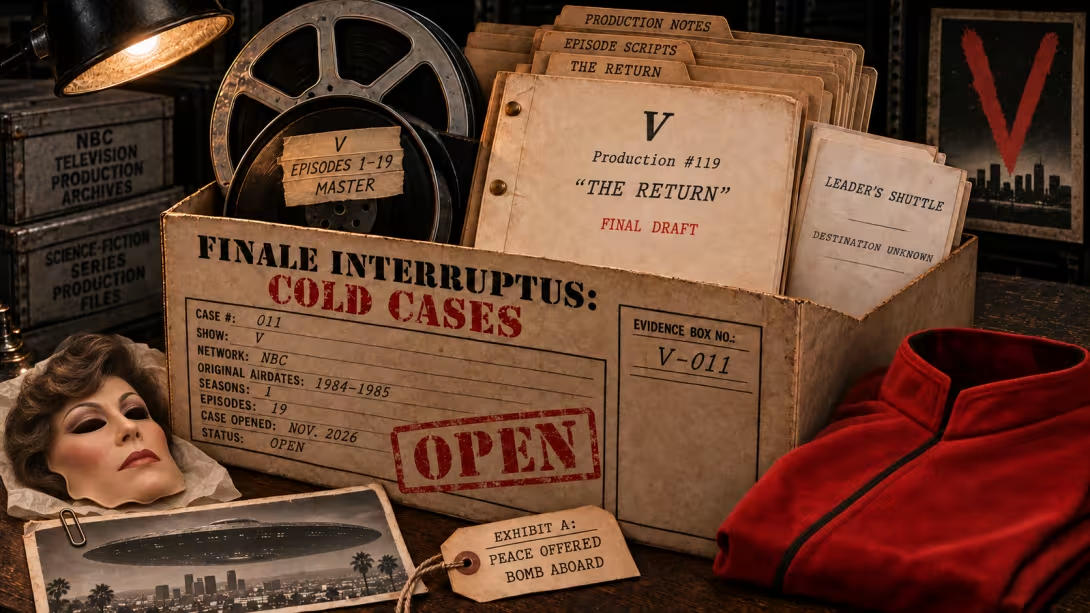
Finale Interruptus: Cold Cases - Case File #011: V
Every television series begins with a promise. Give us your time. Your attention. Your imagination. In return, we’ll tell you a story. And when it ends, we’ll bring it to its proper conclusion.
Most do.
Some don’t.
Some endings are still missing.
These are their case files.
The Invasion That Was Never Supposed to Be About Aliens
The first image was one of friendship. Fifty enormous spacecraft appeared over the world’s major cities, and their occupants descended wearing reassuringly human faces. They came in peace. They needed chemicals that Earth could easily spare, and in return they offered scientific knowledge capable of transforming human civilization. They were attractive, disciplined and unfailingly courteous. Their uniforms were immaculate. Their leader, John, spoke softly about cooperation while Diana smiled for the cameras. Politicians welcomed them, corporations sought partnerships and television audiences watched the Visitors turn an invasion into a public-relations campaign.
Only the spaceships were science fiction. Everything beneath them came from history. Writer-producer Kenneth Johnson had conceived V as a political thriller about an authoritarian movement taking control of the United States. Inspired in part by Sinclair Lewis’s 1935 novel It Can’t Happen Here, Johnson wanted to show that fascism did not arrive announcing itself as fascism. It presented solutions, cultivated collaborators and identified a minority whose supposed disloyalty could justify increasingly extreme measures.
NBC executives doubted that viewers would accept a domestic fascist takeover without an external force behind it. Soviet or Chinese invaders were considered, but neither could plausibly occupy the United States. The decisive suggestion was to make the aggressors extraterrestrial. Johnson initially resisted returning to science fiction after The Bionic Woman and The Incredible Hulk, but eventually recognized that aliens could preserve the political allegory while making the story more accessible. The resulting Visitors were not conquerors in the conventional sense. They did not begin by firing lasers into cities. They manufactured consent.
Scientists became their first targets because they possessed both the knowledge to question the Visitors’ claims and the social credibility to make those questions dangerous. A carefully engineered conspiracy turned public opinion against them. Researchers were accused of sabotage. Their families were shunned. Registration became detention, and detention became disappearance. The progression was deliberate. Viewers were meant to recognize how readily neighbors could become informants, respected institutions could become instruments of repression and ordinary people could persuade themselves that compliance was merely temporary. The Visitors’ human disguises were eventually peeled away, but the collaborators required no makeup at all.
Among them was Daniel Bernstein, a young man who discovered that serving the Visitors gave him the authority and status he had never possessed on his own. His transformation from frustrated bystander to uniformed enforcer provided the story with one of its most important warnings: tyrannies do not survive through villains alone. They require people willing to accept a smaller portion of power in exchange for helping suppress everyone else.
Resistance also developed incrementally. Medical student Juliet Parrish did not begin as a revolutionary commander, and television cameraman Mike Donovan did not set out to expose an alien occupation. Donovan’s camera simply placed him where the truth could no longer be denied. He boarded a mothership, discovered that the Visitors were reptiles wearing synthetic human skin and recorded Diana swallowing a live guinea pig whole. That footage should have awakened the world. Instead, Donovan returned to find himself branded a fugitive and his evidence suppressed. Controlling the story proved almost as important to the Visitors as controlling the planet.
The Visitors’ professed need for industrial chemicals was another lie. Earth’s population was being processed as food, while the planet’s water was being harvested for transport to their depleted home world. Humanity had welcomed guests who regarded it simultaneously as livestock and an obstacle. Yet V was never simply humanity against aliens. The Visitors included their own resistance movement, the Fifth Column, whose members opposed the invasion from within. Martin, Willie and others demonstrated that the dividing line was not species but choice. Some humans embraced fascism; some Visitors rejected it.
That distinction gave the miniseries greater moral complexity than its promotional imagery suggested. The red uniforms and reptilian faces made the enemy visually unmistakable, but Johnson continually returned to the more difficult question of what people did after they understood what was happening. Some fought. Some looked away. Some profited. The title itself supplied the answer. The spray-painted “V” began as the Visitors’ symbol of domination, but resistance fighter Abraham Bernstein reclaimed it as the sign of victory used by occupied Europeans during World War II. Children and adults began painting it over Visitor propaganda. A mark intended to announce ownership became a promise that ownership would not last.
When V aired on NBC on May 1 and 2, 1983, it reached an audience rarely assembled for televised science fiction. Johnson’s official history of the production records an initial American audience of approximately 80 million viewers, with the miniseries earning a 27.0 rating and 40 share. Its combination of spectacle, political allegory and accessible human drama turned what might have been a self-contained television event into a franchise almost immediately. But the original miniseries did not end with Earth liberated. The Resistance exposed the Visitors’ true appearance and sent a signal into space, hoping the aliens had enemies who might answer. The occupation continued. Diana escaped. The motherships remained overhead.
That ending was open, but not defective. It concluded the story Johnson had chosen to tell: ordinary people had recognized fascism, formed a resistance and reclaimed the idea of victory. The war itself could continue beyond the final frame. NBC and Warner Bros. saw something else in that frame. They saw ratings, recognizable characters and a world capable of supporting more television. The network wanted the Visitors back, and the next production arrived with a title that promised something the franchise would repeatedly fail to deliver.
It was called V: The Final Battle.
The Final Battle That Refused to Stay Final
A title like The Final Battle creates an obligation. It tells viewers that the occupation is approaching a decisive confrontation, the Resistance will make its stand and the story will leave its principal characters somewhere more conclusive than another promise of war to come. Kenneth Johnson initially participated in developing that conclusion. During the summer of 1983, he supervised a team of writers assembling a six-hour sequel that would expand the Resistance, deepen the Visitors’ internal divisions and bring the invasion to a meaningful resolution.
The relationship between Johnson and Warner Bros. collapsed before production began. According to Johnson, the studio wanted the sequel made more quickly and economically than he believed the material could support. The decisive break came when executives told him that he would not be permitted to direct any portion of the sequel despite contractual provisions allowing him to do so.
Johnson walked away from both The Final Battle and a potentially lucrative commitment to develop a subsequent series for Warner Bros. He later changed his story credit to “Lillian Weezer,” combining the name and nickname of his golden retriever, and has said that he deliberately avoided watching the completed production. The separation did not remove his ideas from the project, but it ended his creative control over what V would become. The shift was visible on screen. The original miniseries had emphasized incremental collaboration, propaganda and the machinery of authoritarianism. The Final Battle retained those elements but increasingly moved toward action, romance, psychic powers and science-fiction spectacle.
The Resistance had grown into an organized fighting force. Juliet Parrish remained its leader, while Mike Donovan continued searching for his son, Sean, who had been captured and converted by the Visitors. Ham Tyler, played by Michael Ironside, joined the struggle as a harder and more openly militaristic counterweight to Donovan. The Visitors’ internal conflict also expanded. Martin and other Fifth Column members secretly aided the human resistance, while Diana’s ambitions increasingly extended beyond completing the occupation. Her rivalry with Commander Pamela placed personal power struggles inside the invasion force and foreshadowed the operatic command disputes that would dominate the weekly series.
At the center of the sequel was Robin Maxwell’s pregnancy. Robin had been impregnated by the Visitor Brian, producing twins whose births pushed V decisively beyond the political realism of Johnson’s original conception. One child was a reptilian infant that died shortly after birth. The other appeared human and rapidly developed into a seemingly normal girl named Elizabeth. Elizabeth was not normal. She was the first successful human-Visitor hybrid, soon identified as the Starchild and burdened with powers neither species entirely understood. Her accelerated growth would eventually transform her from an infant into a young woman within little more than a year of television time.
The immediate victory, however, came from biology rather than mysticism. After Robin’s reptilian hybrid infant died, Juliet and Robert Maxwell discovered bacteria in its tissues that were harmless to humans but lethal to Visitors. The Resistance cultured the organism into the weapon that became known as the red dust. Distributing the bacteria globally offered humanity its first credible way to defeat the occupation. Once released, the red dust spread through Earth’s atmosphere and killed Visitors exposed to it. The invading fleet withdrew before the contamination could destroy it, while Elizabeth stopped the Los Angeles mothership’s self-destruct sequence and allowed the Resistance to capture the vessel. Diana escaped from the captured mothership aboard a command shuttle, preserving the central threat for the weekly series.
The Resistance had won. The surviving Visitors could not safely return to Earth, humanity was no longer being processed as food and the fleet’s departure allowed The Final Battle to deliver precisely what its title promised. The ending left individual matters available for continuation. Diana survived, Donovan had not recovered Sean and the Visitors remained a threat beyond Earth. Those were future possibilities rather than defects in the conclusion. The occupation itself had been defeated, and the central conflict had reached a natural stopping point.
That should have been the end of V. It was instead the beginning of the version most remembered as unfinished. The Final Battle was another ratings success, and NBC ordered a weekly series for the 1984–1985 season. The decision required the new producers to undo the very resolution viewers had just watched. Earth had to become vulnerable again, Diana had to return and the red dust had to stop functioning as the absolute defense it had been created to provide.
The weekly premiere, “Liberation Day,” supplied the necessary reversal. One year had passed since the Visitors’ withdrawal, and the resistance fighters had attempted to resume ordinary lives. The alien occupation appeared to be over, while industrialist Nathan Bates used recovered Visitor technology to build Science Frontiers into an increasingly powerful corporation. Bates had also discovered the red dust’s fatal limitation. If it spread into colder regions, it would mutate into a form capable of killing humans as well as Visitors. The contamination therefore remained concentrated in warm climates, leaving much of the planet exposed.
Earth was no longer protected by a universal biological shield. The Visitors could return anywhere the red dust had not reached, while the threatened mutation prevented humanity from simply releasing more. Diana soon reappeared and assumed command of a renewed invasion. Martin rescued Donovan but was killed by Diana, removing one of the franchise’s most important Fifth Column figures during the premiere. The Visitors began restoring their military position, and Los Angeles became a precarious open city governed through an arrangement between Nathan Bates and the occupying forces.
The final battle had become a temporary setback. The Resistance reassembled, the mothership returned to the sky and humanity once again faced the war that had supposedly ended. The reversal worked mechanically, but it changed the compact between the series and its audience. The franchise had already sold viewers one conclusion and then revoked it. From that point forward, any victory could be temporary, any death could be negotiated by production needs and any promise of finality could become another season’s premise.
NBC had reopened the case. This time, it would walk away before anyone could close it.
Victory Becomes a Weekly Appointment
The weekly V inherited the scale of a global invasion but received neither the time nor the resources that had made the miniseries convincing. What had been constructed as an event now had to produce another hour of alien occupation every week. David Abramowitz, who served as executive story consultant, later described the practical problem plainly: the weekly production had approximately half the money, shooting time, special effects, sets and characters available to the miniseries. The producers were expected to preserve the appearance of an international war while working within the machinery of ordinary network television.
The contraction was immediately apparent. Although the Visitors had attacked the entire planet, the weekly story concentrated heavily on Los Angeles and the surrounding countryside. The Resistance rarely appeared to possess the national organization established in The Final Battle, much less a meaningful global network. Nathan Bates provided a narrative explanation for the smaller battlefield. His company, Science Frontiers, controlled Los Angeles as an officially neutral “open city,” protected from direct Visitor assault through a private arrangement with Diana. Bates traded access, technology and information while presenting himself as the human authority capable of keeping both sides in check.
His neutrality was transactional. Bates wanted the Visitors’ technology and the political power it gave him, while Diana tolerated the arrangement because it limited the Resistance and offered access to Elizabeth. Neither regarded peace as anything more than a useful temporary fiction. The open city nevertheless gave the series a workable weekly structure. Donovan, Juliet, Ham Tyler, Willie and their allies could conduct missions inside and outside Los Angeles while Diana maneuvered against them from the mothership. Nathan’s son Kyle became involved with the Resistance and developed a relationship with Elizabeth, whose accelerated transformation had carried her from infancy to adulthood.
The struggle was no longer simply humanity against the Visitors. It was divided among the Resistance, Diana’s forces, the Fifth Column and Bates’s corporate state. That should have provided enough political tension to sustain the series, but its shifting creative priorities rarely allowed one arrangement to settle before another replaced it. Characters disappeared, died or changed functions with unusual frequency. Martin was killed in the premiere. Robin Maxwell and several figures central to the miniseries soon left the story. Nathan Bates’s power over Los Angeles ended with his death, while Science Frontiers and the open-city structure largely vanished with him.
Ham Tyler and Chris Farber eventually departed for Chicago, removing Michael Ironside’s harder-edged resistance fighter from the regular cast. Elizabeth’s powers expanded or receded according to the requirements of individual episodes, and Donovan’s search for his converted son Sean repeatedly surfaced without reaching a conclusion. The Visitors’ command structure was equally unstable. Diana shared authority with Lydia, whose rivalry with her increasingly resembled a prime-time soap conducted in red uniforms. Commander Charles arrived to impose order, married Diana as part of an elaborate political maneuver and promptly became the victim of a poisoned ceremonial drink that had been intended for her.
Philip then arrived as Martin’s twin brother, allowing Frank Ashmore to return to the program without reversing Martin’s death. Philip served as the Leader’s inspector general and introduced another layer of Visitor authority above Diana and Lydia. The changes created motion but not always progression. Each new commander, alliance or political arrangement promised to redefine the war, only to be discarded when the production changed direction again.
NBC made the sequence more difficult to follow by withholding “Breakout,” the third episode produced. The network reportedly considered it too violent for the program’s original time slot, so the first broadcast run jumped directly from “Dreadnought” to “The Deception.” That decision damaged continuity. “Breakout” introduced Kyle Bates to members of the Resistance, but “The Deception” proceeded as though those meetings had never occurred. When NBC eventually aired “Breakout” on May 24, 1985, the series had already been cancelled and its narrative finale had been broadcast two months earlier.
The episode therefore occupies two incompatible positions. In production order it belongs near the beginning of the series; in broadcast order it became the last new episode shown on NBC. Any account that identifies “Breakout” as the finale mistakes scheduling debris for narrative intent. The network had originally regarded V as a crucial component of its effort to rebuild Friday nights. Before the premiere, NBC Entertainment president Brandon Tartikoff predicted that the series could average a 28 or 29 audience share and strengthen the programs scheduled around it. Contemporary reporting described it as one of NBC’s most important new prospects.
The audience did not follow the Visitors into weekly television at the expected level. The premiere placed 36th for its week, and the show declined as the season progressed. NBC moved it into the 9 p.m. Friday slot, where it faced Dallas, then one of the most formidable programs on television. The move briefly produced audience shares that gave supporters reason to believe the series might survive. A February 1985 report in The Washington Post said NBC was satisfied with its recent performance and insisted that cancellation reports were premature.
Two days later, the prognosis changed. A contemporary Los Angeles Times report announced that NBC had cancelled V, describing the network as having “succumbed to the alien ratings figures.” At that point the series ranked 61st among 83 network programs, and NBC designated March 22 as its final telecast.
The producers now knew there would be no second season, but the machinery of the finale was already moving. Instead of narrowing the conflict toward a final military victory, “The Return” introduced the most consequential development of the weekly series: the Leader himself was coming to Earth. The Visitors announced a worldwide ceasefire. Their forces began withdrawing, and the Leader offered negotiations that might end the war without another red-dust attack. Elizabeth had been personally summoned to help guarantee the peace.
For the second time, V appeared ready to conclude an invasion. This time, however, the title did not promise a final battle. It promised a return.
The Peace Offer With a Bomb Aboard
“The Return” begins with a development so unexpected that neither side knows whether to trust it. Philip orders the Visitor forces to cease hostilities, and ships around the world begin withdrawing from Earth. The command has come from the Leader. He intends to travel to Earth personally, negotiate a peace settlement and take Elizabeth with him as his mate. Through her psychic connection with him, Elizabeth believes the offer is sincere.
The Resistance has ample reason to doubt her. Every previous Visitor promise concealed another stage of the invasion, and humanity’s first welcome had nearly ended with Earth stripped of its water and population. A ceasefire could be another deception designed to bring the remaining resistance leaders aboard the mothership and eliminate them together. Elizabeth nevertheless insists that the Leader is different. She senses no hostility from him and believes that accepting his invitation may end the war. Donovan, Juliet, Kyle and the others accompany her to the mothership, accepting the risk because rejecting a genuine peace could condemn both species to continued bloodshed.
Diana cannot permit that peace to happen. The end of the war would end her authority, expose her repeated insubordination and leave her subject to judgment by the very Leader she has attempted to circumvent. She joins Lieutenant James in a plan to sabotage the negotiations before they begin. Philip has arranged a ceremonial duel with Donovan using Visitor energy swords rendered harmless for the occasion. Diana and James secretly reactivate the weapons, intending for one combatant to kill the other and destroy the fragile trust between humans and Visitors.
The plot fails because neither Donovan nor Philip wants the fight to become lethal. Once they realize the weapons have been altered, the duel becomes evidence that someone aboard the mothership is actively working against the settlement. Diana escalates. She forces James to arrange an attack on the Leader’s arriving shuttle, making it appear that human resistance fighters have attempted the assassination. The shuttle is destroyed in the landing bay, apparently killing the Leader before negotiations can begin.
The victory lasts only moments. The destroyed craft was a decoy, and the real Leader remains alive. Diana then abandons subtlety. She attempts a coup, seizes control of the mothership and activates its self-destruct system. The resulting explosion would destroy the ship, kill everyone aboard and devastate Earth. If Diana cannot control the war, she is prepared to destroy both peace and planet rather than surrender.
Elizabeth reaches into the mothership’s systems through her psychic connection with the Leader and stops the detonation. Diana, James and their remaining supporters are captured. Philip resumes preparations for the Leader’s arrival, and the peace process appears to have survived its final test. The Leader never fully appears. His presence is represented by a red light inside his royal shuttle and by the voice Elizabeth hears telepathically. The series asks its audience to place the same faith in him that Elizabeth does without revealing what he is, what he wants from her or whether his promise of peace can be trusted.
Elizabeth agrees to leave Earth with him. Her departure is presented as both a personal union and a political guarantee: the human-Visitor hybrid will accompany the Leader to his home world, and her presence will help bind the agreement between the two species. Kyle cannot accept losing her. While Donovan, Juliet, Willie and the others watch the shuttle prepare to depart, he slips away and secretly boards it. No one notices his disappearance until the craft has already left the mothership.
His decision creates the first unresolved crisis. Kyle has entered the Leader’s vessel without permission, placing himself inside an unknown political arrangement with no way to predict how the Visitors will respond when he is discovered. Diana creates the second. Although she has been arrested, she tells James that she has left the Leader a “going-away present.” A bomb is aboard the departing shuttle.
The episode ends before the device explodes, before Kyle reaches Elizabeth and before the Leader’s intentions can be tested. Donovan can only watch the shuttle disappear and wonder whether allowing Elizabeth to leave was the right decision. Juliet attempts to reassure him. She believes Elizabeth may finally find peace and happiness—and that perhaps everyone else will as well. The hope is immediately undercut when the group realizes Kyle is missing and concludes that he has stowed away.
The final credits arrive with the Leader’s shuttle carrying Elizabeth, Kyle and Diana’s bomb away from Earth. That ending does not merely leave room for another adventure. It suspends the principal characters inside an active emergency. The peace settlement may be genuine or fraudulent. The Leader may be a reformer, another tyrant or something beyond the political structure the series has shown. Elizabeth may become his partner, prisoner or weapon. Kyle may save her, compromise the treaty or die beside her.
Diana’s defeat is equally provisional. She remains alive, politically dangerous and convinced that her assassination plan will succeed even while she is in custody. If the bomb destroys the Leader, she may regain power. If it fails, she still faces a trial that could expose the full extent of her actions and divide the Visitors’ command. “The Return” was constructed as a season-ending cliffhanger, not as a completed series finale. Its title suggests restoration or homecoming, but nobody returns. The Visitors withdraw, the Leader arrives and Elizabeth leaves, while the story moves farther from resolution than it had been at the beginning of the hour.
The weekly series had repeatedly revised its rules, alliances and command structure, but this was not another disposable complication. It placed the future of Earth, the Visitor empire and the central relationship between Elizabeth and Kyle aboard the same endangered shuttle. NBC had already cancelled the series. Whatever happened when that shuttle reached its destination would not be televised.
For decades, fans have been told that the answer almost existed—that another episode had been planned, perhaps even partially produced, before the cameras stopped. The surviving evidence supports only part of that story. “The Attack” exists, but not in the form legend has given it.
The Episode That Exists Only on Paper
The lost-episode story is nearly as durable as the cliffhanger itself. Accounts repeated across fan sites and television databases describe a twentieth episode titled “The Attack,” sometimes identifying it as partially filmed when NBC cancelled the series. That claim would change the nature of the case. A partly completed episode might leave behind footage, production photography, call sheets, editing records or enough material for a reconstruction. It would also mean that the answer to “The Return” had moved beyond planning and entered production.
The evidence presently available does not establish that. What can be documented is the existence of a script attributed to David Braff and Paul F. Edwards, from a story by Donald R. Boyle. It appears to be a first-draft screenplay for a prospective second-season premiere rather than a completed episode withheld from broadcast.
No verifiable production number, filming schedule, cast documentation or surviving footage has surfaced to demonstrate that cameras rolled. Contemporary reports announcing the cancellation identify “The Return” as the final scheduled chapter, while later descriptions of “The Attack” generally trace back to fan archives, script circulation and Edward Gross’s reference books The V Files. The responsible conclusion is therefore narrower than the legend: “The Attack” was written, or at minimum circulated in script form, but its frequently repeated status as a partially filmed lost episode remains unproven.
The script is still valuable evidence because it shows how at least one version of the production intended to escape the corner created by “The Return.” Diana’s bomb would not simply have killed Elizabeth, Kyle and the Leader. The departing shuttle would be revealed as another decoy, allowing the principal characters to survive the immediate cliffhanger. The device aboard it could explode without ending the series or removing the characters whose departure had created the crisis.
Elizabeth and Kyle would be drawn into a strange alternate space where the Leader could finally appear. Rather than the red point of light seen in “The Return,” he was conceived as an immense four-armed Visitor whose power extended beyond the abilities previously demonstrated by Diana, Philip or the Starchild. The Leader’s history would introduce a new mythology built around an object called the Anyx. In the distant past, rulers of the Visitor world had feared that one of their number might become too powerful. They broke the Anyx apart and scattered its pieces, preventing anyone from possessing its complete power.
One fragment had been hidden on Earth. That revelation would have transformed the series again. The war for humanity’s survival would become a search for an artifact capable of determining control of the Visitor empire. Earth mattered not only for its water and human population but because it concealed a weapon—or source of power—that the Leader and his rivals might use against one another.
Elizabeth would refuse to rule beside the Leader. Her decision would preserve her connection to humanity and Kyle while making her an active opponent of the political destiny being imposed upon her. Rather than remaining the passive guarantee of a peace agreement, she would return to the Resistance with greater knowledge of the conflict surrounding her. Diana would escape custody, ensuring that her arrest in “The Return” did not remove the series’ central antagonist. The attempted assassination and failed coup would become another reversal she survived, allowing her rivalry with the Leader and Elizabeth to continue.
The proposed story would not have been as merciful to Juliet Parrish. Available summaries describe Julie being killed, removing the Resistance leader who had carried the human struggle from the original miniseries through the weekly series. Her death would have been more than another cast departure. Julie represented the ordinary civilian transformed into a revolutionary by necessity, and her medical knowledge had made the red dust possible. Killing her at the beginning of a new season would have severed one of the franchise’s strongest remaining connections to Kenneth Johnson’s original story.
The script would also have returned Ham Tyler. He would meet the surviving Resistance fighters in a heavily modified vehicle, suggesting that the next version of V would abandon the relatively stable Los Angeles headquarters and send its characters onto the road. The image points toward a soft reconstruction of the program. The open-city politics and Science Frontiers structure were already gone. The mothership’s familiar cycle of command struggles had become increasingly difficult to sustain. Putting the Resistance on the move would provide new locations, new human communities and a clearer search narrative built around the missing piece of the Anyx.
The second season could therefore have followed Donovan, Elizabeth, Kyle, Ham and the remaining fighters as they searched for the fragment while avoiding Diana, the Leader and any other faction seeking its power. It would have been part resistance war, part quest and part fugitive journey through an occupied Earth. That plan answers several immediate questions from “The Return.” Elizabeth and Kyle survive. The Leader is revealed. Diana’s bomb does not destroy the central characters. Elizabeth rejects the future being offered to her and returns to Earth.
It does not provide an ending. “The Attack” exchanges one cliffhanger for a larger mythology. The peace agreement collapses, Diana escapes, Julie dies and the Resistance begins a new search for an object that had never previously been mentioned. Even if the script were accepted as an authoritative statement of intent, it describes the opening of another campaign rather than the conclusion of the Visitor war.
It also represents only one possible continuation. Scripts change before filming, during filming and in editing. Cast availability, budgets and network direction could have altered or eliminated its most dramatic developments. Julie’s reported death, the Leader’s appearance and the Anyx storyline cannot be treated as events that happened within the televised continuity. Nothing in the broadcast series establishes them. The last canonical image remains the Leader’s shuttle leaving the mothership with Elizabeth, Kyle and Diana’s bomb aboard.
“The Attack” tells us that the writers had considered a way forward. It does not allow us to declare the passengers safe, the peace false or the Leader revealed. The episode was never completed, never broadcast and never incorporated into an authorized screen continuation. The supposed solution to the case is itself another piece of unfinished business.
Other creators would try different answers. Comics, novels, television movies, proposed miniseries and an eventual remake repeatedly brought the Visitors back—but each continuation either stopped short of “The Return” or abandoned its continuity altogether.
Every Continuation Except the One We Needed
The cancellation of V did not end demand for the Visitors. It created a succession of proposed conclusions, alternate timelines and revised invasions, nearly all of which were described at some point as the franchise’s return. None brought back the shuttle that left Earth in 1985.
DC Comics was in the best position to continue the weekly series directly. Its licensed V comic had begun while the television program was still in production and attempted to coordinate its stories with the rapidly changing screen continuity. That coordination was never simple. Television characters died or disappeared faster than the comic could respond, while publication schedules forced the writers to work months ahead of what readers saw on NBC. The comic’s letters pages acknowledged those difficulties and promised that the contradictions would eventually be reconciled.
After “The Return,” DC reportedly had permission to resolve the cliffhanger if NBC declined to renew the series. The comic could have followed Elizabeth and Kyle, revealed whether Diana’s bomb exploded and established what the Leader intended to do with the Starchild. Instead, it continued telling other stories. Issues published after the television finale operated around “The Return” rather than completing it, and declining sales eventually forced DC to cancel the title with issue #18.
Editor Robert Greenberger explained in the final months that sales had begun falling around the time the television series left the air. The creative team still had plans to explore other resistance groups, the Fifth Column and new Visitor characters, but the comic ended before those plans—or the promised television resolution—could be completed. The licensed novels kept the franchise alive on bookstore shelves but were poorly positioned to solve the television cliffhanger. Many focused on resistance cells outside Los Angeles or filled portions of the year between The Final Battle and “Liberation Day.” That structure allowed their authors to tell stories within the invasion without predicting developments in a weekly series that was changing during production.
Books such as East Coast Crisis expanded the war geographically, while later novels introduced new operations, resistance fighters and Visitor schemes. They demonstrated that the occupation extended far beyond the handful of locations affordable to weekly television. They did not establish what happened after “The Return.” No licensed novel became the definitive account of Elizabeth, Kyle, the Leader and the bomb.
Blatt-Singer Productions reportedly continued discussing a concluding television movie or miniseries after NBC cancelled the show. One possible approach would have taken the Resistance to the Visitor home world; another would have explored the treatment of Visitors who remained on Earth after the peace agreement. Those concepts never entered production. As time passed, maintaining the original cast, sets and production infrastructure became increasingly difficult, while the commercial urgency diminished with each year away from television.
Warner Bros. made the most substantial later attempt in 1989 when it commissioned J. Michael Straczynski to develop V: The Next Chapter. His proposed opening miniseries, “Rebirth,” would have resumed the conflict approximately five years later and potentially launched another weekly series. Straczynski did not attempt to gather the entire surviving cast and continue from the shuttle. His future history instead assumed that the Resistance had suffered devastating losses. Mike Donovan had been captured, Willie executed, Lydia assassinated and Elizabeth killed. Juliet lived in exile, while Diana had been reassigned.
Ham Tyler would have been the principal returning character, leading a new Resistance from Chicago after the Visitors consolidated their control over Earth. The project shifted attention toward a new generation of fighters and a renewed effort to contact alien enemies of the Visitors. Warner Bros. declined to produce it, reportedly because of the anticipated cost. Straczynski later granted permission for the first three acts of his four-hour script to circulate publicly, leaving fans with another detailed blueprint for a production that never existed. The surviving portion of “Rebirth” is evidence of a serious revival effort, but it is neither a completed story nor part of the televised canon.
Kenneth Johnson eventually constructed his own continuation. His 2008 novel V: The Second Generation takes place roughly two decades after the invasion and follows a world in which the Visitors have tightened their control while the human Resistance seeks assistance from another alien species, the Zedti. Johnson’s sequel carries the authority of the franchise’s creator, but it deliberately branches from his 1983 miniseries. It disregards The Final Battle and the weekly series, productions made without his involvement after his departure from Warner Bros.
That makes The Second Generation a continuation of the original V, not an answer to “The Return.” Its existence creates another legitimate continuity while leaving the one under investigation untouched. ABC tried again in 2009 with a complete reimagining. The new V preserved the arrival of beautiful Visitors, their concealed reptilian nature and the formation of a human resistance, but introduced different characters, mythology and motives.
Jane Badler and Marc Singer eventually appeared, but neither played the same character from the 1980s. Badler’s Diana belonged to the remake’s continuity, while Singer portrayed Lars Tremont rather than Mike Donovan. The remake was cancelled after 22 episodes and ended with most of humanity placed under Anna’s psychic control as additional Visitor ships arrived. Instead of resolving the original V, it created a second Finale Interruptus carrying the same title.
More recent projects have continued circling Johnson’s original concept. V: The Second Generation remains available as Johnson’s authorized literary sequel, while Big Finish’s V – UK reimagines the original invasion in Britain rather than continuing the 1984–1985 weekly series. Johnson has also pursued a theatrical reimagining designed as the beginning of a film trilogy. Those projects may extend or retell Johnson’s version of V. They cannot retroactively determine what happened in the Warner Bros.–NBC weekly continuity after March 22, 1985.
The distinctions matter because V no longer represents a single uninterrupted canon. There is Johnson’s original-miniseries continuity, the Final Battle and weekly-series continuity, the licensed prose and comic expansions, Straczynski’s unproduced future, Johnson’s alternate Second Generation and the independent 2009 remake. One branch contains “The Return.” That branch ends before the shuttle reaches its destination.
The Leader’s nature remains unknown. The peace agreement remains untested. Elizabeth’s future remains undecided. Kyle remains a stowaway, and Diana’s bomb remains aboard the shuttle unless one accepts an unproduced draft that television never made canonical. No subsequent novel, comic, remake or revival has supplied an authorized filmed conclusion to those events. The franchise has repeatedly returned, but the story that asked viewers to come back never did.
CASE STATUS: OPEN
The Visitors announced peace. Elizabeth left Earth to secure it. Kyle followed her, and Diana sent a bomb along for the journey. The final battle had already failed to be final. “The Return” ensured that victory itself would remain unfinished.