
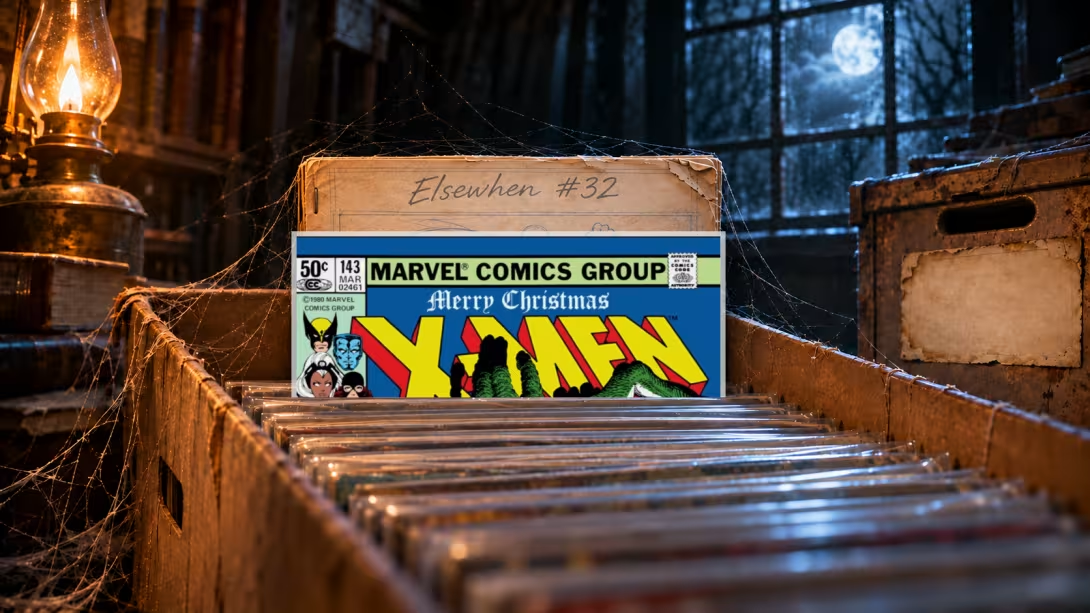
The Longbox Morgue, File #003: X-Men: Elsewhen
Some comic-book stories end with a final issue.
Others simply stop.
Creators leave, publishers change direction, deadlines collapse, and once-promising narratives disappear into filing cabinets, legal limbo or the long silence between solicitations.
Sometimes the abandoned story stays dead.
Sometimes it rises from the Longbox Morgue.
The Last Christmas
There was no funeral on the cover of X-Men #143. Instead, Marvel wished readers a “Merry Christmas” while an enormous green demon descended upon Kitty Pryde, who had been left alone inside Xavier’s mansion. Published in December 1980 with a March 1981 cover date, the issue was a compact holiday horror story in which the X-Men’s youngest member faced an invading N’Garai creature without the protection of her teammates.
Kitty survived by using her intelligence, her still-developing phasing ability and nearly everything in the mansion that could be turned into a weapon. The team returned at the end, presents were exchanged and the story reached a perfectly serviceable conclusion. What the comic did not announce was that an era had just ended.
Issue #143 was the final regular installment produced by writer Chris Claremont, artist and co-plotter John Byrne and inker Terry Austin—the creative combination responsible for one of the most consequential periods in superhero comics. Byrne had joined the book as penciler with issue #108 in 1977, entering a series that Claremont had already begun reshaping around the international team introduced in Giant-Size X-Men #1.
Their collaboration transformed that revival into a phenomenon. Together with Austin, Claremont and Byrne produced the battles with Proteus, the introduction of Alpha Flight, the Hellfire Club conspiracy, “The Dark Phoenix Saga” and “Days of Future Past.” They also made the characters’ relationships as important as the supervillains.
Scott Summers mourned Jean Grey, Wolverine evolved beyond the group’s resident berserker, Storm grew into a leader, and Kitty became the audience’s doorway into a world that could be wondrous, terrifying and painfully human. The partnership was enormously productive, but it was not peaceful. Under Marvel’s working method, Byrne helped plot the stories visually and delivered penciled pages before Claremont supplied much of the finished dialogue and narration.
That process gave both creators considerable influence over the finished comic, while also creating ample room for disagreement over characterization, motivation and what a scene was supposed to mean. Byrne later described mounting frustration when characters he had helped plot behaved differently in Claremont’s finished script than he believed the artwork intended. He identified moments during the team’s final issues when those differences became increasingly difficult for him to accept.
Byrne also wanted to learn whether readers were following The X-Men or following him. Leaving one of Marvel’s fastest-rising titles would allow him to test that question on books where his own creative identity could be more clearly measured. Claremont’s recollection was less definitive.
He has said that he did not fully understand what caused the partnership to disintegrate, particularly because he saw the comic as a genuine collaboration in which the individual contributions were often impossible to separate. Whatever the precise balance of professional frustration, creative disagreement and personal ambition, Byrne departed after #143. Unlike many residents of the Longbox Morgue, however, The X-Men did not die when one of its principal creators walked away.
Claremont remained, new artistic partners arrived and the title continued its ascent toward becoming one of Marvel’s dominant franchises. Nor did #143 end with a dangling plot or an imperiled hero awaiting rescue. Kitty defeated the demon, the mansion remained standing and the X-Men came home.
The unfinished business existed somewhere less visible. John Byrne had left behind an alternate conception of where these characters might have gone—one rooted in a creative dispute that had already changed the ending of the team’s most famous tragedy. Decades later, Byrne would return to that abandoned road and begin drawing the X-Men’s history differently.
He did not start after issue #143. He went back six issues, to the moment when Jean Grey stood on the moon and Marvel decided that the Phoenix had to die.
The Ending Marvel Rejected
The road to X-Men: Elsewhen begins with an ending readers were never supposed to see. In 1980, Chris Claremont and John Byrne brought the Phoenix storyline to its climax in X-Men #137. Jean Grey had been manipulated by Mastermind and the Hellfire Club, surrendered to the power within her and emerged as Dark Phoenix.
She then crossed interstellar space, consumed a star and destroyed an inhabited world. The Shi’ar Empire regarded Jean as a threat to the universe and demanded her destruction. The X-Men refused to surrender one of their own without a fight, leading to a trial by combat against the Shi’ar Imperial Guard on the Blue Area of the Moon.
The published story ended with Jean regaining control long enough to activate an ancient weapon and take her own life. It became one of the defining deaths in comics. It was not the ending Claremont and Byrne originally produced.
In their first version, the Imperial Guard defeated the X-Men and the Shi’ar subjected Jean to a form of psychic surgery. Her Phoenix abilities were removed, along with much of her intellect, leaving her alive but profoundly diminished. Jean returned to Earth with Scott Summers, while the Watcher and a Shi’ar Recorder reflected upon humanity’s capacity for sacrifice and renewal.
That ending had already been drawn, scripted and prepared when Marvel Editor-in-Chief Jim Shooter objected. His problem was not simply that Jean remained alive. Dark Phoenix had exterminated an inhabited planet, killing billions, and the proposed conclusion allowed her to return home with the X-Men after her powers had been removed.
Shooter believed that depowering Jean did not adequately address either the magnitude of the crime or the reactions required from the other characters. A punishment involving permanent confinement was discussed, but Byrne saw that as a narrative trap. Scott and the X-Men could hardly resume their normal adventures while Jean remained imprisoned and suffering somewhere in space.
They would be compelled to rescue her, while Marvel’s ruling that she must remain punished would prevent that rescue from succeeding. Faced with those alternatives, Byrne proposed the more decisive solution: Jean would die. The final pages of #137 were redrawn, its dialogue was extensively revised and the following issue became Jean Grey’s funeral.
The change elevated an already ambitious cosmic story into a tragedy. Jean did not merely lose control of the Phoenix or submit to punishment imposed by the Shi’ar. She recognized that Dark Phoenix could return and chose to die as Jean Grey rather than risk destroying another world.
The revised ending also created an uncomfortable question that Marvel would spend years trying to answer. Had one of the original X-Men genuinely committed genocide? At the time the story was written, Jean and Phoenix were treated as the same being.
The later revelation that the Phoenix Force had created a duplicate while the real Jean remained in suspended animation beneath Jamaica Bay did not arrive until 1986. That retcon permitted Jean to return for the launch of X-Factor without making her personally responsible for Dark Phoenix’s crimes. It also changed the meaning of the original story retroactively.
For Claremont and Byrne in 1980, however, there was no innocent Jean waiting underwater. There was only the woman on the moon, the power inside her and the ending Marvel had rejected. Readers finally received the abandoned version in Phoenix: The Untold Story, released in late 1983 with a 1984 cover date.
The special reprinted most of X-Men #137 but substituted its original conclusion, allowing fans to compare the two endings directly. It also included interviews with the creators and editors involved, preserving differing recollections of how and why the decision had been made. The alternate ending was therefore no longer truly lost.
What remained unwritten was everything that should have followed it. Byrne has explained that the psychic surgery was never intended as a permanent cure. The plan was for Phoenix eventually to reassert herself, transforming Jean into a recurring antagonist and forcing the X-Men to confront the problem again.
How Jean would have recovered, what Scott would have done and whether the Phoenix could ever have been controlled were stories that vanished when death replaced survival. Those missing stories became more intriguing as the published X-Men continuity expanded. Jean returned, the Phoenix acquired an increasingly elaborate mythology and successive creators added new hosts, cosmic judgments and revisions to the relationship between the woman and the force.
The original road remained frozen at the end of Phoenix: The Untold Story. Decades later, when Byrne began drawing the X-Men again for his own amusement, he did not continue from #143, where his professional run had ended. He returned to #137 and removed Jean’s death from the equation.
In the world that would become X-Men: Elsewhen, the Shi’ar carried out their psychic surgery, Jean survived and the future proceeded from the ending Marvel had discarded. It was not merely a story in which Phoenix lived. It was an attempt to reopen the entire X-Men universe at the last point where John Byrne believed it could have gone another way.
Related Reading
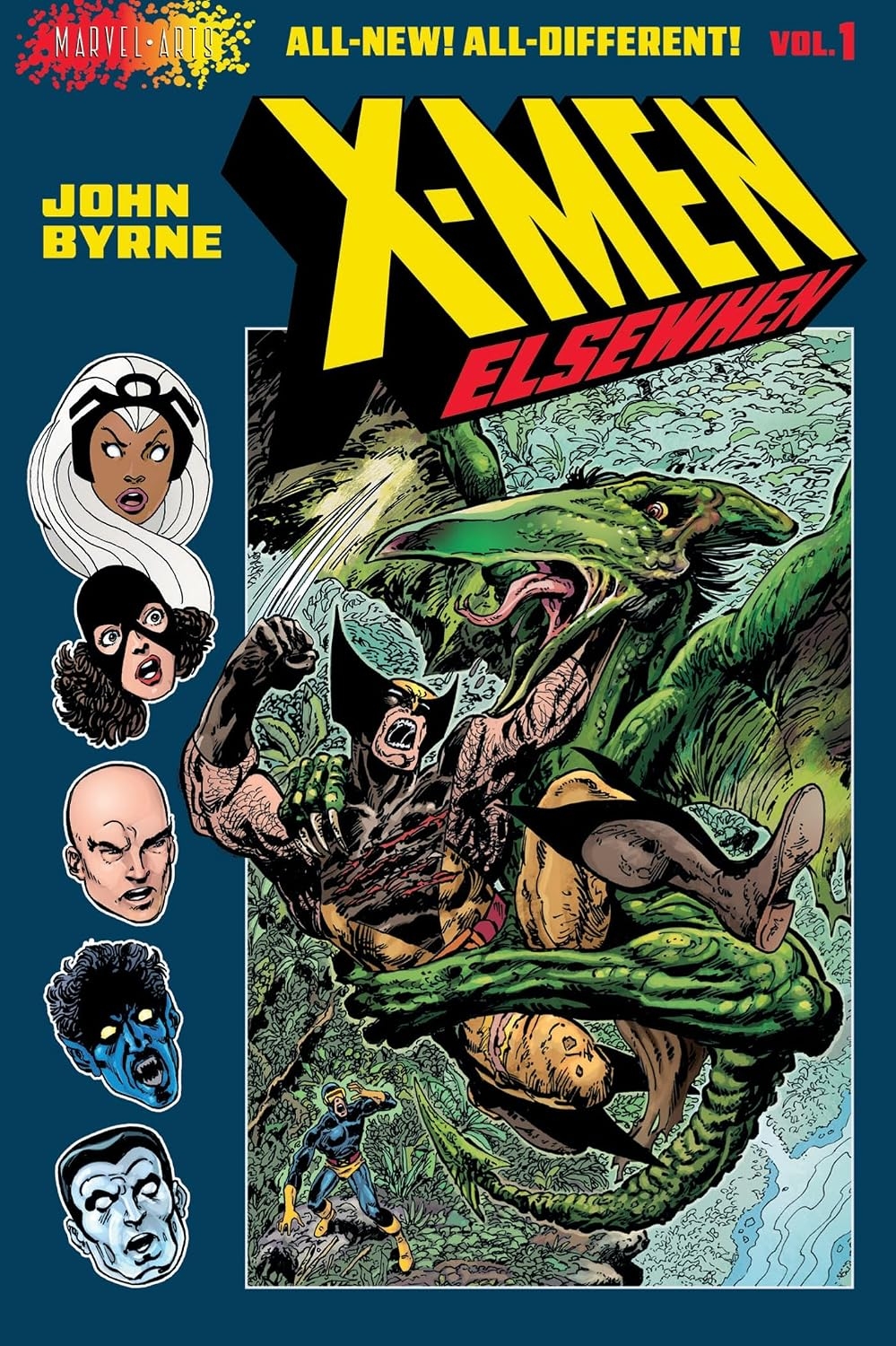
John Byrne returns to the X-Men with the first hardcover volume of his alternate history.
An Itch That Became 32 Issues
X-Men: Elsewhen did not begin as a proposal to Marvel. It began as a test. In 2018, a discussion on John Byrne’s message board turned toward the possibility of his returning to the X-Men.
Chris Claremont had previously revisited his own abandoned continuity in X-Men Forever, beginning from the period when he left the franchise in 1991. Fans naturally wondered whether Byrne might attempt something similar from the point of his departure. Byrne jokingly suggested the title X-Men Evermore for such a project.
Then he found a more interesting place to begin. Rather than continuing from X-Men #143, Byrne proposed returning to the conclusion of the Dark Phoenix storyline and proceeding as though Marvel had published its original ending. Jean would survive.
Scott Summers would remain with the team. The X-Men would enter a future unburdened by the continuity Marvel had constructed after Jean’s death. Byrne called the idea X-Men: Elsewhen.
At first, it was little more than an exercise to determine whether Byrne could still draw the X-Men as he had decades earlier. He had spent years penciling and inking his own work, and a reader’s question about whether he could return to producing conventional pencils for another artist helped prompt the experiment. Byrne drew a page featuring Wolverine fighting Sauron in the Savage Land.
Then he drew another. A few pages became 20, and what had started as an informal demonstration became the first installment of an unauthorized X-Men continuation. Byrne was not working from a formal commission or an approved publishing plan.
He was drawing Marvel’s characters for his own enjoyment and sharing the penciled pages free through the Byrne Robotics message board. The site categorized the project as “Fan Fic,” although that description was unusually modest. This was not an aspiring creator borrowing the X-Men for an amateur adventure.
It was one of the architects of the team’s most celebrated era returning to the characters and visual language he had helped define. The pages were presented largely as uninked pencils, allowing readers to see Byrne’s construction lines, corrections and storytelling decisions. There were no advertisements, variant covers or monthly solicitations.
New pages appeared because Byrne felt like drawing them. That freedom determined how the series developed. Byrne did not begin with a rigid outline for a 32-issue epic.
He has described his preferred writing process as allowing characters to lead the story, following the consequences of their decisions rather than forcing them toward a predetermined destination. When a direction failed to satisfy him, he could discard pages or replace entire sequences without negotiating with an editor or worrying about material already sent to a printer.
He revised designs, redrew machinery and occasionally abandoned substantial amounts of work. The absence of commercial restraints also allowed Byrne to move beyond a simple reconstruction of what might have happened in 1980. Elsewhen began with Jean’s survival, but it did not attempt to reproduce every unpublished plan Claremont and Byrne had discussed during their original collaboration.
It became Byrne’s independent interpretation of the Marvel Universe as it existed around the end of his X-Men tenure. Characters from The Avengers, Fantastic Four and other corners of Marvel could appear without the complications created by more than four decades of subsequent continuity. The project could acknowledge stories Byrne valued, disregard developments he did not and invent an entirely different sequence of consequences.
What began as nostalgia therefore acquired its own momentum. One issue led to another, with Byrne producing new chapters at a pace that sometimes exceeded a traditional monthly schedule. He later estimated that the work occupied approximately three years, although breaks, revisions and discarded issues made the exact production period difficult to define.
By the time he stopped, X-Men: Elsewhen comprised 32 issue-length installments. That represented hundreds of pages produced entirely on Byrne’s initiative. It was comparable in scale to a substantial monthly comics run, created without a publishing contract, editor or deadline.
The experiment had become a second X-Men run hiding in plain sight on an Internet forum. Marvel was not entirely unaware of it. Early in the project, Byrne received an enthusiastic message from Marvel Editor-in-Chief C.B. Cebulski expressing interest in discussing the work.
Byrne nevertheless continued on his own terms. He was financially independent, free from a production schedule and uninterested in returning to what he called the “old harness” of conventional corporate comics. Publishing the material would have required approvals, contracts and compromises that the private exercise did not need.
For several years, that left Elsewhen in an unusual state. It was publicly available but not officially published. It was written and drawn by John Byrne but was not a Marvel comic.
It continued one of Marvel’s most famous storylines while existing outside Marvel continuity, licensing and editorial control. Most importantly, it was substantial enough to feel permanent. Thirty-two issues suggested a complete body of work rather than an abandoned sketchbook experiment.
Readers could begin with Jean Grey’s survival and follow Byrne’s alternate X-Men through years’ worth of imaginary publication history. But volume was not the same thing as completion. Byrne had allowed the story to grow organically, and an organically growing serial rarely knows when it has reached its final page.
When Elsewhen stopped, it did not close with the team safely home or with the narrator declaring that this alternate future had reached its end. It stopped in the middle of another crisis. The man who had returned to resolve one of comics’ most famous rejected endings had created an unfinished ending of his own.
The X-Men According to Byrne
The first surprise of X-Men: Elsewhen is how little it initially resembles a revolution. Byrne does not immediately dismantle the X-Men or replace their world with an unrecognizable alternate reality. He returns to the rhythms of the comic he once drew.
There is a mission to the Savage Land, Wolverine clashes with Sauron, Kitty Pryde remains the inexperienced newcomer known as Sprite, and subplots accumulate around the edges of the main adventure. It feels like an issue of X-Men from 1980 that somehow slipped behind a filing cabinet. Then the consequences of Jean Grey’s survival begin to spread.
The Shi’ar psychic surgery has removed Jean’s telepathic and telekinetic abilities while drastically reducing her intellectual capacity. She retains the body and emotional responses of an adult, but her ability to understand the world has been pushed back toward childhood. This is not the triumphant rescue Scott Summers might have imagined.
Jean is alive, but the woman he knew cannot simply resume her old life. Scott therefore does not leave the X-Men to grieve, as he did following Jean’s death in the published continuity. He remains caught between his responsibilities to the team and his hope that some part of Jean can recover.
Jean returns to her parents, who must protect an adult daughter unable to recognize danger or fully comprehend what has happened to her. Her vulnerability soon becomes more than an emotional concern. Without her powers and mature judgment, Jean can wander into situations she does not understand, placing her at the mercy of strangers who recognize how easily she can be exploited.
The treatment is deliberately uncomfortable. Byrne does not allow Jean’s survival to function as a simple reversal of tragedy. Saving her life has created a different kind of loss for Scott, her family and Jean herself.
It has also failed to eliminate the Phoenix. The cosmic force exists independently of Jean, moving through space and seeking another connection. Its separation from her transforms the original resolution into a temporary reprieve rather than a cure.
Jean may no longer possess the Phoenix’s power, but the entity remains part of the universe—and its unfinished relationship with her continues to shape events. While Jean’s family attempts to care for her, the wider mutant crisis intensifies. Project Wideawake and its Sentinels emerge as a principal threat, with government operative Henry Peter Gyrich and Hellfire Club leader Sebastian Shaw pursuing their own interests through the machinery.
The partnership places mutant persecution inside a web of political authority, private industry and personal ambition. The Sentinels are no longer merely giant robots marching toward Xavier’s mansion. Master Mold begins incorporating captured mutants into new machines, turning the people the program was designed to control into components of its enforcement system.
Nightcrawler, Havok and Polaris become part of that nightmare, forcing their allies to fight weapons constructed around familiar powers and imprisoned friends. The escalation draws the crisis beyond the X-Men. The Avengers and Fantastic Four become involved, while Sentinels appear across the country and the danger expands from a covert anti-mutant operation into a threat that the larger Marvel Universe cannot ignore.
Byrne uses those appearances as more than decorative guest stars. The crossover structure recreates a period when Marvel’s heroes occupied the same world and could be pulled naturally into one another’s emergencies. It also lets Byrne revisit characters he handled during his later runs on Fantastic Four, The Avengers and other titles.
That produces a peculiar fusion of creative eras. The setting is anchored near 1980, but its Marvel Universe is filtered through everything Byrne later learned about the characters. He can return to the X-Men at the moment he left them while bringing decades of storytelling experience to the page.
Not every development Byrne chooses resembles the direction Claremont would have taken. That is fundamental to the experiment. Elsewhen is not a reconstruction of the unwritten Claremont-Byrne plots, nor is it an attempt to prove that one creator possessed the only legitimate future for the team.
It is the X-Men according to Byrne: faster, more plot-driven and built around intersecting threats that continually push the characters into action. The dialogue is leaner than Claremont’s famously introspective scripts. There are fewer extended internal monologues and more rapidly shifting subplots.
A scene at Xavier’s mansion may give way to Asteroid M, the Baxter Building, Avengers Mansion, a Shi’ar installation or the hidden machinery of Project Wideawake. Magneto reenters the story, but he does not arrive inside the redemptive arc that would gradually transform him into one of Claremont’s most complex figures. Byrne approaches him from another angle, preserving more of the implacable adversary who believes his war with humanity is both inevitable and justified.
The distinction demonstrates how quickly this alternate history moves beyond the question of Jean Grey. Once Scott remains with the team, once the Phoenix continues independently and once Byrne replaces later creative decisions with his own, nearly every familiar relationship becomes unstable. Some events that readers remember from the published comics can no longer occur.
Others return in altered form, stripped of the outcomes history assigned them. Even stories from outside the X-Men can be reopened. Byrne brings back characters and concepts from his broader Marvel work, sometimes using Elsewhen to address threads that conventional continuity left dormant.
The series becomes less a single “What If?” story than a private reconstruction of the Marvel Universe at the dawn of the 1980s. That scale explains why the project could not remain a short exercise. Jean’s survival changes Scott.
Scott’s continued presence changes the team. The surviving Phoenix changes the Shi’ar, while the escalating Sentinel program draws in heroes far beyond Xavier’s students. Every divergence creates another.
Byrne had gone back to rescue one discarded ending. He discovered an entire universe waiting behind it.
Wolverine in Hell
By the time X-Men: Elsewhen reached issue #32, John Byrne had carried his alternate Marvel Universe far beyond Jean Grey’s survival. Doctor Doom had entered the story, and his objective extended beyond the X-Men’s usual concerns. Doom’s mother, Cynthia von Doom, had condemned her soul through a bargain with Mephisto.
Her imprisonment in the demon’s realm was not a new invention for Elsewhen. The published Marvel continuity had established Doom’s repeated attempts to free her, most notably in Roger Stern and Mike Mignola’s Doctor Strange and Doctor Doom: Triumph and Torment. Byrne returned to that motivation but devised a different rescue plan.
Doom intended to exploit Nightcrawler’s teleportation abilities. Nightcrawler does not merely disappear in one place and reappear in another. His teleportation carries him through another dimension, ordinarily for only the fraction of a second between departure and arrival.
Doom believed that passage could be manipulated to reach parallel realities. He would use it to gather alternate versions of himself and assemble an army of Dooms powerful enough to invade Mephisto’s domain. The figures appearing at the end of issue #32 were therefore not Doombots.
They were Victor von Doom—again and again—drawn from multiple universes for a campaign against Hell. Wolverine was poised to become entangled in that campaign. Byrne summarized the intended direction with three words: “Wolverine in Hell.”
It was the kind of premise capable of carrying several issues. Doom’s obsession, Nightcrawler’s dimensional abilities, Mephisto’s kingdom and Wolverine’s capacity to survive almost any physical torment had been placed on the same collision course. Then the pages stopped.
The interruption was not caused by Marvel canceling the series. There were no disappointing sales, missed orders or retailers returning unsold copies. Elsewhen had no publisher to cancel it and no schedule Byrne was contractually required to maintain.
The obstacle was Byrne’s dissatisfaction with his own story. Issue #32 had been completed and left sitting for months before he decided to share it. When he began posting the pages, Byrne warned readers that their appearance did not mean he had resumed regular work on the series.
The issue was being released because it already existed. More importantly, Byrne said it was the installment that had sent him into “the doldrums.” He believed its ending and one of its subplots were not working.
If he returned to Elsewhen, he intended to redraw the final pages. The difficulty can be seen in a discarded direction involving Kitty Pryde. Byrne had twice attempted to send Kitty into tunnels associated with the Mole Man, where she would encounter Pixie from X-Men: The Hidden Years.
He concluded that the subplot did not fit and abandoned it again. For a commercially published monthly comic, an imperfect subplot might have been repaired under deadline or carried forward until a later issue could redirect it. Elsewhen operated without that pressure.
Byrne could stop when the story ceased to satisfy him. That freedom had allowed 32 issues to exist. It also meant there was no external mechanism compelling issue #33.
The final pages therefore occupy an uncertain place even within the project. They are the last publicly posted pages of the run, but Byrne had already identified them as material he might replace. The apparent direction is known, yet the precise transition into that story was never fixed to his satisfaction.
Readers were left with alternate Dooms gathering, Nightcrawler’s powers being exploited and Wolverine facing a journey into Mephisto’s realm. They never received the invasion. They never learned how Wolverine would survive Hell, whether Nightcrawler could break Doom’s control or which version of Doom might betray the others first.
Nor did they see how the expedition would connect with the larger questions surrounding Jean Grey, the Phoenix and the X-Men’s altered future. The series did not conclude its major arcs and then tease another adventure as an optional coda. It stopped while introducing that adventure.
That distinction makes Elsewhen a legitimate resident of the Longbox Morgue. Many unfinished comics leave readers with only a solicitation, a rejected proposal or a few unpublished pages. Byrne delivered 32 issues before walking away.
The size of the surviving work makes the absence of an ending more conspicuous, not less. There is enough material to form a substantial run, establish a separate continuity and lead its characters into multiple interconnected crises. There is also enough material to demonstrate that Byrne was not finished.
The original X-Men collaboration had ended with #143, a complete Christmas story concealing a creative departure. The second Byrne run ended differently. There was no final victory, farewell or return to the mansion.
There was an army of Doctor Dooms preparing to storm the underworld—and Wolverine standing at the mouth of a story that never arrived.
Official at Last But Is It Finished?
For years, X-Men: Elsewhen occupied a legal and commercial nowhere. John Byrne had written and drawn the pages, but Marvel owned the characters. Fans could read the story online, yet no conventional publisher could collect or sell it without Marvel’s permission.
That changed when editor Chris Ryall helped connect Byrne with Abrams ComicArts. Abrams already published licensed Marvel projects through its Marvel Arts imprint, creating a route by which Elsewhen could become an authorized book without requiring Byrne to return to Marvel’s monthly comics operation. The arrangement was announced in July 2025.
The penciled webcomic would be remastered, inked, colored and lettered for a three-volume hardcover edition published by Abrams under license from Marvel. Byrne remained directly involved, writing and penciling the entire project while also inking portions of it. Paul Wills supplied additional inks, with Lovern Kindzierski, Leonard O’Grady and other contributors handling color, and Patrick Brosseau assisting with lettering.
Terry Austin, whose inks helped define Byrne’s original X-Men work, was approached but declined to participate. The first volume arrived on June 23, 2026. The 232-page hardcover collected the equivalent of the first ten online issues, now presented in full color and edited into a more cohesive graphic-novel sequence.
A project that had once identified itself as free fan fiction was now an officially licensed X-Men publication. Its reception justified the faith Abrams had placed in it. The first volume became a national bestseller, introducing the project to readers who had never followed the individual penciled pages on Byrne’s forum.
It also placed Elsewhen in an extraordinary position within comics history. Marvel had authorized an alternate continuation created outside its editorial system by a former collaborator who had once publicly severed his relationship with the company. The abandoned branch had been grafted back onto the tree.
Volume Two, subtitled From the Stars He Comes, is scheduled for June 1, 2027. Its announced storyline continues the crisis involving Jean Grey, the Phoenix Force and the Shi’ar, with the Avengers, Fantastic Four, Spider-Man and Silver Surfer drawn into the consequences. A third volume is intended to complete the collection of Byrne’s work.
That does not necessarily mean it will complete the story. Byrne has been unusually candid about the problem. In a June 2026 interview, he said that the third volume would end on a cliffhanger and warned readers not to expect further issues afterward.
Once the existing project had been inked and prepared for publication, Byrne suggested that he would consider his work finished unless something extraordinary persuaded him to continue. Other statements introduce a small measure of uncertainty. When a reader asked in 2025 whether the ending would be adjusted for publication, Byrne answered yes.
His introduction to the first hardcover also indicates that the third volume will contain editing, alterations and additional material intended to give some shape to what he originally abandoned. Those comments suggest that the published edition may not reproduce issue #32 exactly as it appeared online. They do not establish that Byrne has created a full issue #33 or completed the proposed “Wolverine in Hell” storyline.
A revised final sequence can soften an interruption without resolving everything beyond it. An epilogue, altered page or narrative summary could give the collection a stronger stopping point while leaving Doom’s invasion of Mephisto’s realm untold. Until the third volume appears, readers cannot know precisely where Abrams’ edition will stop.
The most accurate verdict is therefore provisional. X-Men: Elsewhen is no longer unpublished, unauthorized or inaccessible. The restoration is active, and the surviving material is receiving a presentation few abandoned comics could ever hope to receive.
Yet the narrative itself remains unfinished. Its creator has acknowledged the cliffhanger, expressed no commitment to continue beyond the three-volume edition and identified the final online installment as a story that had stopped working for him. That places Elsewhen in a rare corner of the Longbox Morgue.
It was born from an ending Marvel rejected, grew into a second John Byrne X-Men run without Marvel’s participation and was eventually welcomed back as an authorized publication. Its recovery is real. Its conclusion remains in doubt.
The irony is almost too precise. Byrne returned to the X-Men to explore what might have happened if Jean Grey’s story had not ended on the moon. He gave her another life, Scott Summers another future and the Marvel Universe another history.
Then he sent Wolverine toward Hell and put down his pencil. For the second time, John Byrne’s X-Men reached the edge of a future only he could draw. For the second time, readers were left waiting to see what came next.