
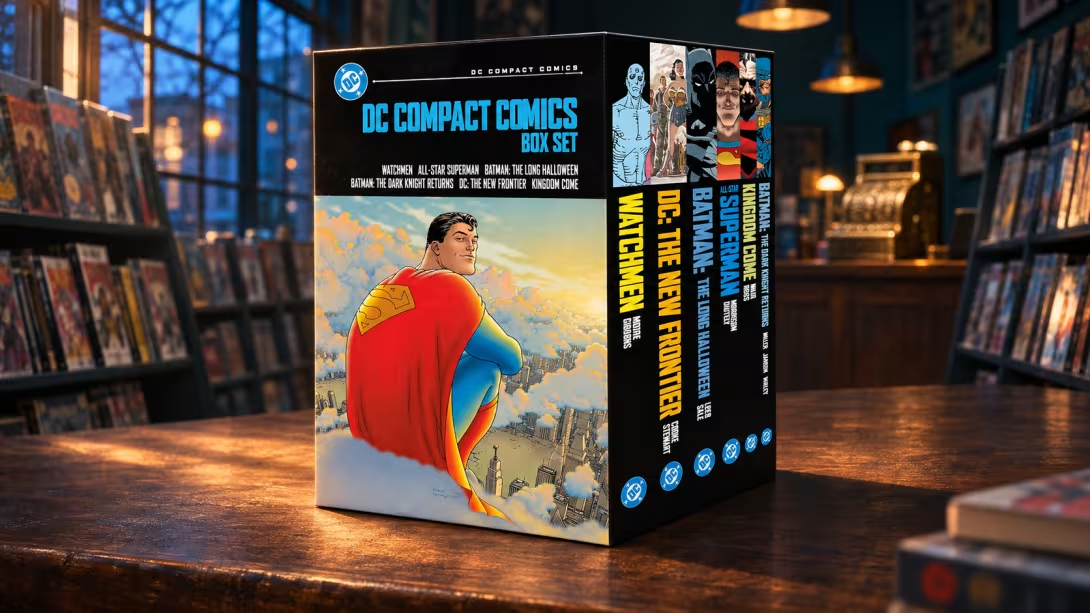
DC’s $50 Starter Library Comes With Two Batmans and a Copy of Watchmen
A DC Library for Fifty Dollars
If you’re buying comics for somebody who doesn’t read them, the hardest part can be telling them where to start. Say “Batman” and you’ve narrowed it down to a character who has been in print since 1939. You still have to choose a book, figure out whether the story begins in that book, and make sure it ends there. DC’s holiday answer is a box with two Batman stories in it. One begins early in his career. In the other, he’s already retired.
The DC Compact Comics Box Set goes on sale November 24 for $49.99. It holds six paperbacks and 1,912 pages, according to the Penguin Random House listing. At the line’s $9.99 list price, those six books would cost $59.94 individually. The box takes almost exactly one book off the bill. More to the point, you can hand the whole thing to someone without having to explain which one comes first.
That was part of the appeal when DC announced Compact Comics ahead of the line’s June 2024 launch. The company chose a 5½ × 8½-inch trim familiar to trade paperback readers, kept the art in color, and priced the books at $9.99. DC general manager Anne DePies specifically named prose and manga readers. If you’re already used to picking up a paperback because the cover interests you, DC wanted a Superman book to be that easy to buy.
There’s a trade-off in shrinking pages drawn for a larger format. Frank Quitely’s panels still have the same number of things to look at, and Dave Gibbons’s lettering takes up less physical space. A longtime reader might prefer a bigger edition for precisely those reasons. But this box is an invitation to read the books in the first place. It asks for fifty dollars and a little shelf space, and the person opening it gets to decide which story looks good enough to start tonight.
That makes the selection the most revealing thing about the set. DC had six slots to tell a newcomer what its comics could do. It spent one on Superman at his most generous, two on Batman at very different ages, and one on a book that asks how much trust anybody ought to place in a person who puts on a costume.
Two Batmans and a Copy of Watchmen
Start with the two Batman books in the box set. In The Long Halloween, Jeph Loeb and Tim Sale give us a Batman who still thinks he can help Harvey Dent and Jim Gordon put Gotham’s mob out of business. The three men have a plan. Then someone starts killing on holidays, and the city they thought they understood starts changing around them. By The Dark Knight Returns, Frank Miller’s Bruce Wayne has been away long enough to watch Gotham get used to life without him. He puts the suit back on anyway. Read the two books back to back and you can spend an evening watching Batman go from making a pact with the district attorney to picking a fight with Superman.
Then open All-Star Superman. Grant Morrison and Frank Quitely give Superman a death sentence and let him decide what to do with the time he has left. He has plenty to do, but the moment that tells you who he is takes a single page. He stops to talk to a girl on a ledge. If you’ve just come from Miller’s Gotham, where Superman arrives as an instrument of government power, the man on that ledge is a good reason to keep two very different versions of a character on the same shelf.
Darwyn Cooke’s DC: The New Frontier and Mark Waid and Alex Ross’s Kingdom Come make a pair of their own. Cooke places the arrival of a new generation of heroes in the America of the Cold War and the space race. His Hal Jordan is a pilot who has already seen what his country can ask of a man in uniform. Waid and Ross start with a generation that has come and gone. Their Superman returns to a world that has embraced heroes willing to kill, and the story puts a minister, Norman McCay, in a position to watch what happens when the old guard decides it knows how to set things right. Cooke earns the moment when his heroes come together. Waid and Ross ask what the rest of us are supposed to do when they do.
And then there’s Watchmen. Alan Moore and Dave Gibbons give a newcomer a murder to follow, a dead man’s bloodstained smiley-face badge, and a cast of people who have spent years justifying what they do in costume. You can read it first. Put it last and some of the questions carry over from the other books. Who asked these people to act on everyone else’s behalf? What happens when they disagree about whom to save? The box gives you a Superman who stops for one person on a ledge and a book in which someone decides how many people can die for the sake of everybody else. DC is selling both as places to start.
What Do You Read Next?
If The Long Halloween is the book that gets passed around after Christmas, the next purchase is easy to imagine. Jeph Loeb and Tim Sale made a sequel, Dark Victory. A reader who loved the way Darwyn Cooke drew the world of The New Frontier might follow him out of DC’s superhero universe altogether and into his adaptations of Richard Stark’s Parker novels. Those are two different ways into comics. One reader wants to know what happens next. The other wants to see what the artist does with a different kind of story.
The box is narrower than its six titles make it look. Two books carry Batman’s name, and two more put Superman near the center of an argument about what heroes should be. Wonder Woman has a place in that company, especially in The New Frontier, but she never gets a book of her own. DC already had Wonder Woman: Earth One in the Compact Comics line. Putting it in the box would have meant giving up one of the six books. I’d miss the conversation between the two Batman books, but I’d also like to see what a first-time reader would make of a shelf where Diana got the same space Bruce did.
I’d buy it for someone who has a favorite superhero movie and has never followed that character into a comic shop. If they open The Dark Knight Returns first and find Miller’s Gotham a little too pleased with its own ugliness, there’s a different Superman a few inches away. If they finish Watchmen and want to go back to see what Gibbons was doing in the panels before they knew how the murder story ended, they already own the book. They can leave it on the nightstand and come back to it in February. A fifty-dollar box of paperbacks gives them that much room to find out what they like.