
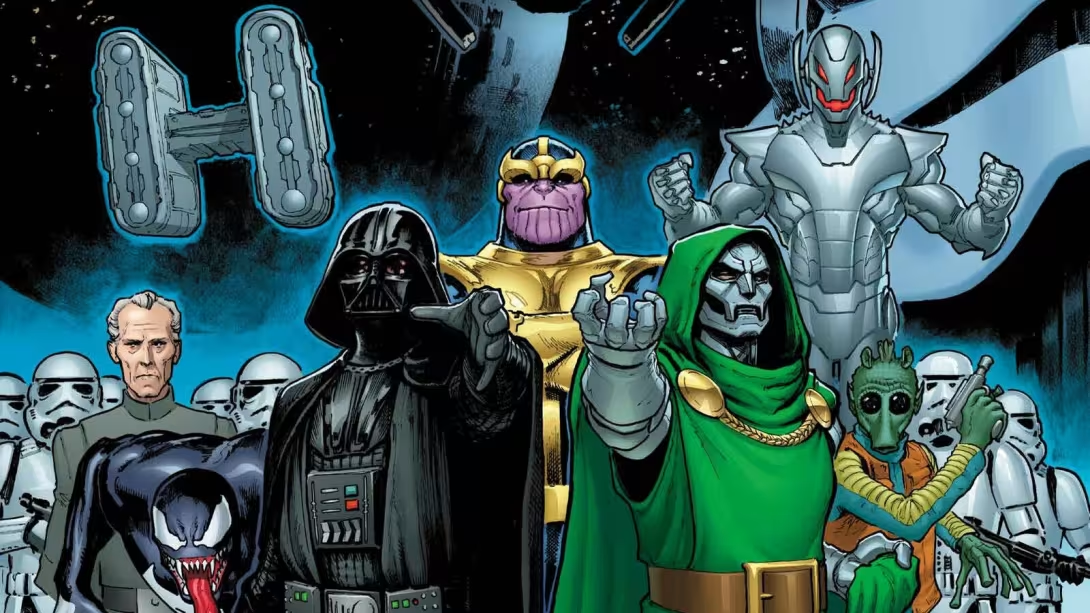
Star Wars Meets Marvel: Kevin Smith Brings Two Universes Together in Hope Assembles
It was only a matter of time before two of the largest fictional universes in popular entertainment found themselves occupying the same space. Marvel Comics and Lucasfilm are bringing the heroes and villains of Star Wars into direct contact with the Marvel Universe in Star Wars/Marvel: Hope Assembles, a six-issue limited series written by Kevin Smith and illustrated by David Marquez. The first issue arrives January 13, 2027, but comic book retailers have a more immediate date to consider: November 23, 2026, is the final order cutoff.
The project is part of the celebration surrounding the 50th anniversary of the original Star Wars film, and the premise goes considerably further than simply placing two recognizable franchises on the same comic book cover. According to the official announcement from Lucasfilm, the crossover brings Luke Skywalker, Princess Leia, Han Solo, and Darth Vader together with Spider-Man, the Avengers, Doctor Doom, and other inhabitants of Marvel's Earth-616.
Call it Starvel Wars if you like, but Marvel's latest crossover is taking the concept of a shared universe to an entirely different galaxy. And with Kevin Smith writing the adventure, fans can probably expect a few characters to notice just how strange the situation has become.
A Long Time Ago, on Earth-616
The story begins with a reality-shattering spell that causes the events of Star Wars: A New Hope to unfold on Earth-616, the primary continuity of Marvel Comics. That premise immediately opens the door to combinations that would ordinarily be impossible. The Rebel Alliance and the Avengers can find themselves fighting the same enemies, while the Empire suddenly has to contend with superheroes whose abilities make even the most impressive Jedi powers seem a little less extraordinary.
It also creates some fascinating questions about the relative power of the characters involved. What happens when Darth Vader encounters Thor? How does Spider-Man react to the existence of lightsabers? Could Iron Man develop a suit capable of competing with Imperial technology? And perhaps most importantly, what happens when Doctor Doom discovers a galactic dictatorship already operating under someone else's management?
Marvel's promotional material specifically identifies Doom and Vader among the crossover's major villains. That pairing alone should be enough to attract readers who have spent years debating which fictional tyrant possesses the more formidable combination of technological genius, supernatural power, and spectacularly inflated self-regard.
The challenge for Smith will be making these encounters feel like an actual story rather than a sequence of elaborate introductions. Crossovers have an unfortunate tendency to become exercises in determining which characters can defeat which other characters, sometimes at the expense of the narrative that brought them together. A reality-altering premise gives Hope Assembles considerable freedom, but it also places a responsibility on the creative team to make the collision of these universes matter beyond its novelty.
Marvel and Star Wars Have a History
Although this is being promoted as the first true crossover between the two fictional universes, Marvel's relationship with Star Wars reaches back almost to the beginning of the franchise. Marvel published Star Wars #1 in 1977, adapting George Lucas's original film for comic book readers before the movie had even reached theaters.
That early publishing arrangement became an important part of both companies' histories. The original Marvel series continued well beyond its adaptation of the first film, developing new adventures and introducing characters and situations that helped keep the franchise active between theatrical releases. Marvel's original Star Wars run ultimately reached 107 issues before concluding in 1986.
The publishing history eventually became more complicated as the Star Wars comics license passed to Dark Horse Comics, which developed an extensive line of stories spanning multiple eras of the fictional galaxy. Following Disney's acquisition of Lucasfilm, Marvel resumed publishing Star Wars comics in 2015, bringing the property back under the same corporate umbrella as the Avengers, Spider-Man, and the X-Men.
Yet sharing a publisher is not the same thing as sharing a fictional continuity. Marvel's Star Wars stories have generally remained within the established framework of the Lucasfilm universe, rather than treating Luke Skywalker as another character who might reasonably encounter Peter Parker on the streets of Manhattan.
Hope Assembles changes that arrangement, at least for the duration of its limited series. Fifty years after Marvel first introduced comic book readers to Luke Skywalker, the publisher is finally allowing him to meet some of the other characters who have occupied its pages for generations.
Kevin Smith Gets the Keys to Both Kingdoms
Kevin Smith is an interesting choice to oversee a crossover of this magnitude. Although best known to mainstream audiences for films such as Clerks, Mallrats, and Chasing Amy, Smith has an extensive history writing superhero comics, including memorable work on Marvel's Daredevil and DC's Green Arrow.
Smith also brings an unusually visible enthusiasm for both franchises. His familiarity with the characters and their histories makes him a logical candidate for a project that depends as much on understanding the personalities involved as it does on arranging spectacular confrontations.
David Marquez, whose credits include Uncanny X-Men and major Marvel superhero projects, will handle the interior artwork. His experience with large casts and cinematic action should serve a story that must accommodate everything from costumed superheroes to starfighters, Imperial technology, and lightsaber combat.
The creative team's task is not simply to make these characters look convincing together. It is to find a narrative reason for readers to care about what happens when two established mythologies collide. The strongest crossover stories understand that the appeal lies not merely in seeing familiar characters occupy the same panel, but in discovering how those characters respond when their assumptions about the world are challenged.
Nine Covers and a January Launch
Marvel is giving the first issue an appropriately substantial launch, with nine announced cover options. The standard edition features artwork by David Marquez, while additional covers include contributions from Alex Ross, Kaare Andrews, Cory Smith, Rafael Albuquerque, Dan Jurgens, Rogê Antônio, and Matteo Lolli.
The cover program includes an Alex Ross alliance variant, a Kaare Andrews battle variant, a Dan Jurgens retro cover recalling Marvel's earlier Star Wars publishing era, and a foil edition by Matteo Lolli. There are also incentive variants for retailers ordering qualifying quantities, including a 1:25 Marvel homage cover and a 1:100 virgin variant.
The standard issue is priced at $5.99, runs 40 pages, and carries a Teen rating. The foil variant is listed at $8.99. Readers interested in particular covers should check with their local comic shops, especially where incentive editions are concerned, because availability and pricing may depend on individual retailer orders.
According to the Penguin Random House Comics retailer listing, November 23 is the final order cutoff for the January 13 release. That makes today's announcement particularly relevant to comic shops preparing their orders and collectors hoping to secure specific variants.
Two Universes, One Very Large Playground
There is no shortage of possible confrontations once the barriers between these franchises disappear. A confrontation between Doctor Doom and Darth Vader practically writes its own promotional copy, while the idea of Spider-Man encountering a Jedi Knight offers opportunities for humor that would be difficult to resist. Even the Avengers might discover that defending one planet is considerably simpler than becoming involved in a galactic civil war.
Still, the real appeal of Hope Assembles is not the promise of settling arguments about which characters would win in hypothetical battles. It is the opportunity to see two storytelling traditions, each with its own rules and mythology, interact in ways that neither could accommodate independently.
Marvel's superhero universe has always been elastic enough to embrace science fiction, magic, cosmic entities, alternate dimensions, and the occasional reality-ending catastrophe. The Star Wars universe, meanwhile, has built an enormous mythology around the Force, galactic politics, ancient conflicts, and the struggle between freedom and authoritarian power. There is plenty of common ground, even if the participants have traditionally operated in different galaxies.
Whether this crossover ultimately becomes a memorable anniversary celebration or simply an entertaining exercise in corporate synergy will depend on what Smith and Marquez do with that common ground. The ingredients are certainly there, and the 50th anniversary provides a fitting occasion to revisit the publishing relationship that helped introduce Star Wars to comic book readers in the first place.
Star Wars/Marvel: Hope Assembles #1 arrives in comic shops January 13, 2027. With the final order cutoff falling on November 23, readers who want a particular edition should contact their retailers now rather than rely on finding their preferred cover on release day.
After half a century of Marvel publishing adventures from a galaxy far, far away, the two universes are finally going to meet. The only question is whether Earth-616 is ready for the company.