
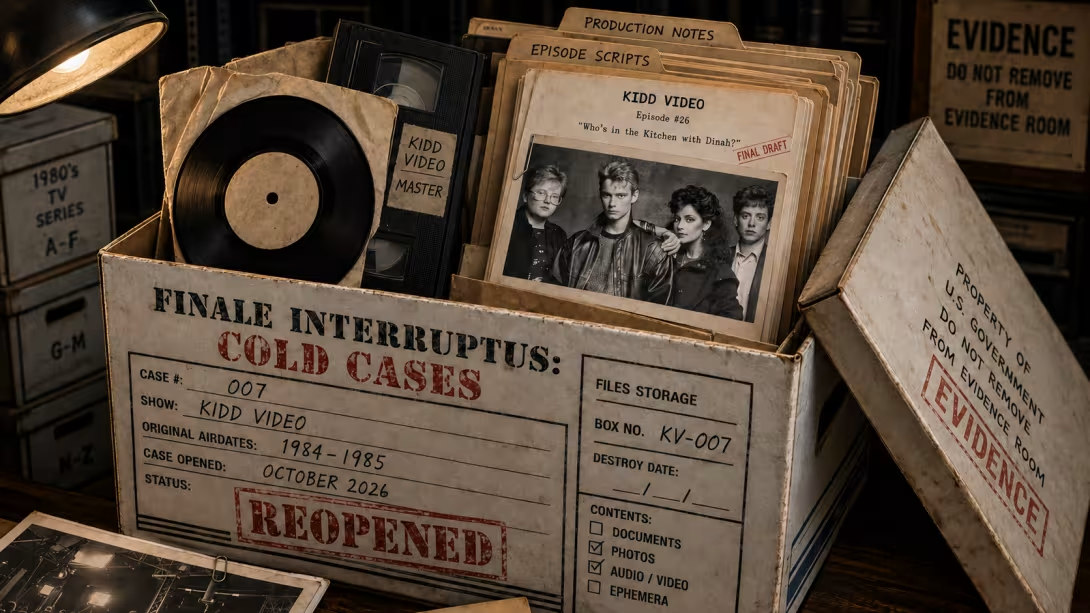
Finale Interruptus: Cold Cases - Case File #007: Kidd Video
Every television series begins with a promise.
Give us your time. Your attention. Your imagination.
In return, we’ll tell you a story. And when it ends, we’ll bring it to its proper conclusion.
Most do.
Some don’t.
Some endings are still missing.
These are their case files.
1. From My Video to My Radio
Case File #007 ought to belong to Pierce Brosnan. Unfortunately for our numbering gimmick, Remington Steele actually resolved most of its outstanding business. Its final episodes revealed the identity of Steele’s father, settled his relationship with Laura Holt and allowed its leading couple to consummate the romance that had sustained the series. The man’s birth name remained a mystery, but Remington Steele had become more than an alias. It was the identity he had chosen.
The four members of Kidd Video were not so fortunate. They never chose to live in the Flipside. They were abducted, transformed and stranded there—and when their television series ended, nobody sent them home.
The story began in a live-action rehearsal space where four young musicians were practicing together. Kidd was the lead singer and guitarist. Carla played drums. Ash handled keyboards, bass and saxophone. Whiz played guitar and keyboards while serving as the group’s resident inventor. Before they could finish rehearsing, a bizarre animated record executive called the Master Blaster emerged through a portal and pulled the entire band into another dimension.
Passing through that portal converted the musicians into animated versions of themselves. Their rehearsal space disappeared, but Whiz’s Subaru Brat crossed over with them and became the Kiddmobile, a much larger vehicle capable of carrying the band across the musical geography of the Flipside. The Master Blaster intended to make Kidd Video his personal house band—musical slaves whose talent could be exploited for his benefit—but a fairy named Glitter helped them escape before his plan could be completed.
Escape from the Master Blaster was not the same thing as escaping the Flipside. Kidd, Carla, Ash and Whiz remained trapped in a world governed by the logic of music videos, where songs could become physical places, musical terminology described actual creatures and the corrupt executive who had kidnapped them continued trying to bring them under his control. Each adventure might foil one of the Master Blaster’s schemes, but the larger case remained open: the band still had to find its way back to the real world.
That premise could only have been created during one particular moment in popular culture. MTV began broadcasting in 1981 and rapidly transformed the music video from a promotional accessory into an entertainment form of its own. Songs no longer merely played on the radio. They arrived with costumes, choreography, fantasy worlds and miniature narratives that could be stranger and more visually ambitious than the films appearing in theaters. Saturday-morning television noticed.
By 1984, programmers were searching for ways to bring the style and energy of MTV to a younger audience. Cable television had already produced experiments such as Nickelodeon’s Nick Rocks and the Disney Channel’s DTV, which edited familiar animation to popular recordings. Network television wanted its own version of the phenomenon, and DIC Enterprises had two of them ready for the fall schedule: ABC’s Wolf Rock TV and NBC’s Kidd Video.
As Cash Box reported shortly before the premiere, Kidd Video combined an animated half-hour with contemporary rock hits and ended each episode with a live-action performance by the band created for the series. It was not simply a cartoon about musicians. It was designed to function as an animated music-video program, a fantasy adventure and the launching pad for an actual recording act.
The concept originated with the creative partnership surrounding DIC Enterprises and Saban Productions. Jean Chalopin and Andy Heyward brought DIC’s animation experience, while Haim Saban and Shuki Levy supplied the musical machinery that had already become integral to the company’s programs. Saban and Levy had learned how effectively synthesizers, driving rhythms and instantly memorable melodies could distinguish an animated series. With Kidd Video, music was no longer decorating the program. Music was the program’s environment, its subject and one of its principal commercial ambitions.
Early promotional material referred to the project as Hot Rocks, but the eventual title did more than name the band. “Kidd Video” described the product NBC hoped to sell: music-video culture repackaged for children too young to be MTV’s primary audience. The spelling made the calculation unmistakable. This was rock video for kids, presented by a performer whose own name was Kidd.
Unlike purely fictional cartoon bands, however, Kidd Video existed on both sides of the television screen. Bryan Scott played Kidd, Gabriele Bennett played Carla, Steve Alterman played Ash and Robbie Rist played Whiz. The performers appeared in the live-action opening, supplied the voices of their animated counterparts and participated in the musical performances shown at the end of the episodes. Their characters were transformed into cartoons, but the actors themselves were meant to remain visible enough for young viewers to recognize them as a real band.
Rist later remembered the production fondly, explaining in a 2015 interview that the job allowed the cast to sing, play, act and pretend to be rock stars. Their promotional performances sometimes relied upon prerecorded tracks, but Kidd Video was not merely four actors standing in front of instruments they could not use. Music was part of their professional lives, and the producers genuinely hoped the group might develop an audience beyond Saturday morning.
The plan initially seemed plausible. The program premiered on NBC on September 15, 1984, and quickly distinguished itself in the children’s ratings. A contemporary Cash Box report described it as the highest-rated program in its Saturday-morning time period and quoted Saban calling it an “animated musical adventure.” Rather than interrupting an ordinary cartoon to show music videos, the series attempted to integrate portions of those videos and recordings into a continuous story.
That construction gave Kidd Video an identity no later release could easily reproduce. An episode might use a popular song behind a chase, turn a lyric into a visual joke, or stop long enough for a character to display part of an actual music video. Lionel Richie, Cyndi Lauper, Duran Duran, Culture Club, a-ha, Tears for Fears, Wham! and other performers became part of the program’s musical vocabulary without becoming regular characters within its narrative.
The approach was exhilaratingly current—and almost designed to become legally unmanageable. A conventional animated series could be rerun or sold on home video as a self-contained production. Kidd Video carried fragments of the mid-1980s recording industry inside its episodes. Every featured song and inserted video brought another piece of licensed material whose future use would depend upon contracts written for a world before streaming, digital downloads or online video archives.
None of that mattered to a child watching in 1984. To that audience, the Flipside looked like a place where radio had become geography and every music video might open a doorway into another adventure. The colors were brighter, the rules were stranger and the songs were already familiar. It was a world built from everything playing on the radio and everything suddenly appearing on television. It was also a prison.
Kidd Video could travel through the Flipside, challenge the Master Blaster and rescue other musicians from his schemes. The band could perform at the end of every episode and briefly become flesh and blood again for the audience. What its members could not do was cross that final boundary themselves. The Master Blaster had pulled them through the screen. The case would remain open until someone found a way to pull them back.
2. Trapped on the Flipside
The opening title sequence of Kidd Video performed an enormous amount of narrative labor. In approximately one minute, it introduced the band, brought the Master Blaster into the real world, transported the musicians into the Flipside, transformed them into cartoons and showed Glitter freeing them from captivity. Every subsequent episode could therefore begin with the essential situation already established: Kidd Video had escaped its kidnapper, but it had not escaped the world into which he had taken it.
The Flipside was not presented as another planet or a conventional fantasy kingdom. It was a musical dimension in which the language of the recording industry had become physical reality. Cities, creatures and machines were named after songs, instruments, audio technology and popular culture. Neon City could have emerged from the background of an MTV video. Beatburg was ruled by rhythm. Grooveyard City turned discarded songs and obsolete musical styles into part of its landscape. Popland made an entire country out of a radio format.
This allowed the writers to construct adventures from musical puns that younger viewers could understand even when they did not recognize every recording being referenced. Woofers and tweeters were no longer merely parts of a stereo system. A lost note could become a literal object. Chameleons and dragons existed beside jukebox castles, living instruments and machines capable of manipulating music itself. The Flipside did not obey the laws of physics because it obeyed the laws of a music video.
The band’s personalities were broad enough to function within that environment but distinct enough to generate conflict. Kidd was the confident frontman, usually prepared to act before anyone had established whether his plan was sensible. Carla was athletic, energetic and frequently the most practical member of the group. Ash loved music but lacked courage, making him especially vulnerable whenever an adventure required the band to enter some threatening corner of the Flipside. Whiz supplied the technical solutions, constructing or repairing whatever device the plot required while becoming irritated when his friends failed to treat a problem with sufficient seriousness.
Their transformation into cartoon characters did not give them conventional superpowers. They survived by relying upon one another, improvising with music and using the exaggerated possibilities of the Flipside. Whiz’s inventions were particularly important because the Kiddmobile served as the closest thing the group possessed to a home. The vehicle had entered the portal as his Subaru Brat and emerged as a mobile headquarters large enough to transport the band through the animated world. It was both their connection to the life they had lost and evidence that the Flipside could rewrite anything passing through its boundary.
Glitter became their guide and fifth member. Small, winged and seemingly fragile, she possessed extraordinary strength whenever she sneezed. The joke provided an emergency solution without making her permanently invincible: Glitter could rescue the others, but only when the appropriate involuntary reaction occurred. More importantly, she belonged to the Flipside. While the band viewed the dimension as a place from which it needed to escape, Glitter understood its inhabitants, geography and dangers.
The second season added Toolbot, a compact robotic toolbox associated primarily with Whiz. Toolbot expanded the show’s supply of mechanical jokes and gave Whiz another character with whom to discuss inventions. The addition also demonstrated that the producers expected the world to continue expanding. New allies, locations and devices could be introduced indefinitely without bringing Kidd Video any closer to home.
The Master Blaster remained the cause of the larger problem even when he was not directly responsible for every weekly crisis. He was less a sorcerer than the nightmare version of a record-industry executive: a man who regarded musicians as property, talent as something that could be extracted and popular songs as products to be duplicated. His floating headquarters resembled a giant jukebox, turning the machinery that delivered music into the fortress from which he controlled it.
His enforcers made the metaphor even less subtle. Cool Kitty, Fat Cat and She-Lion were the Copy Cats, a trio of anthropomorphic performers whose principal talent was reproducing music stolen from someone else. The Master Blaster did not need to develop artists when he could capture them, drain what made them valuable and transfer that ability to a more obedient act.
The premiere episode, “To Beat the Band,” made that threat explicit. The Master Blaster trapped Lionel Richie and other musicians inside a bubble connected to a machine that allowed the Copy Cats to reproduce their talent. He also manipulated the tempo of life in Neon City, first accelerating its residents toward premature old age and then planning to slow them until they could no longer move. Music was not simply playing beneath the action. Tempo, performance and artistic theft had become the action.
Kidd Video repeatedly interfered with such schemes. The band rescued people, recovered musical objects and prevented the Copy Cats from exploiting the Flipside’s inhabitants. Popular recordings often accompanied the resulting chases, while actual music videos could become weapons of distraction. Characters would stop to watch a screen long enough for Kidd and the others to escape, effectively acknowledging the hypnotic power that music television exercised over the show’s own audience. What the band did not accomplish was any measurable progress toward leaving.
Episodes occasionally reminded viewers that Kidd, Carla, Ash and Whiz came from another world. The live-action performances at the conclusion reinforced that connection every week by returning the actors to human form for the audience, even though their characters remained animated within the story. The sequence created the sensation that the real band still existed somewhere beyond the Flipside, waiting for its cartoon counterparts to catch up.
Within the narrative, however, the search for home remained elastic. The group could discover a possible route, encounter a place resembling the real world or find some device powerful enough to suggest dimensional travel. Something would inevitably prove false, malfunction or become necessary for solving that week’s more immediate emergency. By the closing credits, the possibility had disappeared and the Kiddmobile was back on the road.
This was normal for a Saturday-morning adventure series. The premise had to survive because the premise generated the episodes. If Kidd Video defeated the Master Blaster and returned home, the show’s animated format would effectively end. The producers therefore had little incentive to let the characters succeed while new seasons remained possible. The problem emerges only when no final season is recognized as final.
A continuing quest can postpone its destination for years if the storytellers are eventually given an opportunity to reach it. The Fugitive could delay Richard Kimble’s confrontation with the one-armed man because the series ultimately produced that confrontation. Gilligan’s Island could repeat failed rescue attempts because later television movies finally removed the castaways from the island. Even a highly episodic children’s cartoon can close its governing premise if its creators know that the last adventure has arrived.
Kidd Video never received that warning in a useful form. Its 26 episodes accumulated places, allies and temporary victories without constructing a route toward a conclusion. The Master Blaster remained in power because he was needed for the next scheme. The Copy Cats remained available because there would always be another talent to steal. The Kiddmobile continued moving because the band could never reach its destination.
That destination mattered. Kidd Video had not voluntarily entered a magical realm and decided to explore it. The band members had been seized from their own lives by someone who intended to enslave them. Every colorful adventure took place inside the continuing consequences of that crime.
The Flipside might have looked like a music video, but the record could not end properly until the needle found the final groove. For Kidd, Carla, Ash and Whiz, every road still led to another song—and never through the doorway home.
3. The Band That Was Supposed to Become Real
Kidd Video was conceived as more than a television program. The animated adventures would attract viewers, the contemporary music videos would keep the series culturally current, and the live-action performances would introduce audiences to a band that could theoretically continue after the closing credits. NBC was not merely broadcasting four actors portraying musicians. DIC and Saban Productions hoped they were manufacturing a recording act.
The idea had precedent. The Monkees had begun as a television series built around a fictional band and developed into a group whose records outlived the program that created it. The Partridge Family had generated hit singles, albums and concert appearances from another carefully assembled television act. Saturday-morning animation had also produced the Archies, whose “Sugar, Sugar” reached the top of the Billboard chart even though most of the band’s supposed members existed only as drawings.
Kidd Video offered an additional advantage: its performers were visible, young and capable of appearing in person. Bryan Scott, Gabriele Bennett, Steve Alterman and Robbie Rist could promote the show, perform its songs and provide recognizable human faces for characters who spent most of each episode in animated form. The weekly transition from cartoon adventure to live-action music video was designed to make those identities inseparable.
Scott had the clearest frontman role as Kidd. Bennett supplied Carla’s physical energy and visual presence behind the drums. Alterman and Rist were working musicians as well as actors, and Rist had already spent years performing in bands around Los Angeles. The cast sang on the recordings and played at least some of the instrumentation, even though promotional appearances—like many television-created musical acts—sometimes required them to perform along with prerecorded tracks.
That distinction would later cause Kidd Video to be dismissed as a prefabricated band, but fabrication was part of the program’s premise. The Master Blaster wanted musicians he could control. The Copy Cats imitated music that belonged to other performers. Outside the story, producers and songwriters were attempting to assemble a marketable group from actors selected for a television series. The conflict between authentic creation and manufactured pop music existed on both sides of the screen.
The songs were not amateur productions. Haim Saban and Shuki Levy understood how to construct hooks capable of surviving repeated exposure, and the series surrounded the cast with experienced professional songwriters. “Video to Radio,” which opened and closed the program, announced the entire commercial strategy in its title. Other songs included “A Little TLC,” “We Should Be Together,” “Come Back to Me,” “You Better Run,” “Time” and “Where Did Our Love Go Wrong?”
“A Little TLC” had particularly strong credentials. Written by Lynsey de Paul and Terry Britten, it functioned as a polished pop single for the fictional group. “We Should Be Together” was also recorded by former ABBA singer Agnetha Fältskog for her 1985 album Eyes of a Woman. Kidd Video was not being given disposable novelty songs. Its producers were drawing from the same professional songwriting economy that supplied established recording artists.
The band’s performances usually appeared after the animated story had concluded. This gave each episode something resembling a miniature concert encore. The adventure might involve a stolen note, a musical monster or another Master Blaster scheme, but the closing minutes returned the cast to the physical world and placed the music at the center of the screen. For viewers, the transformation seemed to reverse: the cartoon musicians became human again, picked up their instruments and performed.
Within the fiction, however, no such return occurred. The live-action segments did not show Kidd and his friends arriving home after an adventure. They existed outside the episode’s continuity, functioning as promotional music videos rather than scenes from the band’s life after the Flipside. The audience could see the performers back in the real world every week while the characters remained trapped.
The series also incorporated music belonging to artists who required no introduction from NBC. Lionel Richie, Cyndi Lauper, Culture Club, Duran Duran, Prince, Wham!, Tears for Fears, a-ha and numerous other acts appeared through recordings or portions of existing videos. A child who tuned in for the cartoon could encounter songs already dominating radio and MTV, while a viewer attracted by the music could be carried into the continuing conflict with the Master Blaster.
That arrangement made Kidd Video unusually dependent upon the moment in which it was produced. Its musical references were not nostalgic selections licensed from a stable catalog. They were current releases being used while the artists, labels and music videos were still part of an active promotional cycle. The series effectively became a weekly time capsule of what younger viewers might have heard on Top 40 radio during 1984 and 1985.
Initially, the formula worked. Contemporary trade coverage reported strong ratings, and the program developed enough visibility for the cast to make promotional appearances. The promotional live shows were lip-synched to prerecorded tracks, a practice Rist later joked made Kidd Video “New Kids on the Block before there was one.” He nevertheless emphasized that the cast did sing and play, describing the production as an opportunity to combine the different kinds of work he had already been doing.
The hoped-for American recording breakthrough never occurred. In a 1986 assessment of Saban Productions, NBC children’s-programming executive Phyllis Tucker Vinson said Kidd Video had exceeded the network’s expectations as a television program. It had ranked among the ten highest-rated children’s shows and had been the strongest new program when introduced. The failure was not the cartoon’s immediate popularity. It was the attempt to launch its stars as a successful recording act.
DIC president Andy Heyward also believed the program’s advantage might be disappearing. Music videos had seemed like the future of youth entertainment when Kidd Video entered development, but trends designed around novelty have a short shelf life. By 1986, Heyward suspected that children were tiring of the format. A series constructed to capture the newest thing on television was vulnerable the moment that thing no longer felt new.
Kidd Video found a more durable audience elsewhere. The band became especially popular in Israel, where music and merchandise continued after the American production had ended. CBS Records released Kidd Video: The TV Show Hits on vinyl and cassette in Israel in 1986, and the group reportedly made promotional appearances in Israel the following year. Coloring books, chocolate bars and other licensed products preserved the band in a market where it had achieved the recognition its producers originally wanted in the United States.
The members did not remain together as a permanent recording act. They returned to their individual careers, although music continued to connect several of them. Rist became a prolific voice actor, musician and producer. Alterman also continued acting, voice work and playing music, at one point performing with Rist in the Beat Society. Bennett later worked as a teacher and dance instructor. Scott continued in voice acting and sound post-production.
Rist and Bennett reunited musically in 2012 for a performance at a Woodland Hills pizza restaurant. It was not a formal Kidd Video revival, but the sight of Whiz and Carla singing together again demonstrated the affection surrounding a project that had occupied only a short portion of their careers. Rist has described reconnecting with the other cast members through the Internet and has consistently spoken of them warmly.
There is an appropriate irony in the location of that reunion. The final episode of Kidd Video would begin with Whiz wanting pizza, sending him and Glitter to a shopping mall where Master Blaster’s latest scheme was already developing. Decades later, two members of the cast found themselves making music together in a pizza restaurant in the real world. The actors had escaped the production and moved forward with their lives. Their animated counterparts remained exactly where NBC had left them.
Before the investigation reaches that final pizza, however, it must examine the occasions when Kidd Video appeared to offer its stranded band a route home. The most important of those possibilities announced itself directly in an episode title. It was called “No Place Like Home.” The title was accurate in a way the band could not yet understand.
4. No Place Like Home
The most revealing failed escape occurred only five episodes into the series. “The Pink Sphinx” begins with Whiz suffering from homesickness. After becoming separated from the others, he saves Celesta, the leader of Beatburg, and is rewarded with access to the Pink Sphinx. Once each year, the creature awakens and grants a single wish to whoever can solve its riddle. Whiz immediately recognizes what the rest of the band’s adventures sometimes allowed them to forget: one correctly worded wish could send them home.
Kidd, Carla and Ash are less interested. They decide to enjoy one final outing in the Flipside while Whiz pursues the Sphinx, only to be captured by the Copy Cats and placed in mortal danger. Whiz solves the riddle, but the emergency forces him to choose between using the wish to return to the real world and using it to rescue his friends.
His wording attempts to accomplish both. Whiz wishes for everyone to be “safe at home,” presumably expecting the Sphinx to return the entire band to its rehearsal space. The creature interprets only the first portion of the request, making everyone safe without sending anyone home. Kidd, Carla and Ash survive, but the group remains in the Flipside.
The episode presents the outcome as a lesson about friendship. Whiz sacrifices his opportunity to escape because abandoning the others would be wrong. Beatburg also loses the wish normally used to keep its climate warm, leaving its residents prepared to endure a year of snow because Whiz needed the Sphinx’s power more urgently. Everyone accepts the consequences, and the band’s relationship emerges stronger. As evidence in the present investigation, however, the incident establishes something more important: returning home was possible.
The Pink Sphinx possessed enough power to grant the wish. The failure did not occur because the Flipside was permanently sealed or because travel between dimensions could happen only through the Master Blaster. Whiz had located a functioning means of escape and lost it to a combination of immediate danger and deliberately treacherous wording. The band did not need to discover whether a route home existed. It needed another opportunity to use one successfully. That opportunity appeared again in “Professor Maestro.”
Glitter brings the band to an eccentric inventor capable of sending it back to the real world. Professor Maestro has constructed a Flipside Dimensional Reverser, a machine whose purpose could hardly be clearer. Unlike the Pink Sphinx, it does not require a once-a-year wish. It is technology specifically designed to reverse the dimensional displacement that stranded Kidd Video.
The machine requires Ash’s Groove Machine to operate. This gives the Master Blaster a way to interfere: the Copy Cats steal the Groove Machine, forcing the band to pursue them through Professor Maestro’s hazardous laboratory. The ensuing adventure includes a life-sized video game, a giant pinball machine and Whiz being used as the ball. Eventually, Kidd Video recovers the missing component and returns to the laboratory. The Dimensional Reverser still cannot be activated.
Earlier in the episode, Whiz erased equations from Professor Maestro’s blackboard while attempting to free him from the machinery in which he had become trapped. Those equations are now required to complete the dimensional process. The band possesses the inventor, the machine and the stolen component, but the necessary information is gone. Once again, the door home closes at the exact moment the story reaches it.
This was not accidental repetition. “The Pink Sphinx” and “Professor Maestro” reveal the structural problem facing the writers. The band’s desire to return home supplied emotional weight and long-term motivation, but any device capable of satisfying that desire had to fail before the episode ended. The closer Kidd Video came to escaping, the more elaborate the obstruction needed to become.
Season Two opened with another machine capable of turning desire into reality. In “The Dream Machine,” Whiz invents a device that makes dreams come true. The Master Blaster wants it after the people of West End refuse to pay his music tax, and the Copy Cats convert it into a Nightmare Machine. The invention becomes the source of that week’s danger rather than the answer to the band’s larger problem. Whiz could create a machine capable of manifesting dreams, but the series could not allow him to use it to fulfill the dream that mattered most. Then came “No Place Like Home.”
Kidd and the others discover slides and a map leading to Homeward, a town that appears to resemble the real world. The name alone seems to promise what earlier devices had denied them. Believing they may finally have found someplace closer to the life they remember, the band undertakes a dangerous journey through the Cobalt Mountains. Homeward is not the real world.
The resemblance offers comfort without escape. Whatever familiar details draw the band toward the town, Homeward remains part of the Flipside and operates according to the same unstable fantasy logic. The title invokes Dorothy’s return from Oz, but Kidd Video cannot click its heels and awaken in the rehearsal space. The group finds another imitation of home inside the dimension that has already transformed it into imitations of itself.
The episode’s use of Nu Shooz’s “Point of No Return” could scarcely have been more appropriate. In surviving online copies, the actual video segment has sometimes been removed because of copyright restrictions. What remains is an adventure about characters crossing a hazardous landscape in search of home, accompanied in its original form by a song whose title warns that they may already have traveled too far to return.
After “No Place Like Home,” the search becomes less prominent. The later episodes send Kidd Video toward musical contests, pirate adventures, endangered friends and new schemes involving the Master Blaster’s relatives. Whiz gains Toolbot as a companion and appears less consumed by homesickness. The group has adapted to the Flipside, but adaptation is not resolution. Nothing establishes that the band has chosen to remain.
Kidd, Carla, Ash and Whiz never renounce the real world or decide that the Flipside has become their proper home. There is no episode in which they consider the lives waiting for them, weigh those lives against the friendships they have formed and deliberately choose the animated dimension. The series simply stops placing the question at the center of every adventure.
That distinction prevents the later episodes from functioning as an implied ending. A character can accept permanent exile, but the story has to dramatize that acceptance. Silence cannot substitute for a decision, particularly when the opening sequence continues reminding viewers that these musicians were kidnapped and brought into the Flipside against their will.
The band’s repeated failures also eliminate the argument that returning home was impossible within the rules of the series. The Pink Sphinx could apparently grant the necessary wish. Professor Maestro built a machine capable of reversing dimensional travel. Whiz invented technology capable of making dreams real. Homeward proved that the Flipside could reproduce at least the appearance of the world they had lost. The necessary mechanisms existed. What Kidd Video lacked was permission from its own format to use them.
A planned finale could have returned to any of these ideas. Professor Maestro might have reconstructed his equations. The Pink Sphinx could have awakened for another annual wish. Whiz might have repaired the Dream Machine or built a more reliable dimensional device. Even the Master Blaster’s original portal provided evidence that travel between the two worlds remained possible.
No such finale arrived. Instead, the second season moved toward an episode whose title promised neither escape nor confrontation. There would be no final battle in the Master Blaster’s jukebox fortress and no last journey through the dimensional barrier. There would be pizza, a shopping mall and a love potion. Then the music would stop.
5. Pizza, Love Potion and Then Silence
The final authenticated episode of Kidd Video is titled “Who’s in the Kitchen with Dinah?” It does not begin with the band discovering another portal, reconstructing Professor Maestro’s Dimensional Reverser or preparing for a decisive assault on the Master Blaster’s jukebox fortress. It begins because Whiz wants pizza.
Glitter takes him to the Twin Cities Shopping Mall, where Dinah operates as both a potion maker and a part-time pizza maker. The Master Blaster has business at the same destination. He sends the Copy Cats to obtain a love potion from Dinah, placing Whiz and Glitter in the path of another scheme that must be stopped before the closing credits.
Everything about the episode identifies it as a normal installment rather than a planned conclusion. The conflict is local, comic and entirely disconnected from the band’s search for home. The Master Blaster is not making his final move against Kidd Video. Kidd is not leading a mission to liberate every musician held captive in the Flipside. No character behaves as though a long struggle is approaching its resolution.
Even the band is divided during much of the story. Whiz and Glitter encounter the principal problem because of the trip for pizza, while the remaining members are drawn into the resulting complications. The Copy Cats remain bumbling servants rather than adversaries facing their last defeat, and Dinah is another colorful resident introduced for a single adventure.
The episode incorporates ABC’s “Be Near Me” and originally included part of a-ha’s “Take On Me.” The latter choice was almost inevitable for Kidd Video. Few music videos from the period more famously crossed the boundary between the live-action world and animation. In a-ha’s video, a young woman is pulled into the illustrated world of a comic book and must find her way back into reality. Kidd Video’s members had undergone essentially the same transformation. There was one crucial difference. The woman in “Take On Me” escaped before the song ended. Kidd, Carla, Ash and Whiz had been trying for two seasons.
Nothing in “Who’s in the Kitchen with Dinah?” uses that parallel to resolve the series. The a-ha footage functions as another contemporary musical insert, not as a clue or doorway. Whatever symbolic value the video acquired in the final broadcast was accidental. The band watches another story about someone crossing between reality and illustration, then remains on the wrong side of its own screen.
The episode concludes with the live-action Kidd Video performance of “A Little TLC.” The same song had accompanied the end of “To Beat the Band,” the first regular episode. Viewed retrospectively, its return creates an elegant musical circle. The audience finishes the series with the band in human form performing one of its signature songs, just as it had near the beginning. That is a bookend, but it is not an ending.
The performance exists outside the animated continuity. It does not show the characters returning to their rehearsal space or resuming the career interrupted by their abduction. The Master Blaster has not been defeated, the Copy Cats have not been reformed and Glitter has not said goodbye to the friends she helped rescue from slavery. The live-action music video closes the television episode while leaving its story exactly where it had begun.
NBC broadcast “Who’s in the Kitchen with Dinah?” on December 7, 1985. It was the thirteenth episode of the second production season and the twenty-sixth episode overall. That number matters because several online databases now list a supposed twenty-seventh installment called “The Finale.” No credible production record supports it.
The fabricated description claims that the Master Blaster kidnaps Wham!, that one member of the duo escapes to enlist Kidd Video and that the Copy Cats discover a way to destroy the world. The language does not resemble a professional synopsis, and the episode does not appear in established broadcast records, contemporary listings or the 13-episode production block. Its presence on editable databases has allowed fiction to masquerade as a lost conclusion.
There was no episode 27. There was no adventure titled “The Finale,” and Wham! did not enter the story as guest characters requiring rescue. George Michael and Andrew Ridgeley appeared through music-video footage, just as other contemporary performers did. Database credits generated from archival footage cannot transform those appearances into a missing narrative episode.
The actual record contains two seasons of thirteen episodes. That structure was normal for network animation. NBC could repeat each package throughout the broadcast year without commissioning the larger episode orders used for weekday syndication. Kidd Video remained visible after production ended because those 26 episodes continued circulating in reruns.
This has created another misleading impression: that the series continued producing new episodes until 1987. It did not. NBC continued showing the existing library after the last original episode aired in December 1985. CBS later acquired reruns, extending the program’s broadcast life without extending its story. For a child encountering an episode out of sequence, there was no obvious distinction between a new adventure and one made several years earlier. Kidd Video appeared to remain active because the band was perpetually moving through the same unresolved present.
The production did not end because the program had immediately collapsed in the ratings. In August 1986—months after the last original episode—the Los Angeles Times still described Kidd Video as a hit for NBC that had ranked among the top ten children’s programs. NBC executive Phyllis Tucker Vinson said it had exceeded the network’s expectations.
The larger commercial experiment had been less successful. NBC and Saban Productions had wanted the cast to develop into a popular recording act, and that did not happen in the United States. DIC president Andy Heyward also believed children’s interest in music videos might be fading. The format that had made Kidd Video appear extraordinarily current in 1984 risked making it look attached to a passing fad only two years later.
Music licensing is frequently cited by fans as the reason for the cancellation. It unquestionably complicated later reruns and home-video releases, but no reliable contemporary source uncovered in this investigation establishes rising licensing costs as the decisive reason NBC stopped ordering episodes. The safer conclusion is less dramatic: the network had two 13-episode packages it could continue repeating, the hoped-for recording career had not materialized, and the children’s market was moving toward heavily merchandised weekday cartoons with much larger episode orders.
Whatever discussions occurred behind the scenes, the surviving episode offers no indication that the writers were instructed to bring the premise to a conclusion. “Who’s in the Kitchen with Dinah?” contains no hurried farewell or improvised attempt at closure. It was produced as another adventure because another adventure was all anyone expected it to be.
The absence of a finale also means there is no canonical answer to the case’s central questions. Did the band eventually find another dimensional portal? Could Professor Maestro reconstruct his equations? Would the Pink Sphinx grant another wish after a year passed? Could Whiz reverse the Master Blaster’s original transportation technology? Would Glitter accompany her friends into the real world, or remain behind in the Flipside? No episode answers them.
The Master Blaster successfully committed the kidnapping at the center of the series and escaped permanent punishment. The Copy Cats continued serving him. The other musicians held within the Flipside were never collectively liberated. Kidd Video won individual battles while losing the one battle that defined the premise.
There is something peculiarly appropriate about a television series built around music ending without a final chord. No narrator announced that the adventure was over. No image froze as the band crossed the threshold home. No final lyric explained what its members had learned. Whiz ate—or attempted to eat—his pizza. Dinah’s love potion was dealt with. “A Little TLC” played one more time. Then NBC returned the band to the beginning and started the reruns.
6. The Case Copyright Forgot
A canceled television series ordinarily leaves behind a stable body of evidence. Its episodes can be repeated, collected on disc and transferred from one streaming service to another while viewers debate what might have happened next. Kidd Video presents a more complicated problem because the program preserved its era too accurately.
The animation still exists. The voice performances still exist. The live-action Kidd Video songs still exist. What does not necessarily remain attached to them is the legal permission to use every contemporary recording and music video embedded in the original broadcasts.
Those elements were fundamental to the series. A chase scored to a current hit was not always interchangeable with generic production music. The characters might react to the song, move according to its rhythm or use an actual music video to distract an opponent. Removing the licensed material could preserve the basic plot while damaging the pace, jokes and cultural identity that distinguished Kidd Video from other cartoons.
Later broadcasts demonstrated the problem. After the original NBC run, the existing episodes continued in reruns, eventually appearing on CBS and in syndication. In 1989, Kidd Video was paired with another DIC music-based cartoon as The Wolf Rock Power Hour. Fan-maintained broadcast histories report that WGN aired the series as late as 1992, but by then some licensed recordings had been replaced with generic music and the inserted videos had been removed.
Collector records identify six American VHS releases from Golden Books Video. Four contained a single episode, while two offered three episodes each. Those releases retained more of the program’s original music than some later television versions but omitted the commercial music-video inserts. Even viewers who collected every available tape could not reconstruct the complete NBC broadcasts.
The Internet eventually became the series’ unofficial evidence locker. Fans uploaded episodes recorded from different broadcasts, compared American versions with foreign-language copies and attempted to identify which songs had originally appeared in which scenes. Those efforts have recovered material that might otherwise have disappeared, but online copyright enforcement can reproduce the same absences that affected syndication.
The surviving upload of “Who’s in the Kitchen with Dinah?,” for example, identifies the location where a-ha’s “Take On Me” was removed following a copyright claim. “No Place Like Home” similarly circulates without its Nu Shooz video segment. The episode remains understandable, but the record is incomplete. A series built to bring radio, video and animation together survives with pieces of that relationship cut away.
Fan restoration efforts have since searched international broadcasts for missing dialogue, footage and musical sequences. Different territories preserved different components, allowing dedicated viewers to compare versions and rebuild approximations of the original episodes. The achievement is considerable, but a fan reconstruction is not the same thing as an authorized remaster assembled from original production elements and cleared for commercial release.
That helps explain why Kidd Video has never received the comprehensive DVD, Blu-ray or streaming presentation enjoyed by many less successful cartoons of the same period. A distributor would need more than clean animation masters. It would have to determine the rights attached to the series itself, the Kidd Video recordings, the popular songs, the original videos and the various territories in which those elements might be shown.
Ownership is not simple enough to reduce to a single familiar corporate name. DIC Enterprises and Saban Productions were both involved in the production, and the libraries associated with those companies later traveled through different acquisitions and reorganizations. Saban Entertainment asserted ownership of the Kidd Video trademark during the 1990s, while DIC’s larger catalog eventually became associated with successors including Cookie Jar and WildBrain. Determining who could authorize a revival would require examining contracts and chain-of-title documents unavailable in ordinary public sources.
The music introduces an additional layer. Saban controlled original material such as “Video to Radio,” but that did not confer ownership of recordings by Lionel Richie, Culture Club, Duran Duran, a-ha or the other artists whose work appeared in the episodes. Even if one company possesses the underlying program, it may not possess the right to redistribute the version viewers remember.
A revival could solve that problem by omitting the old recordings and licensing new ones. The basic premise remains remarkably adaptable. A band could be pulled from today’s digital music culture into an updated Flipside governed by streaming platforms, algorithms, viral trends and synthetic performers. The Master Blaster’s desire to own artists and reproduce their talent through the Copy Cats may be even more relevant in an era of artificial intelligence than it was during the age of MTV.
Such a production could also resolve the original case. Kidd, Carla, Ash and Whiz might finally locate a stable route home. The story could reveal that little time had passed in the real world, allowing them to emerge from the portal near the moment of their disappearance, or it could confront the stranger possibility that decades had elapsed while they remained unchanged inside an animated dimension. The original performers could appear as older versions of the characters, relatives searching for them or musicians whose unfinished recordings have become clues.
None of that has happened. There has been no authorized continuation, reunion movie or published final story establishing what became of the band. Robbie Rist has spoken warmly about the production and reconnecting with his castmates, and his later performance with Gabriele Bennett demonstrated that affection for the group survived. Nostalgia, however, is not continuity. Two performers sharing a stage cannot transport their animated counterparts out of the Flipside.
The absence of a documented intended conclusion means this investigation cannot reconstruct one from creator interviews. No publicly documented series bible uncovered in this investigation contains a final confrontation, and no verified unproduced script sends the Kiddmobile through a portal. No producer has explained that a third season would have revealed the Master Blaster’s technology or allowed Whiz to complete a dimensional machine. The case therefore rests entirely upon the episodes that exist.
Those episodes establish that dimensional travel is possible. The Master Blaster accomplished it in the opening sequence. The Pink Sphinx possessed enough power to send the band home, even if Whiz’s wish was diverted. Professor Maestro built a Flipside Dimensional Reverser but lost the equations needed to activate it. Whiz created machinery capable of making dreams real. The writers left several plausible routes available for a finale they were never asked to produce.
The episodes also establish that the characters did not accept permanent residence in the Flipside. They adapted because they had to. They formed friendships, protected communities and repeatedly defeated the Master Blaster’s schemes, but they never chose exile. The disappearance of their homesickness from later stories does not transform kidnapping into consent.
Nor can the live-action performances be treated as proof of their return. Those videos presented the actors as the band for promotional purposes; they did not continue the animated narrative. If they did, Kidd Video would have escaped at the end of nearly every episode and inexplicably been stranded again the following week.
The verdict must therefore remain open. Kidd, Carla, Ash and Whiz are still somewhere beyond the screen, traveling in the Kiddmobile through a world constructed from music that can no longer be licensed easily enough for the rest of us to visit. Glitter remains with them. The Master Blaster still occupies his flying jukebox, and the Copy Cats remain available for another stolen performance.
The program attempted to turn music television into a cartoon, and time performed the opposite transformation. Kidd Video became a collection of incomplete recordings, edited reruns, foreign copies and fan restorations—a series about characters trapped inside media that is itself trapped inside obsolete agreements.
CASE STATUS: OPEN
The band never escaped. The villain was never defeated. The last episode supplied pizza instead of passage home, and the closing song offered “A Little TLC” when what the story needed was one final portal. The needle lifted, but the record never finished.