

Kingdom Come at 30: When a Cautionary Tale Became a Prophecy
The most damning indictment of the superhero industry in 1996 may have come from a comic book in which Superman was among the people who had lost their way. In Kingdom Come, Mark Waid and Alex Ross envisioned a future in which the proliferation of superpowered individuals had made the world considerably more dangerous, and the man who might once have prevented such a development had surrendered his responsibility to do so.
Thirty years later, DC Comics is revisiting that future with the release of Kingdom Come: 30th Anniversary Deluxe Edition, a hardcover collection featuring new cover artwork by Ross and retrospective afterwords from both creators. The anniversary comes at an interesting point in the history of superhero entertainment, when many of the creative disputes that inspired the original miniseries have spilled over into movies and television, bringing an argument once largely confined to comic book shops before a considerably larger audience.
Readers discovering Kingdom Come today may recognize elements of contemporary superhero entertainment in its pages. Readers who purchased those four issues as they appeared in 1996 will remember how directly the book spoke to what was happening in the industry at the time.
The Generation That Replaced Superman
The commercial and critical successes of Alan Moore and Dave Gibbons' Watchmen and Frank Miller's The Dark Knight Returns in the 1980s established that superhero comics could sustain considerably more literary and thematic complexity than their detractors had traditionally acknowledged. Both works examined the psychological and social consequences of extraordinary power, and both helped expand the audience for a medium that much of the general public still regarded as exclusively children's entertainment.
Some of the comics that followed, however, appeared to have taken their creative cues from the most readily imitated aspects of those works. By the early 1990s, exaggerated musculature, elaborate weaponry and increasingly violent confrontations had become prominent features of the superhero marketplace. Characters such as Cable and the Punisher enjoyed considerable popularity, and the emergence of Image Comics in 1992 gave the industry's most commercially successful artists an opportunity to bring their own creations to market.
There was considerable creative energy behind that movement, and its importance to the development of creator-owned comics should not be discounted. But the popularity of heroes willing to kill presented an interesting problem for a character whose identity was so closely associated with the preservation of life. The qualities that had distinguished Superman for decades were becoming less fashionable in the very genre he had helped establish.
Ross had already demonstrated an affinity for examining superheroes from the perspective of ordinary people with Marvels, his 1994 collaboration with writer Kurt Busiek. As detailed in DC's retrospective on the development of Kingdom Come, Ross approached the publisher with sketches and story concepts that he subsequently developed with Waid, whose considerable knowledge of DC history made him particularly well suited to the project.
The resulting collaboration gave the creators an opportunity to examine the changing definition of heroism through a character specifically designed to embody many of the era's prevailing aesthetic and moral sensibilities: Magog.
In the future depicted in Kingdom Come, the Joker has murdered Lois Lane and other employees of the Daily Planet. Superman intends to bring him to justice, but Magog kills the Joker before that process can take place. When Magog is acquitted and embraced by the public, a disillusioned Superman withdraws from society. The people he has spent his life protecting have endorsed a course of action fundamentally at odds with his principles.
Waid has explained that finding a believable reason for Superman to retire was one of the creative challenges presented by Ross's initial concept. The death of Lois alone would not adequately explain why a man committed to a never-ending battle would abandon it. The public's repudiation of his values provides the motivation, although Superman's response ultimately compounds the problem. His absence deprives subsequent generations of the example that might have offered an alternative to Magog.
By the time Wonder Woman persuades him to return, a confrontation involving Magog and his fellow heroes has resulted in the devastation of much of Kansas. The superpowered population has grown increasingly accustomed to fighting amongst itself with little regard for the ordinary people caught between its opposing factions. For all the supposed freedoms afforded by abandoning the moral restrictions of their predecessors, these heroes have failed at the most basic responsibility associated with their profession.
The Fallibility of the World's Greatest Heroes
It would have been easy for Waid and Ross to construct a story in which the returning Superman defeats his misguided successors and restores the values of a supposedly superior generation. Such a story would certainly have appealed to readers frustrated with the direction of mainstream superhero comics, but it would have deprived Kingdom Come of much of its substance.
Superman's reconstituted Justice League attempts to bring the metahuman population under control, eventually establishing a massive prison known as the Gulag. The circumstances surrounding its creation are understandable, particularly in the aftermath of the Kansas disaster, but the institution embodies an increasingly troubling assumption about the authority Superman believes he possesses. His efforts to prevent another catastrophe help create the conditions for one.
Wonder Woman has endured her own estrangement from the ideals that once defined her, adopting an increasingly militaristic approach to the crisis. Batman, physically diminished by decades of crimefighting, maintains control over Gotham City through robotic enforcers. Despite their objections to the excesses of the younger generation, the three principal figures of the DC Universe have each developed a rather complicated relationship with the exercise of power.
Ross's paintings contribute enormously to the reader's understanding of what has happened to these characters. The gray at Superman's temples, the physical deterioration of Bruce Wayne and the increasingly martial bearing of Wonder Woman convey the accumulated consequences of their respective histories. Readers accustomed to seeing these characters perpetually restored to their familiar appearances between publishing eras were confronted with versions who had been allowed to age and who carried the evidence of decisions they had made decades earlier.
The religious dimension of the narrative also has its origins in Ross's personal history. The son of a Protestant minister, Ross drew inspiration from his father in developing Norman McCay, the elderly pastor through whose eyes much of the story unfolds. Accompanied by the Spectre, McCay witnesses the developing conflict and is ultimately called upon to exercise a form of moral judgment for which his superpowered contemporaries are often remarkably ill-equipped.
The imagery and language of the Book of Revelation lend the proceedings an appropriately apocalyptic atmosphere. Yet the presence of McCay also ensures that the story remains concerned with the people whose lives are at stake. The increasingly insular world of the superheroes, absorbed in disputes over how best to manage their own kind, has largely lost sight of those people.
Advertisement
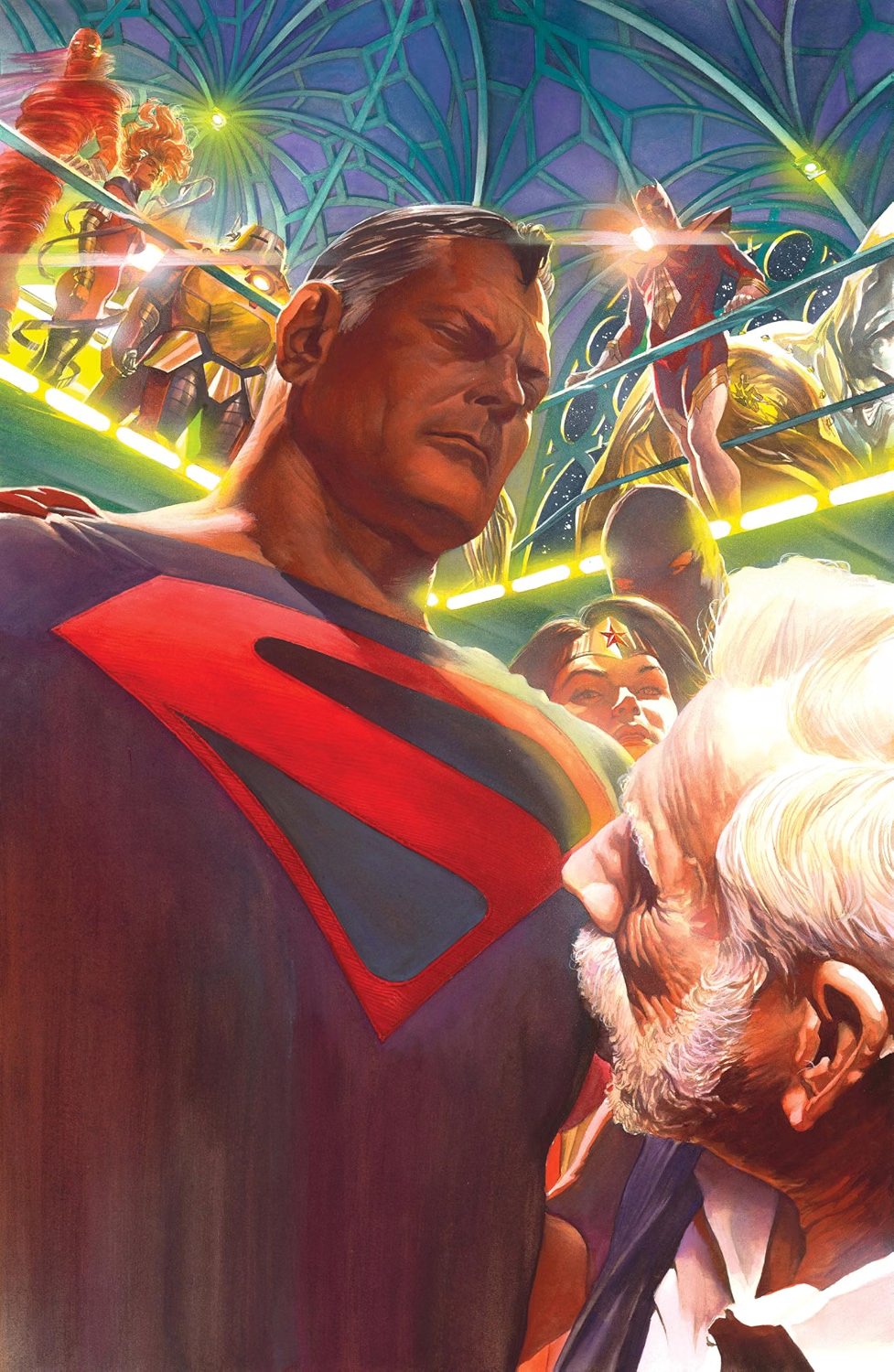
Kingdom Come: 30th Anniversary Deluxe Edition
Revisit the landmark collaboration between Mark Waid and Alex Ross in a 352-page deluxe hardcover featuring a new cover, retrospective afterwords, sketches and annotations.
As an Amazon Associate, we earn from qualifying purchases.
When Hollywood Discovered Magog
In 1996, the possibilities for bringing superheroes to the screen were considerably more limited than they would become in the following decades. The commercial success of the Batman films had demonstrated the potential of DC's characters, but the industry was still years away from treating interconnected superhero franchises as a cornerstone of its theatrical business. When Hollywood finally embraced those possibilities, it inherited many of the creative disagreements that had occupied comic book readers.
Zack Snyder's Man of Steel in 2013 brought the subject of Superman's willingness to kill before a worldwide audience. Henry Cavill's Superman ultimately kills General Zod to prevent him from murdering a family, a decision that generated considerable disagreement among viewers familiar with the character's established moral outlook.
Although Superman had killed in previous comic book stories, perhaps most notably when John Byrne's interpretation of the character executed three Kryptonian criminals in Superman #22 in 1988, the circumstances under which he might resort to lethal force remained a contentious subject. Byrne's story, in fact, made the psychological consequences of that decision a significant part of Superman's subsequent adventures.
The disagreement surrounding Man of Steel was therefore less about establishing whether Superman had ever killed than about the kind of story filmmakers should choose to tell with him. Snyder's defenders saw an inexperienced Superman confronted with an unbearable moral dilemma. His detractors questioned the creative decision to make such a dilemma the culmination of the character's introduction to a new cinematic universe.
Three years later, Batman v Superman: Dawn of Justice presented an older Bruce Wayne whose methods had become increasingly brutal. Although his circumstances were quite different from those of the Batman depicted by Ross and Waid, both interpretations explored what could happen to the character after decades of personal loss and exposure to criminal violence.
The television adaptations of The Boys and Invincible, both based on comics published after Kingdom Come, have taken related concepts in their own directions. Homelander's corruption of the familiar superhero archetype and the revelations surrounding Omni-Man depend, to a considerable extent, on the audience's recognition of the kind of hero each character outwardly resembles.
The success of those productions need not constitute an indictment of contemporary superhero entertainment. Both have used violence and moral ambiguity to explore subjects that more conventional superhero adventures might have difficulty accommodating. Their effectiveness, however, owes something to the continued cultural familiarity of the traditional Superman archetype. Without an established understanding of what a man possessing Superman's abilities might aspire to be, the corruption of those abilities would carry considerably less dramatic weight.
Goodness as a Creative Challenge
James Gunn's Superman, released in 2025, offers a particularly useful point of comparison with Kingdom Come. Gunn had attracted considerable attention in November 2022 by sharing Ross's artwork from the graphic novel on social media, prompting speculation that the newly appointed DC Studios co-chairman might be contemplating an adaptation. His eventual introduction of David Corenswet as Superman proved to have a more philosophical connection to the material.
Speaking to NPR in an interview accompanying the film's release, Gunn discussed his initial reservations about directing a character whose outlook seemed rather removed from the more irreverent sensibilities associated with his own filmmaking. In an environment characterized by cynicism, he came to regard Superman's refusal to adopt that attitude as one of the character's more interesting qualities.
Corenswet's Superman is capable of making mistakes and is frequently confronted with circumstances more complicated than he initially appreciates. His concern for individual lives nonetheless remains evident even amid the large-scale destruction expected of a contemporary superhero film. The much-discussed moment in which he saves a squirrel provides a small but revealing example of where his priorities lie.
There is an interesting parallel here with what Waid and Ross recognized in 1996. The dramatic possibilities of Superman's moral outlook increase considerably when the world around him provides compelling reasons to abandon it. Maintaining that outlook requires something of the character, particularly when a more expedient course of action might yield an immediate victory.
That was also the source of Superman's greatest vulnerability in Kingdom Come. Having concluded that humanity no longer wanted what he represented, he eventually returned with a diminished appreciation for its ability to participate in decisions concerning its own future. His rehabilitation required him to recover something considerably more fundamental than his position as the leader of the Justice League.
Thirty Years Later
The continued availability of Kingdom Come in multiple formats is a testament to the book's significance within DC's publishing history. The new 352-page anniversary hardcover, priced at $39.99, supplements the original material with sketches, annotations and retrospective commentary from Waid and Ross. For a work whose development involved such an extensive visual collaboration, the supplementary material offers an opportunity to appreciate how thoroughly its creators considered the histories and appearances of even relatively minor characters.
During a presentation at the 2024 San Diego Comic-Con for the documentary The Legend of Kingdom Come, Waid discussed the development of the project and identified a particular moment that helped him understand the story he and Ross were constructing. As reported by The Beat, Waid found an important element of Superman's emotional journey in the seemingly mundane act of putting his Clark Kent glasses back on.
It is a particularly effective detail in a book filled with spectacular imagery. Superman initially retreats from humanity into an artificial recreation of the Kansas farm on which he was raised. His return to the outside world is undertaken almost entirely in his capacity as Superman, and the relative absence of Clark Kent helps explain the difficulty he encounters in relating to the people whose interests he believes he is serving. The glasses signify the recovery of an identity he had all but discarded.
Thirty years of superhero entertainment have provided ample demonstrations of how powerful Superman can be, how destructive a confrontation between beings of comparable strength might become, and how frightening such abilities would be in the hands of someone indifferent to human suffering. Those concepts were already present in Kingdom Come, where Ross was perfectly capable of making Superman appear as intimidating as any of the characters against whom the book was ostensibly arguing.
Yet the most consequential intervention in the story ultimately belongs to an elderly minister who persuades Superman to reconsider his actions at a moment when no physical force seems capable of restraining him. Norman McCay's importance to the resolution of the conflict is a reminder of how much Waid and Ross understood about a character whose appeal has always depended upon his relationship with people considerably less powerful than himself.
Perhaps the most enduring image in Kingdom Come is not one of its elaborate battles or imposing portraits of the assembled Justice League, but the sight of Superman wearing a pair of glasses again. After thirty years of increasingly sophisticated efforts to bring the extraordinary abilities of superheroes to the screen, there is still something to be learned from the significance Waid and Ross attached to that thoroughly ordinary object.