
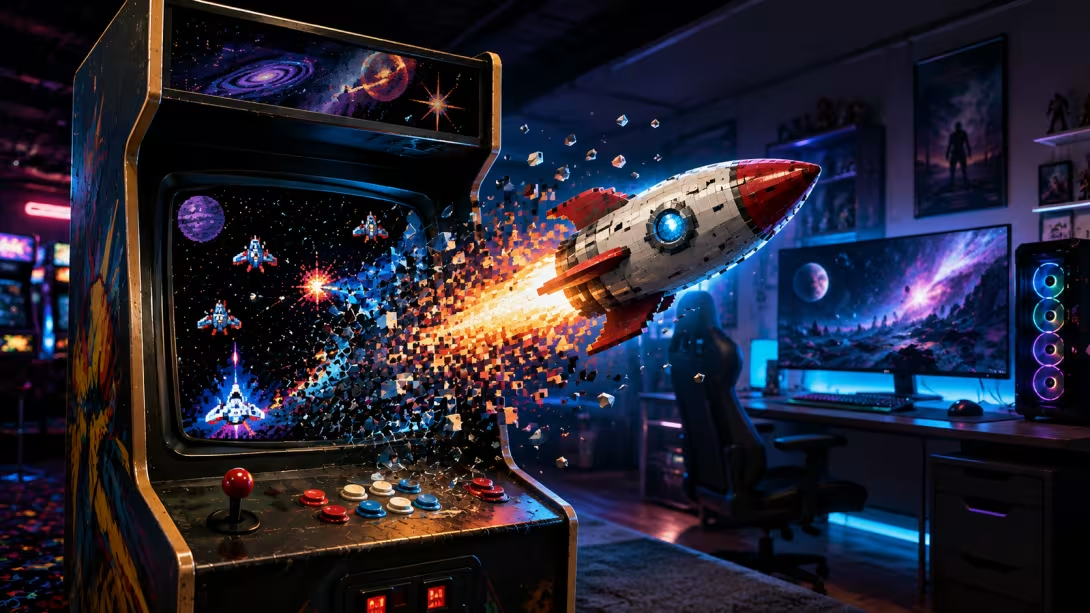
Retro Gaming Isn't About Going Backward Anymore
There was a time when keeping an old video game system connected to the television felt less like preserving history and more like refusing to clean the basement. The new console was better. The graphics were better. The controllers had more buttons, the cartridges gave way to discs, the discs gave way to downloads, and yesterday's technological miracle became the thing you shoved into a box because surely you would never need it again.
Then a funny thing happened. We discovered that newer and better were not synonyms. A game did not stop being fun because somebody invented more polygons, and the limitations developers once fought against became part of a visual and mechanical vocabulary players could recognize instantly. The Atari 2600, Nintendo Entertainment System, Sega Genesis and their descendants stopped being obsolete appliances and became instruments with distinctive sounds.
Retro gaming consequently isn't quite about nostalgia anymore. Nostalgia remains part of it, certainly, but the culture surrounding old games has expanded beyond people trying to reconstruct Saturday afternoons from 1986. We preserve old games, rebuild them for new hardware, manufacture new machines that accept old cartridges and, increasingly, create entirely new games that deliberately behave as though several decades of technological escalation were optional.
That's not going backward. It's what happens when a medium becomes old enough to have traditions.
The Games We Were Supposed to Outgrow
Video games spent their early decades obsessed with technical progress because technical progress was impossible to ignore. Every new generation could put more objects on the screen, display more colors, produce better sound and simulate worlds that the previous hardware simply could not manage. Marketing practically demanded side-by-side screenshots so consumers could see exactly why the machine under the Christmas tree needed replacing.
That race produced extraordinary games, but it also encouraged the assumption that games aged like hardware. Nobody expected a 1977 television set to compete indefinitely with whatever came next, so why should a game made for 1977 hardware remain relevant? The answer turned out to be embarrassingly simple: because hardware performs a function, while a game creates an experience.
Pac-Man does not require ray tracing to be Pac-Man. Tetris does not become strategically obsolete when the blocks acquire textures. Super Mario Bros. still understands momentum, timing and level design regardless of how many processors are available to render the Mushroom Kingdom. Once players began separating technological age from design quality, an enormous portion of gaming history became playable rather than merely historical.
That distinction also explains why retro aesthetics migrated into new games. Pixel art was once the best approximation of a character that the hardware could display. Today it can be a conscious artistic choice. Limited palettes, chunky sprites, chiptune music, fixed viewpoints and simple control schemes can communicate a design philosophy before the player presses Start.
Film never discarded black and white after color arrived. Musicians did not stop using acoustic guitars when synthesizers appeared. Games are finally mature enough to understand the same principle: a technique doesn't become artistically invalid merely because technology has invented another one.
Preservation Became a Platform
There is another reason retro gaming has become more than nostalgia: old games are surprisingly fragile cultural objects. A cartridge can survive for decades, but the machine required to play it may not. Digital storefronts close. Licensing agreements expire. Operating systems change. Companies disappear. A game that once existed in millions of homes can become inconvenient or impossible to purchase legally even though perfectly functional copies still exist in the world.
That has turned preservation into an industry as well as a hobby. Collections no longer need to be folders containing ROMs and a menu. The best modern archival releases provide scans, interviews, development materials, historical context and multiple versions of the games themselves, treating interactive entertainment with the same seriousness film collectors expect from a restored disc release.
Atari has made that philosophy unusually visible. Its Atari 50: The Anniversary Celebration combines more than 100 playable games with interactive timelines, interviews and archival material, effectively turning a game compilation into a playable documentary. The company also acquired Digital Eclipse, whose specialty is restoring and contextualizing classic games, and Nightdive Studios, whose business is built around making older titles function properly on contemporary systems.
The interesting thing about that strategy is that preservation and commerce are not enemies. If old games can be packaged intelligently, explained properly and made convenient to play, history becomes a product people actually want. A preserved game doesn't have to sit behind museum glass. The entire point is that somebody can pick up the controller.
Old Games on New Machines
The most fascinating current development may be happening outside the companies that own the games. In August, PC Gamer argued that retro game recompilations are one of the most exciting things happening in gaming, and the enthusiasm is understandable. Fan developers are increasingly taking the code of older console games and translating it so those games can run natively on modern computers rather than requiring the original hardware to be simulated wholesale.
That distinction sounds technical until you see the results. Recompiled games can gain widescreen support, higher frame rates, modern controller options, accessibility improvements, quality-of-life changes and extensive modding while preserving the underlying game. Players generally still need to supply their own legally obtained game data, but the surrounding software can make a decades-old console title behave remarkably like a native PC release.
The movement is accelerating. Projects have targeted Nintendo 64 games including Ocarina of Time, Majora's Mask, Banjo-Kazooie, Mario Kart 64 and others, while similar approaches are spreading to different platforms. Just this week, a years-long effort reached a complete decompilation of GoldenEye 007 for Nintendo 64, opening another famous old game to the possibility of native ports and extensive modification.
This is preservation with a toolbox open. Emulation asks modern hardware to impersonate an old machine convincingly enough to run its software. Recompilation asks what happens when the software itself is taught to live somewhere new. Neither replaces the other, but both demonstrate how thoroughly the assumption that old games belong on old machines has collapsed.
Even the platform holders are participating in the broader idea. Microsoft recently began bringing selected original Xbox games to PC through backward compatibility, while Atari sells modern hardware capable of accepting original 2600 and 7800 cartridges. We have reached the wonderfully strange point where a cartridge manufactured before some players' parents were born can be inserted into hardware sold today.
And Now We're Making New Old Games
Preserving an old game is one thing. Making a new game that intentionally feels old is something else, and perhaps that is the clearest sign that retro has graduated from an age category into a genre.
Comic creator George Peter Gatsis offers a particularly literal example with Joe King Adventure Hour, an original 2026 browser-based retro space rescue game. Nothing is being emulated and no forgotten cartridge is being restored. The game runs directly in a modern browser, but its presentation and priorities deliberately evoke the games that once ate quarters by the handful.
And in Gatsis' case, that's exactly where the inspiration came from.
When we asked him what he had in mind while creating the Joe King Adventure Hour retro game, Gatsis immediately went back to the arcades of his childhood.
“I was inspired by the greatest games in my childhood, that I had lost the MOST quarters on,” Gatsis told us, naming Asteroids, Tron, Galaga, Lunar Lander and Space Invaders among the culprits.
That's practically an evolutionary tree of early arcade gaming. Each game gave the player a relatively simple set of rules, then found increasingly inventive ways to make surviving within those rules difficult. There weren't hours of cinematics explaining your motivation. The quarter went in, the game started, and within moments you understood the problem.
But Gatsis wasn't interested in simply recreating one of those experiences.
“But I wanted to level it up,” he said, “so it would be more of an adventure in decision making during the action-packed gameplay.”
That distinction gets directly to what modern retro gaming can do that nostalgia alone cannot. Joe King Adventure Hour borrows the immediacy of the arcade era without being restricted by it. The premise is immediately readable: people are stranded on planets throughout a changing solar system, and the player pilots a spacecraft between emergencies, transporting survivors to spacedocks while enemy ships threaten the route. But instead of merely chasing a high score until the inevitable GAME OVER, the player continually has to decide what matters most.
The game defines three escalating ways to measure success. At the easiest level, rescue people and deliver them safely. The next objective adds protecting the planets from hostile forces. The hardest asks the player to accomplish both while stopping DOOMSDAY before it reaches the Sun and triggers a black-hole event capable of consuming the solar system.
The ship itself becomes part of that decision-making. At spacedocks, players can build and customize it from modular components, moving, rotating, resizing and duplicating pieces. A secondary section can be separated during an emergency and turned into a timed explosive sacrifice; if that section is destroyed, construction robots at a spacedock can rebuild it piece by piece.
Do you fight? Do you rescue? Do you repair? Do you sacrifice part of the ship to survive the immediate threat and worry about rebuilding it later?
Those are more complicated decisions than Space Invaders ever demanded, but they're being made under the same pressure that made those old arcade cabinets so effective: something is happening right now, and you'd better do something about it.
That's what makes Joe King Adventure Hour relevant to the larger retro discussion. Gatsis isn't trying to convince anyone that the game was discovered on an unreleased arcade board from 1983. He's taking the things he remembers about the games that consumed all those quarters—the immediate action, understandable objectives and relentless pressure—and asking what can be built on top of them now.
The technology is new. The design ancestry isn't.
You can play Joe King Adventure Hour in your browser. The game page recommends a Chromium-based browser such as Chrome or Brave and includes the controls and an explanation of its underlying systems before launch.
And George, if you're wondering, apparently would like some of those quarters back.
Retro Is a Genre Now
The word “retro” used to answer a simple question: When was this game made? Increasingly, it answers a different one: What kind of experience is this game trying to create?
A game released in 1982 is retro because of its age. A game released in 2026 can be retro because of its grammar. It can value immediate readability over cinematic exposition, accept abstraction instead of chasing photorealism, build complexity from a small number of mechanics and use visual limitations as style rather than apology.
That doesn't mean old design was universally better. Anyone who actually lived through early gaming remembers terrible collision detection, passwords copied incorrectly onto scraps of paper, arcade games designed to consume quarters and adventures whose principal puzzle was discovering which undocumented command the programmer expected. Nostalgia has a remarkable ability to improve frame rates and erase loading times.
But we also learned things in those years that remain useful. Restrictions forced designers to communicate quickly. A player needed to understand what was dangerous, what could be collected and where the character could move from a handful of pixels. Games often had to become interesting before they became enormous because there wasn't enough memory available to hide a thin idea beneath fifty hours of content.
Modern retro gaming lets developers choose those virtues without inheriting every limitation that accompanied them. A new game can look deliberately simple while autosaving. An old console game can run at a modern frame rate. A cartridge can feed a contemporary HDMI machine. A thirty-year-old title can be preserved with interviews explaining how it was made, while a brand-new browser game can ask us to save a solar system using a design language that would have felt perfectly at home beside an arcade cabinet.
That is why the current retro movement feels less like an attempt to retreat into childhood than an expansion of gaming's vocabulary. We didn't abandon orchestras when electric guitars arrived, and we didn't throw away novels when movies learned to talk. Once a medium has accumulated enough history, creators stop treating yesterday's tools as obsolete and start treating them as choices.
Video games have reached that point.
The future of gaming can have ray tracing, enormous worlds, artificial intelligence and hardware capable of rendering individual pores on a character's face. It can also have pixels, cartridges, high scores, four directions and a button marked FIRE.
There's room on the screen for both.