


Some assignments are too dangerous for the law. Some enemies are too powerful for ordinary men. And some heroes have to die before they can begin.
Finale Interruptus: Case File #005 - Pirates of Dark Water
FTC Statement: Reviewers are frequently provided by the publisher/production company with a copy of the material being reviewed.The opinions published are solely those of the respective reviewers and may not reflect the opinions of CriticalBlast.com or its management.
As an Amazon Associate, we earn from qualifying purchases. (This is a legal requirement, as apparently some sites advertise for Amazon for free. Yes, that's sarcasm.)
Submitted by Bill Casticart on Tue, 08/25/2026 - 15:35
Every television series begins with a promise.
Give us your time. Your attention. Your imagination. Invite these characters into your home, follow their lives, and return each week to see what happens next.
In return, we'll tell you a story. And when it's over, we'll bring it to its proper end. We'll answer the questions, settle the conflicts, and give the characters—and the audience—a chance to say goodbye.
Most series keep that promise.
Some don't.
Some disappear between seasons, leaving their characters suspended in place and their audiences waiting for a conclusion that never arrives.
Some endings are still missing.
These are their case files.
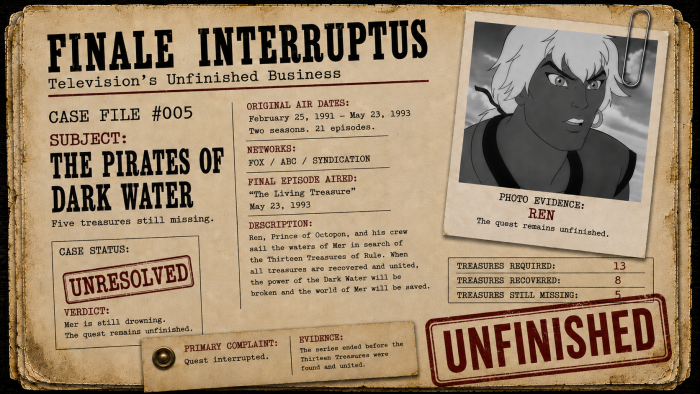
CASE FILE #005
SUBJECT: THE PIRATES OF DARK WATER
Original Run: February 25, 1991 – May 23, 1993
Network: Fox Kids / ABC / First-run syndication
Episodes: 21
Final Episode: “The Living Treasure”
Follow-up: No canonical continuation
Case Status: UNRESOLVED
THE SEA WAS BEING EATEN ALIVE
There are cliffhangers, and then there are assignments left incomplete.
The Pirates of Dark Water belongs firmly in the second category. It didn't leave its audience with a single unanswered question, a mysterious door that never opened, or a hero dangling from a precipice. It gave its hero a job with a number attached to it.
Find the Thirteen Treasures of Rule.
Ren needed all thirteen.
He found eight.
Then the show ended.
That remarkable bit of arithmetic makes The Pirates of Dark Water one of the cleanest cases ever to land on the Finale Interruptus desk. We don't have to speculate about whether the writers might have had another story to tell. The entire premise of the series announces exactly when the story will be finished, and the series stops five treasures short of getting there.
But to understand why those five missing treasures matter, you first have to understand what was happening to the world of Mer. Dark Water was spreading.
Not ordinary water made sinister by an ominous adjective, but a living, malevolent substance consuming everything in its path. It swallowed ships, destroyed islands and threatened eventually to cover the entire planet. The seas themselves were becoming the enemy, and there was only one known means of stopping them: locate the legendary Thirteen Treasures of Rule and bring them together.
Unfortunately, almost nobody knew where they were. When we first meet Ren, he isn't a prince commanding a fleet or a warrior preparing to inherit a kingdom. He's a teenage lighthouse keeper on the island of Octopon, raised without knowing his true identity. That changes when a mysterious stranger arrives and reveals that Ren is the son of Primus, the lost king of Octopon. The stranger is Primus himself, and father and son don't get much time for catching up.
Primus has spent years opposing the pirate lord Bloth and searching for the Treasures of Rule. Before he can complete that mission, Bloth's forces catch up with him. Primus entrusts Ren with the quest, and the boy who began the story tending a lighthouse suddenly inherits considerably more than a throne. He inherits an endangered world.
Ren's companions gradually assemble around him. Ioz is a pirate and swordsman whose self-interest doesn't prevent him from becoming one of Ren's most dependable allies. Tula initially has motives of her own but proves to possess formidable abilities and eventually becomes indispensable to the quest. Niddler, the monkey-bird, provides transportation, appetite and comic relief, although reducing him to the latter badly undersells how often Ren needs him.
And pursuing them is Bloth, the massive, ruthless pirate captain commanding the enormous vessel Maelstrom.
Bloth isn't interested in allowing Ren to save Mer. He wants the Treasures himself, and Brock Peters gives him the sort of booming authority that made the character considerably more frightening than Saturday-morning television villains were generally required to be. Bloth has monsters, pirates, prisons, weapons and an enormous ship at his disposal. Ren begins his quest with little more than his father's broken sword, a handful of companions and the knowledge that failure eventually means the end of everything.
It is an extraordinarily big premise for a Hanna-Barbera cartoon. That deserves emphasis because The Pirates of Dark Water arrived carrying a studio name that, by 1991, audiences associated as readily with Scooby-Doo reruns, talking animals and decades of Saturday-morning cartoons as with sweeping serialized fantasy. Yet here was an invented world with its own geography, cultures, creatures, mythology and an environmental catastrophe steadily consuming it. Mer felt dangerous.
The heroes traveled through places that existed beyond the requirements of a single episode. Strange species populated ports and islands. Alliances shifted. Characters had secrets. Ren wasn't simply protecting a status quo that would conveniently reset before the next broadcast. He was traveling toward something.
And every Treasure mattered because every Treasure moved him closer to the end. That is the crucial distinction.
Plenty of adventure cartoons gave their heroes goals that existed mostly to justify another episode. Cobra Commander would hatch another scheme. Skeletor would attack Eternia again. Somebody would inevitably cause trouble in the vicinity of the Mystery Machine.
Ren had a finite mission. Thirteen objects existed: find them, unite them, stop the Dark Water, save Mer. The audience could count along.
That makes what happened to The Pirates of Dark Water particularly painful in retrospect. The series wasn't asking viewers to imagine that Ren and his friends would continue adventuring forever. It had established a finish line, and for 21 episodes they sailed toward it. They just never got there.
THIRTEEN TREASURES AND A PROMISE
Before it was The Pirates of Dark Water, it was simply Dark Water.
The adventure began on Fox Kids in February 1991 as a five-part animated miniseries. Those opening chapters establish Ren, reveal his heritage, assemble the beginnings of his crew and send him into a world that already feels considerably larger than the story has had time to explore.
When the adventure continued later that year, it did so under the title by which most viewers now remember it: The Pirates of Dark Water. The change was appropriate. Ren may be the prince of Octopon, but this isn't much of a story about sitting on a throne. It's about sailing, and Mer gave the writers plenty of places to sail.
One of the series' greatest strengths was the sense that its world existed beyond whatever island happened to appear that week. Mer wasn't simply Earth with the names changed. It was an alien fantasy world filled with bizarre creatures, unfamiliar civilizations and geography that could turn hostile without warning.
The vocabulary helped. There were monkey-birds and ecomancers. There were leviathans, strange beasts and stranger peoples. Bloth commanded the Maelstrom, a gigantic pirate vessel that looked less constructed than grown. Ren sailed aboard the comparatively modest Wraith. Even familiar concepts were surrounded by enough invented language and visual design to make Mer feel like a place with a history nobody had completely explained to us.
The show trusted young viewers to keep up. More importantly, it trusted them to remember.
That matters because The Pirates of Dark Water wasn't simply a collection of adventures involving the same characters. The series had continuity. What Ren accomplished this week could change where the quest stood next week. Characters and ideas returned. Information accumulated. Most importantly, the number of Treasures in Ren's possession could increase.
That gave the series something extraordinarily useful for serialized storytelling: visible progress.
The Treasures of Rule weren't thirteen interchangeable magic coupons that Ren needed to punch before receiving a free kingdom. Each discovery required another journey into Mer, and the search continually exposed more of the world and more of the people traveling through it.
Ren also wasn't the same person at the end of every adventure.
He begins with an inheritance he barely understands. Being the son of Primus doesn't magically provide the experience necessary to replace him. Ren has to become the person capable of completing his father's mission, and much of the appeal comes from watching an essentially decent young man discover how difficult decency can become when everybody around him has competing priorities.
Ioz understands survival. Tula understands that people can have obligations they don't immediately disclose. Niddler understands lunch. Ren has to understand all of them.
Their personalities make the quest work because this isn't a fellowship assembled from people who naturally belong together. Ioz can be cynical and mercenary. Tula has secrets. Niddler can be cowardly, impulsive and extremely distractible. Ren is the idealist trying to hold the mission together.
Bloth provides the opposite philosophy. If Ren represents responsibility inherited before he's ready for it, Bloth represents power pursued because he wants it. The Treasures can save Mer, but possession of that power also makes them valuable to anyone interested in controlling what remains of the world. That keeps the quest from becoming a scavenger hunt.
Ren isn't searching empty ruins at his leisure. He and Bloth are competing for the same prize while Dark Water continues spreading around them, and the clock is always running even when nobody can see its hands.
That underlying urgency distinguishes The Pirates of Dark Water from many animated adventure series of its era. A self-contained episode could still introduce an island, monster or local crisis, but the larger mission remained in the background. Eventually Ren had to return to the Treasures because the Treasures were the reason the journey existed.
The structure also created a contract with the audience. Thirteen is a wonderfully specific number.
If the series had merely told us that Ren must search for "the legendary Treasures of Rule," the quest could have continued indefinitely. Another Treasure could always exist beyond the next horizon. The writers could produce adventures until ratings disappeared and then plausibly argue that Ren's life simply continued somewhere beyond the final credits.
But somebody put a number on the mission: thirteen. That number turns the mythology into a promise.
We don't necessarily know how long finding thirteen Treasures will take. We don't know what each Treasure will be, where it is hidden, what Ren will have to sacrifice to obtain it or what exactly will happen when all thirteen are finally united.
But we know what completion looks like. Thirteen means finished. Twelve means almost. Eight means there is still a lot of story left.
And initially, The Pirates of Dark Water moved through that story with remarkable confidence. The five-part Dark Water miniseries didn't spend its entire running time merely getting Ren onto the boat. The quest was already underway, and Treasures were being found.
When the continuing series arrived, the count kept climbing. For a while, it looked entirely reasonable to believe that if we kept coming back, Ren would eventually find all thirteen.
That was the bargain: give us your Saturday mornings, we'll take you across Mer, and somewhere out there are thirteen Treasures waiting to be found. The audience kept its part of the bargain. The television industry would prove less reliable.
SEVEN DOWN... THEN EIGHT
For a series whose cancellation would eventually strand Ren five Treasures short of his goal, The Pirates of Dark Water initially moved through the quest at an impressive pace.
The original five-part Dark Water miniseries didn't merely establish the premise and send everybody sailing toward some distant objective. Ren actually began finding the Treasures. By the time the continuing adventures were underway, viewers had good reason to believe the number thirteen wasn't decorative mythology. The show intended to count.
And count it did.
Over the first thirteen episodes, Ren's collection grew from nothing to seven of the Thirteen Treasures of Rule. More than half the objects necessary to save Mer had been recovered, and the series had accomplished that while introducing islands, civilizations, enemies and enough bizarre wildlife to suggest the map still had plenty of blank spaces left on it.
Seven out of thirteen is progress. More importantly, it creates expectations.
At that rate, another substantial run of episodes might actually finish the job. There was no reason for a viewer reaching the end of those first thirteen adventures to assume the series would spend another decade finding Treasure Number Eight. Ren was more than halfway there.
Then The Pirates of Dark Water returned for eight more episodes, and the treasure counter stopped moving.
That doesn't mean the series stopped telling stories. Ren and his companions continued sailing through Mer, encountering new threats and becoming involved in adventures that expanded the world around them. But the central quest suddenly became much less productive. Episode after episode passed without adding another Treasure to Ren's collection.
For a conventional adventure series, that wouldn't necessarily matter. The journey can be the point. Give the characters an interesting destination this week and another one next week, and the audience can enjoy both without checking a scoreboard.
The Pirates of Dark Water had given us a scoreboard: seven. We needed thirteen.
So every adventure that didn't produce another Treasure carried an increasingly uncomfortable implication. The world was still being consumed by Dark Water, and our heroes weren't getting any closer to acquiring the only known means of stopping it.
Then came episode 21, "The Living Treasure." Even the title announces that something important has finally happened.
Ren's search leads to the Eighth Treasure of Rule, although this one isn't quite what anyone might have expected from the word "treasure." It is alive: a small blue creature rather than another conventional object waiting to be collected and carried aboard the Wraith.
That revelation is wonderfully appropriate for Mer. By this point, viewers have encountered enough strange life and enough unusual magic that discovering one of the legendary Treasures has a personality of its own hardly seems unreasonable.
More importantly, Ren gets it: Treasure Number Eight.
After an entire batch of episodes without advancing the count, the series finally moves the quest forward again in what would become its last produced adventure. That should have been a beginning.
Seven Treasures had become eight. Five remained. Ren, Ioz, Tula and Niddler still had more of Mer to explore, Bloth remained a threat, and Dark Water was no less interested in swallowing the world because the closing credits were approaching.
Nothing about "The Living Treasure" behaves like a story preparing to end.
There is no sudden discovery that the Thirteen Treasures were metaphorical all along. Nobody reveals that eight will do. Ren doesn't find a shortcut capable of defeating the Dark Water without completing his father's mission. The quest isn't abandoned because the characters discover some larger truth that renders it unnecessary.
The rules remain exactly what they were when the journey began: thirteen Treasures. Ren has eight. He still needs five. And then there are no more episodes.
This is where The Pirates of Dark Water becomes almost unnervingly perfect for Finale Interruptus. Most canceled television requires some interpretation before we can determine what was actually lost. A season may end with unresolved relationships or a villain still at large, but perhaps the producers intended those things merely as possibilities for future stories. A finale may leave a door open without necessarily failing to close the one behind it.
There isn't much room for that argument here.
The Pirates of Dark Water established a finite task in its opening story and spent 21 episodes demonstrating that the task was real. Treasures were located. Treasures were recovered. Their number mattered. Bringing all thirteen together remained the means by which Ren could fulfill his father's mission and save Mer from the Dark Water.
The final episode doesn't resolve that premise. It updates the counter to eight, and that is where Ren remains today: eight Treasures aboard a quest requiring thirteen, with five somewhere beyond the edge of the last episode.
Mathematically, Ren completed approximately 61.5 percent of the job. Television canceled the remaining 38.5 percent.
Of course, television series aren't spreadsheets. Five missing Treasures don't necessarily equal five missing episodes. Each could have required several adventures, and the ultimate confrontation over the completed set could have supported an entire concluding arc of its own.
That's precisely the problem. We don't know how much television existed between Treasure Eight and Treasure Thirteen because nobody got to make it.
"The Living Treasure" aired on May 23, 1993. Its title would become accidentally prophetic in a way nobody involved could have wanted. The Eighth Treasure was alive. The series wasn't. Somewhere on Mer, five Treasures of Rule were still waiting to be discovered, and Ren simply never got another Saturday morning in which to look for them.
THE QUEST GETS CANCELLED
There is a particularly cruel kind of cancellation reserved for television shows that have already survived one cancellation.
The Pirates of Dark Water came dangerously close.
After the original five-part Dark Water miniseries and the continuing episodes that followed, Hanna-Barbera had produced thirteen installments of Ren's quest. Those episodes had carried him more than halfway toward his objective, with seven of the Thirteen Treasures of Rule recovered.
Then ABC declined to continue the series. Under ordinary circumstances, that's where this case file would end: thirteen episodes, seven Treasures, six missing. Roll credits and spend the next thirty years wondering what happened.
But the people making The Pirates of Dark Water apparently weren't ready to let Ren's ship sink. Accounts preserved by the long-running Pirates of Dark Water fan archive describe producer Cos Anzilotti and Hanna-Barbera president David Kirschner pushing to keep the project alive after ABC passed on additional episodes. Their efforts worked, at least temporarily. Eight more episodes were commissioned, giving the series something most prematurely canceled shows never receive: a second chance.
Those eight episodes are the reason we're talking about Treasure Number Eight instead of Treasure Number Seven, and they also make the eventual cancellation considerably more frustrating.
The additional episodes were produced during a period of enormous change at Hanna-Barbera. The studio that had dominated American television animation for decades was itself changing hands. Turner Broadcasting acquired Hanna-Barbera in 1991, bringing new ownership, new priorities and an inevitable reassessment of projects inherited from the previous regime.
The Pirates of Dark Water was expensive-looking fantasy animation built around a serialized story that required audiences to follow an ongoing quest. It wasn't an endlessly resettable comedy that could be shuffled into practically any order and rerun indefinitely without confusing anyone. Ren was going somewhere, and getting him there required the studio to keep making episodes. It didn't.
The final eight eventually reached television through Hanna-Barbera's syndicated Funtastic World programming, extending the life of the series beyond its ABC run. They kept Ren sailing, kept Bloth pursuing him and ultimately allowed the quest to advance one more step. But only one. "The Living Treasure" became episode 21. There was no episode 22.
That distinction matters because unfinished television inevitably generates legends. Fans hear that a series was canceled and begin wondering whether scripts existed for episodes that were never produced. Perhaps storyboards survived. Perhaps an ending had been written. Perhaps somewhere in an archive there is a document explaining exactly what would have happened if only the network had ordered another season.
With The Pirates of Dark Water, no such completed ending has surfaced. There is no lost final episode in which Ren finds the Thirteenth Treasure, no produced adventure sitting unaired in a Hanna-Barbera vault, and no known five-episode concluding arc that simply failed to make it through animation. As far as the available record shows, production stopped where the television series stops.
That doesn't mean nobody had ideas. A series with a world as elaborate as Mer obviously generated more concepts than could fit into 21 episodes, and surviving development material demonstrates how much thought went into its mythology. An original series bible still exists, preserving descriptions of the world, characters and early direction of the project. What it does not provide is the thing we would most like to find: Treasures Nine through Thirteen. There is no convenient page at the back labeled "Here's How It Ends."
That's important because it prevents us from turning speculation into lost canon. Over the years, fans have naturally imagined what the remaining Treasures might have been and where Ren might have found them. Memories of interviews and convention discussions have circulated. Early concepts for what the Treasures themselves represented have also survived in secondary accounts.
But none of that gives us five missing television episodes.
In fact, the concept of the Treasures appears to have evolved during development. Early descriptions associated the quest with qualities Ren would need to become a worthy ruler — virtues such as perseverance, strength, grace, generosity and kindness — suggesting that the original conception may have been more symbolic than the literal collection of magical objects the produced series ultimately presented.
That's fascinating development history. It isn't an ending.
The television series established its own rules, and those rules became remarkably concrete. Ren could hold the Treasures. Bloth could pursue them. Viewers could count them. "The Living Treasure" could introduce Number Eight as an actual living creature and add it to the collection.
Once the show made the quest literal, the missing Treasures became literal too.
The cancellation therefore didn't merely deprive viewers of additional adventures in Mer. It removed the portion of the story necessary to fulfill the premise.
That's a different offense from canceling a successful episodic formula.
If Scooby-Doo stops producing episodes, we don't assume Mystery Incorporated failed because there are still mysteries somewhere in the world. Their mission has no defined endpoint. If another superhero cartoon disappears while its hero is still fighting crime, we can reasonably imagine that the character simply keeps fighting tomorrow.
Ren cannot simply keep sailing forever offscreen and call the story complete.
His father gave him a mission, the series gave us a number, and the Dark Water gave him a deadline.
And the final eight episodes — the ones that almost didn't exist at all — demonstrate that the people making the show still regarded that mission as active. They didn't use their unexpected reprieve to manufacture a quick substitute ending. They kept telling the story as though more story would follow.
Perhaps they expected it to. Television history is full of productions that finished a season assuming there would be another one. Renewal decisions happen after scripts are written, actors go home and animation pipelines have completed work months before broadcast. An episode becomes a series finale not because anybody designed it that way, but because somebody later decides not to order the next one.
"The Living Treasure" has all the fingerprints of that kind of finale. Ren finds Treasure Eight. The count advances. The quest continues. Except it doesn't.
The Pirates of Dark Water had already survived ABC deciding that thirteen episodes were enough. Its producers found a way to make eight more and bought Ren one additional Treasure.
Then corporate history caught up with him. Hanna-Barbera changed. Priorities changed. Television changed. The arithmetic didn't: eight out of thirteen.
And if you're wondering whether somebody eventually used a comic book, video game, role-playing game or some other corner of the franchise to finish what television abandoned, that's exactly where the investigation has to go next.
Because Ren's ship did continue sailing outside television.
The question is whether any of those journeys ever reached Treasure Thirteen.
DID ANYBODY EVER FIND THE OTHER FIVE?
Cancellation doesn't necessarily mean the end anymore.
A television series can die on one network and reappear on another. A movie can arrive years later. Novels can continue the story. Comic books can rescue characters from cliffhangers their actors will never get to resolve. We have already encountered unfinished television whose missing conclusions survived as scripts, audio productions and later adaptations.
So before we stamp The Pirates of Dark Water UNFINISHED, there is one more possibility we have to eliminate: maybe Ren finished the quest somewhere else.
The franchise certainly didn't disappear when the television series did. The world of Mer escaped into comic books, video games, role-playing material and other merchandise. For a viewer left staring at eight of thirteen Treasures, any one of those could theoretically contain the ending television never supplied.
Marvel Comics would seem like the obvious place to look. Marvel published nine issues of The Pirates of Dark Water beginning in 1991. The comic initially followed material familiar from the animated series before expanding beyond what had originally been planned as a shorter run. That gave Ren additional pages in which to sail, fight and explore Mer. What it didn't give him was Treasure Thirteen.
The comic never became a secret continuation that completed the television quest. There is no final Marvel issue in which Ren collects the remaining five Treasures, defeats the Dark Water and restores Mer while television viewers have unknowingly spent three decades complaining about an ending sitting in a back-issue bin.
Scratch Marvel off the list. Then things get stranger.
In 1994, Mindgames published The Pirates of Dark Water World Book, a licensed role-playing supplement that allowed players to adventure in Mer themselves. If any medium was suited to expanding an unfinished fantasy world, a tabletop role-playing game certainly was. It could provide locations, creatures, mythology and — most tantalizingly — additional information about the Treasures.
And it did. Sort of.
The World Book provided material surrounding the first seven Treasures and indicated that the remaining six Treasures and their locations would be covered in future products.
Read that sentence again from the perspective of a Finale Interruptus investigator.
A licensed product based on a television series canceled before completing its treasure hunt promised that later products would reveal the rest of the treasure hunt.
Those later products never arrived. The role-playing game got its own Finale Interruptus. There is something almost admirable about the consistency.
Television says there are Thirteen Treasures and stops at eight. The RPG says it will tell you about the remaining Treasures later and then stops publishing. Mer apparently possesses some supernatural force specifically designed to prevent anyone from finishing this story.
That leaves the video games. Sunsoft released separate Pirates of Dark Water games for the Super Nintendo Entertainment System and Sega Genesis. They share the property and characters, but they're different games rather than interchangeable ports, and neither should automatically be treated as a canonical continuation of the animated series. Still, we're looking for closure wherever we can find it.
The Super Nintendo game is particularly revealing because it understands that defeating Bloth isn't the same thing as completing Ren's mission.
After fighting through the game and defeating Bloth, Ren doesn't announce that Mer is saved and retire to Octopon. He acknowledges that the quest isn't over: the rest of the Thirteen Treasures still have to be found. Even the video game knows the rules.
That's almost astonishing. A licensed adaptation had every opportunity to create a convenient GAME OVER screen, declare victory and provide players with the emotional satisfaction television denied them. Instead, it effectively sends Ren back out onto the water to find the remaining Treasures. Again.
The Sega Genesis game muddies the water somewhat because its adaptation takes greater liberties with the television story and can be read as providing its own version of closure. That makes it interesting as an alternate telling, but it doesn't make it episode 22.
This distinction matters. An adaptation can change the rules of a story and finish the version it is telling. That doesn't retroactively finish the television series any more than beating a Star Wars video game inserts its events into a movie that was never filmed. Unless the creators deliberately designate another work as the continuation or conclusion of the original narrative, we can't use an alternate adaptation to acquit an unfinished television show.
And there is no evidence that the Genesis game was intended to serve as the official missing finale to The Pirates of Dark Water.
So we keep looking. No later animated movie completes the quest. No revival returns an older Ren to Mer. No published final script explains Treasures Nine through Thirteen. No comic-book continuation finishes what the cartoon started. The RPG promises more Treasure material and then disappears before delivering it. One video game explicitly reminds us that Ren still has more Treasures to find, while another offers an alternate game-specific conclusion rather than a continuation of the television narrative.
Thirty-three years after "The Living Treasure," Ren remains exactly where television left him: eight.
That's what makes The Pirates of Dark Water such an unusually durable unfinished story. Popular culture has become very good at resurrection. Shows return. Casts reunite. Comic books finish cartoons. Streaming services discover that somebody's childhood has market value and commission another season decades after everyone assumed the sets had been thrown away.
Ren hasn't received that call.
And unlike some canceled characters, he can't even plausibly be imagined as having completed his mission immediately after the screen went dark. Five Treasures remained undiscovered. Bloth remained part of the struggle. Dark Water remained a threat. Whatever was supposed to happen when all thirteen Treasures were united never happened in the television story.
We went looking for an appeal. We checked the comics, the role-playing game and the video games. Nobody produced the missing five Treasures.
Which means the evidence has brought us back to the same place we started: a ship on the world of Mer, a prince with eight Treasures, five empty spaces, and Dark Water still spreading.
MER IS STILL DROWNING
There are some cases where the Finale Interruptus verdict requires an argument. The Pirates of Dark Water is not one of them.
We have followed Ren's quest from the lighthouse on Octopon through 21 produced episodes and into every continuation we could reasonably investigate. None supplies the missing ending.
Nothing changes the number: thirteen Treasures of Rule are required. Ren recovered eight. Five remain missing.
That isn't simply a series ending while there were still interesting things its characters might have done. American Gothic taught us to make that distinction. A television series can die prematurely without leaving its story unfinished. Characters don't need to exhaust every possible adventure before we're allowed to say goodbye.
The Pirates of Dark Water is different because its ending condition was built into its premise. Primus didn't tell Ren to go out into Mer and have adventures. He gave his son a mission: find the Thirteen Treasures of Rule.
Ren didn't decide after eight that he had learned enough about friendship and responsibility to make the remaining five unnecessary. The series didn't reveal that the Treasures were merely symbols and that becoming worthy of the throne was the real objective. Bloth wasn't permanently defeated, the threat of Dark Water wasn't eliminated, and Mer wasn't saved through some unexpected alternative.
Ren simply ran out of episodes. That may be the purest Finale Interruptus we've encountered yet.
ALF left its hero captured by the military, although a later movie eventually told us what happened next. Dungeons & Dragons denied its heroes their intended "Requiem," but at least the script survived to tell us what their final choice would have been. American Gothic looked guilty until we examined "Requiem" and discovered that its central story actually reached a conclusion.
The Pirates of Dark Water doesn't give us any of those escape routes. There is no later television movie, completed final script, canonical comic-book conclusion or creator-supplied outline telling us what Treasures Nine through Thirteen would have been and how Ren would ultimately use them. There is only an unfinished voyage.
The numbers make the loss sound almost clinical: thirteen Treasures required, eight recovered, five missing. Approximately 61.5 percent of the objective was completed; approximately 38.5 percent was left undone.
But television isn't mathematics, and that's why the missing 38.5 percent hurts more than the figure suggests.
We don't know whether those five Treasures would have required five episodes, fifteen episodes or several seasons. We don't know what islands Ren would have discovered, what creatures would have lived there, what secrets Tula or Ioz might have revealed, or what price the crew of the Wraith would have paid for reaching the end.
We don't know what the Thirteenth Treasure was, what happened when all thirteen were brought together, or what the final confrontation with Bloth looked like. Most importantly, we never saw Ren finish the responsibility his father placed in his hands at the beginning of the story. That's the promise television broke.
For all its strange creatures, invented vocabulary and fantastical geography, The Pirates of Dark Water gave its audience one of the easiest narrative contracts a child could understand: there are thirteen; come back and watch us find them. We came back. The show didn't.
Maybe that's one reason the series remains lodged so firmly in the memories of people who watched it. The world itself was distinctive, certainly. Bloth was an imposing villain. The Maelstrom was unforgettable. Ren, Tula, Ioz and Niddler made a wonderfully mismatched crew, and Dark Water was a threat that looked and felt unlike almost anything else on children's television.
But somewhere underneath all of that is the irritation of an unfinished checklist. Eight. You can almost see the five empty boxes beneath it.
Three decades later, the temptation remains to imagine somebody finally filling them. Animation has become unusually willing to resurrect properties whose original audiences now have children of their own. Streaming has brought back shows that once seemed permanently buried. Comic books and graphic novels can continue stories without requiring the budget of an animated television series.
The world of Mer is still sitting there. The Wraith is still seaworthy. Ren still knows what he has to do. And somewhere beyond the horizon, five Treasures are waiting.
Until somebody lets him find them, however, this case doesn't require deliberation.
CASE STATUS: UNRESOLVED
FINAL EPISODE: "The Living Treasure"
TREASURES REQUIRED: 13
TREASURES RECOVERED: 8
TREASURES MISSING: 5
CENTRAL STORY RESOLVED: No
PRIMARY COMPLAINT: Quest interrupted
VERDICT: Mer is still drowning. The quest remains unfinished.
UNFINISHED
There is no mystery about what went wrong here.
The mystery is what was waiting at Treasure Number Nine.


FEATURED ALBUM

Songs of faith, family and moving forward.


