Absolute Domination: DC Nears 50% of Weekly Comic-Shop Sales
For one week, DC Comics came within a percentage point of accounting for half the sales tracked at hundreds of comic shops. That is the kind of number that turns a publishing rivalry into a headline. It also invites an obvious question: is DC’s Absolute Universe changing the balance of power, or did one very big Batman comic simply arrive at the right time?
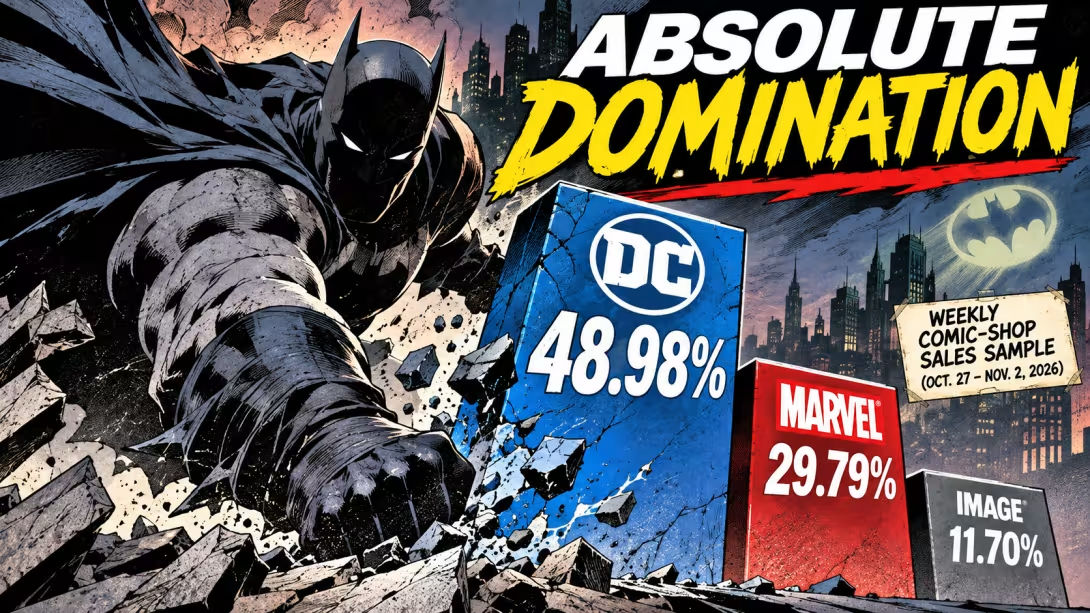
The answer is a little of both. According to sales figures published November 4 by Bleeding Cool, DC captured 48.98% of the publisher share recorded by Prana Direct Market Solutions for October 27 through November 2, 2026. Marvel followed at 29.79%, with Image Comics at 11.70%. The sample covers point-of-sale transactions from more than 600 stores using Manage Comics and Comic Shop Assistant. It is a substantial view of participating specialty retailers, not a census of every comic sold in North America.
Absolute Batman #25 led the weekly ranking, followed by Absolute Wonder Woman #25. DC also held third place with DC All In Saga: Darkseid vs. the World #1 and fourth with Batman: Bad Seeds Sunrise #1. Marvel’s Amazing Spider-Man #1002 was fifth. DC took five of the top seven positions once Justice League: The Dark Realm Special #1 is included. The figures are striking, especially for a company whose familiar characters have been relaunched so many times that even veteran readers occasionally need a map.
Weekly Comic-Shop Sales Share
October 27–November 2, 2026
DC
48.98%
Marvel
29.79%
Image
11.70%
A Big Week, but Not the Whole Story
Weekly comic-shop shares are unusually sensitive to release schedules. A milestone issue can produce an enormous spike, particularly when it ships with collector editions or variants. Marvel supplied the perfect demonstration just a month earlier: for September 29 through October 5, the same Prana reporting put Marvel at 51.07% and DC at 26.20%, with Amazing Spider-Man #1000 leading the chart. Calling either result permanent dominance would be a mistake.
The broader numbers are more revealing. ICv2 reported that DC led the third quarter of 2026 with 33.6% of dollar sales tracked by ComicHub, compared with Marvel’s 29.8%. DC was up from 31.9% in the second quarter; Marvel also improved, from 28.3%. ComicHub’s quarterly sample includes more than 125 stores and uses a different reporting base from Prana, so the two sets of percentages should not be blended into a single trend line. They do, however, tell a consistent story: DC has been competitive over a period longer than one shipping week.
Quarterly Dollar Share: DC vs. Marvel
ComicHub participating stores, Q2 and Q3 2026
DC Comics
Q2
31.9%
Q3
33.6%
Marvel Comics
Q2
28.3%
Q3
29.8%
Nor does every strong DC week require a new Absolute Batman. The preceding October 20–26 Prana sample put DC at 39.98%, helped by Absolute Green Arrow #6. Earlier September rankings also showed strong results for regular-continuity Batman and new Doom Patrol, Legion of Super-Heroes and Teen Titans titles. Absolute is central to the conversation, but it is not the only thing on the shelves.
Why Absolute Feels Different
DC launched the Absolute Universe in 2024 with a proposition that sounds familiar until the details come into focus. The heroes are recognizable, but the conditions that formed them have been rearranged. Scott Snyder and Nick Dragotta’s Bruce Wayne lacks the inherited wealth and elaborate infrastructure associated with Batman. Kelly Thompson and Hayden Sherman’s Wonder Woman has an upbringing far removed from the conventional Themysciran story. Jason Aaron and Rafa Sandoval’s Superman is separated from the familiar formative role of the Kent household.
None of those changes automatically makes a comic good. The important question is what remains after the usual equipment and supporting structures are taken away. Batman can be resourceful without being rich. Diana can be compassionate and formidable without following her standard origin. Superman’s decency can be tested in circumstances that would have been foreign to the boy raised in Smallville. Those are storytelling opportunities, not proof that continuity no longer matters.
The experiment also has a practical advantage: the established versions still exist. A reader who wants the traditional Bruce Wayne does not have to accept the Absolute interpretation as a replacement. DC is selling different approaches side by side, rather than insisting that the latest revision cancels everything that came before. In a market where every reboot risks alienating somebody, giving customers a choice is hardly a trivial decision.
The Batman Problem
There is a catch. DC’s strongest titles remain heavily concentrated around Batman and the Absolute brand. Four of the five highest-ranked DC books in the latest top seven are either Batman-related or directly tied to the All In/Absolute publishing push. That concentration can generate impressive headlines without guaranteeing equal demand for the rest of the catalog.
Green Lantern, Flash, Aquaman, Green Arrow and the publisher’s team books need sustained readership of their own. A line built around a few exceptionally successful properties can thrive, but it can also become vulnerable when those properties cool. The question for DC is whether the attention earned by Absolute Batman turns into a habit of buying more DC comics, not merely more Batman comics.
Marvel, meanwhile, is not in retreat simply because DC won this particular week. Its third-quarter share grew, and its own 51.07% October week shows how rapidly the order can reverse. The sensible comparison is not a boxing match declared over after one round; it is an ongoing competition in which DC currently has an especially effective set of attractions.
The Lesson Is Not “Change Everything”
Publishers sometimes talk as though readers must choose between new ideas and established characters. Absolute suggests that is a false choice. The appeal of these books lies partly in seeing how far a hero can be pushed away from familiar circumstances while still behaving like the person readers recognize. That is a more interesting creative exercise than changing details simply to announce that a new era has begun.
It would be equally foolish to credit the entire sales surge to a philosophical commitment to character. Art, pacing, promotion, distribution, variants, issue numbering and the enthusiasm of individual retailers all affect what sells. Point-of-sale figures can tell us what customers purchased in participating shops. They cannot tell us what those customers believed about the proper way to write Batman.
What they can tell us is that DC’s gamble has produced real commercial momentum. The Absolute books have become major attractions, and the publisher’s quarterly lead shows that the excitement is not confined to a single Wednesday. If DC can carry that interest beyond its biggest names, this may become more than a successful alternate-universe imprint.
For now, “Absolute Domination” is an irresistible description of the latest weekly chart, provided we remember what the chart measures. The more durable achievement is simpler: DC has given readers a new reason to buy familiar heroes without asking them to stop loving the originals.