

Some assignments are too dangerous for the law. Some enemies are too powerful for ordinary men. And some heroes have to die before they can begin.
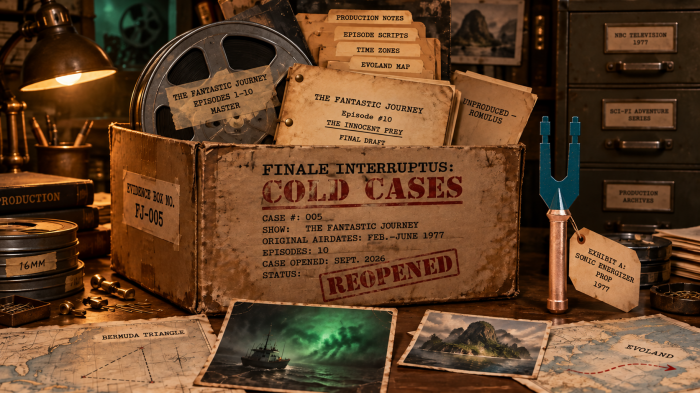
Finale Interruptus: Cold Cases - Case File #005: The Fantastic Journey
FTC Statement: Reviewers are frequently provided by the publisher/production company with a copy of the material being reviewed.The opinions published are solely those of the respective reviewers and may not reflect the opinions of CriticalBlast.com or its management.
As an Amazon Associate, we earn from qualifying purchases. (This is a legal requirement, as apparently some sites advertise for Amazon for free. Yes, that's sarcasm.)
Submitted by Bill Casticart on Sun, 09/27/2026 - 05:00
Every television series begins with a promise.
Give us your time. Your attention. Your imagination.
In return, we’ll tell you a story. And when it ends, we’ll bring it to its proper conclusion.
Most do.
Some don’t.
Some endings are still missing.
These are their case files.
1. The Voyage That Never Came Home
Some television characters are denied an ending because their series concludes before the writers can resolve a particular storyline. Others remain trapped in circumstances that no ordinary episode could ever hope to fix. Somewhere in the Bermuda Triangle, five travelers belonging to different centuries—and in one case, a different world—are still walking east.
They were searching for a place called Evoland. According to legend, somewhere within that mysterious land was a doorway through time: a means by which every displaced traveler might finally return to the life from which he or she had been taken. Varian could go back to the 23rd century. Dr. Fred Walters and young Scott Jordan could return to 1977. The mercurial Dr. Jonathan Willoway might resume the life he lost sometime during the 1960s. Liana could presumably return to Atlantium, although whether she would ever choose to do so was another matter.
None of them made it.
NBC’s The Fantastic Journey premiered on February 3, 1977, and exhausted its entire existence before summer officially arrived. Only ten episodes were produced. The ninth aired on April 21, after which the network left the travelers suspended for nearly two months before quietly broadcasting the final completed episode, “The Innocent Prey,” on June 16. It was not a finale. It was not even an episode particularly concerned with the search for Evoland. It was simply the next adventure along the road—and then there was no road left for viewers to follow.
That makes The Fantastic Journey an unusually pure example of a Finale Interruptus: Cold Case. The series did not merely end before every character received a satisfying emotional resolution. Its entire premise was a journey toward a physical destination, undertaken for the specific purpose of escaping the island and returning its travelers to their proper times. When NBC canceled the series, those characters remained precisely where they had been when the story began: displaced, stranded and still searching for the way home.
The case has gathered dust since 1977, but the evidence has not vanished. The ten produced episodes preserve clues about the nature of the island, the invisible system governing its time zones and the elusive destination the travelers believed lay somewhere “far to the rising sun.” An unproduced script titled “Romulus” suggests that at least one more stop had already been plotted. Most importantly, story editor D.C. Fontana later revealed that the writers possessed something the characters never did: a map.
Before we examine where that map might have led them, however, we must first return to the waters that swallowed the expedition—and to a decade in which the Bermuda Triangle seemed capable of swallowing almost anything.
2. Into the Bermuda Triangle
The Bermuda Triangle did not begin with The Fantastic Journey, but the show could scarcely have arrived at a better moment to exploit it. During the 1970s, the region loosely bounded by Florida, Bermuda and Puerto Rico had become one of America’s favorite modern legends. Vincent Gaddis had helped establish the mythology during the previous decade, while Charles Berlitz’s bestselling 1974 book The Bermuda Triangle transformed a collection of maritime accidents, missing aircraft, questionable reports and outright embellishments into a mass-market paranormal phenomenon. The legend’s popularity was near its peak when NBC sent a boat full of scientists directly into it.
The original version of the story was developed under the title The Fantastic Island. Bruce Lansbury—brother of Angela Lansbury and a veteran producer whose later credits would include Wonder Woman and Knight Rider—conceived the project as a television movie that could serve as the pilot for an ongoing series. The premise combined several durable forms of adventure fiction: the shipwreck, the lost world, the time-travel story and the weekly encounter with a strange new civilization. Instead of carrying its heroes from planet to planet aboard a starship, the series would send them on foot through adjoining zones occupying the same impossible island.
The expedition aboard the vessel Scott Free begins innocently enough. Professor Paul Jordan leads a scientific voyage into the Triangle accompanied by his thirteen-year-old son, Scott; physicians Dr. Fred Walters and Dr. Eve Costigan; and graduate student Jill Sands. Their equipment begins behaving erratically before an ominous green cloud overtakes the boat. Bells can be heard where no bells should be, and the ship and its passengers are deposited in waters beside an island that appears on none of their charts.
The island is not uninhabited. One of its territories is controlled by 16th-century privateers led by the ruthless Sir James Camden, played by Ian McShane decades before Deadwood made him television’s most eloquent purveyor of profanity. Another inhabitant initially appears to be an Arawak man, but the disguise conceals someone far more extraordinary. Varian is a healer, musician and pacifist from the year 2230, himself drawn into the Triangle and unable to escape.
Varian explains that the castaways have entered what amounts to a space-time continuum divided into separate zones. People, settlements and even pieces of civilizations from different periods have been pulled into the island. The past, present and future do not replace one another there; they exist side by side, separated by borders that can sometimes be crossed as easily as walking through another cloud.
The first great promise of the series comes from a story Varian heard from the Arawaks. Far to the east—“far to the rising sun”—lies a place called Evoland. There, a traveler may find a doorway capable of returning him to his own time. Varian cannot guarantee that the story is true, but on an island from which boats cannot sail and ordinary geography offers no escape, a legend is enough to establish a direction.
That direction becomes more important after the survivors reach Atlantium, a futuristic city populated by descendants of the lost civilization of Atlantis. Professor Jordan, Eve Costigan and Jill Sands are said to have been returned to their own time, although Scott is not permitted to accompany his father. The explanation is painfully thin, particularly given that it leaves a thirteen-year-old boy stranded in a temporal wilderness while his father apparently accepts transportation home without him. It was less an organic development than emergency surgery performed upon the program after NBC demanded sweeping changes to the pilot.
The network had approved the concept but not the company of characters expected to carry it. Scott Thomas, Susan Howard and Karen Somerville disappeared with their respective roles as Paul Jordan, Eve Costigan and Jill Sands. Half the original ensemble was removed almost immediately, leaving Scott, Fred and Varian to proceed into the weekly series. Liana, the telepathic daughter of an Atlantean father and an extraterrestrial mother, joined them in “Atlantium.” Roddy McDowall’s Jonathan Willoway would arrive in the following episode, “Beyond the Mountain,” completing the familiar traveling party after the journey was already underway.
The turmoil was visible behind the camera as well. Fontana later recalled that the pilot sold in November and had to reach the air in January—although its eventual premiere slipped into early February—leaving the staff racing to write scripts while simultaneously rebuilding the cast and deciding who these people were. NBC further ordered that the travelers should no longer encounter figures from the historical past after the pirate-filled pilot. According to television historian John Kenneth Muir’s retrospective, the network considered the past “boring,” effectively amputating half the potential from a premise built around past, present and future coexisting.
Even in its altered form, however, the destination remained. The newly assembled travelers would move from zone to zone, confronting societies formed by people from different eras, worlds and possible futures. Every border crossed was supposed to carry them closer to Evoland and the machinery that could send them home.
The viewers who began the journey in February 1977 had no reason to believe they would never see that doorway. They could not yet know that NBC represented a barrier more impenetrable than any time zone on the island—or that Scott Jordan’s father would not be the last member of the expedition to disappear without a proper goodbye.
3. Strangers from Yesterday and Tomorrow
Once NBC had finished dismantling the original expedition, The Fantastic Journey finally assembled the group viewers would remember. They were not a family, a military unit or a team selected for a mission. They were people whom the Triangle had stolen from different places and times, gradually bound together by the shared hope that Evoland could give them back what they had lost.
Varian became the group’s natural leader. Played by Jared Martin, he came from the year 2230, where humanity had apparently evolved beyond many of the impulses still governing the 20th century. He was a healer and a pacifist, but not a helpless one. The small device worn on his hand could heal injuries, render people unconscious, manipulate objects and perform whatever additional function a particular script might require. His greater advantage was the discipline with which he used it.
That made Varian something more interesting than the standard man from the future. He possessed knowledge that could have allowed him to dominate the others, yet he rarely treated them as inferiors. He was supposed to represent a better version of humanity—calmer, wiser and less violent—but the series never had enough time to examine what his century had overcome or what it had sacrificed in the process. Martin later observed that Varian was “closer to God than the rest of us,” but also conceded that the character could be stiff and humorless. The distance between Varian and his 20th-century companions was one of the show’s most promising ideas, and one it had only begun to explore.
Dr. Fred Walters, played by Carl Franklin, provided a more contemporary counterweight. Fred was a young physician from 1977, practical enough to challenge explanations that depended too heavily upon advanced science or mysticism. He had entered the Triangle as a member of Professor Jordan’s expedition and remained behind after Jordan and the other original travelers were abruptly written out. That left Fred carrying a responsibility no one formally assigned him: helping protect Scott after the boy’s father had vanished from the story.
Scott Jordan was the audience’s point of entry. Ike Eisenmann, already familiar to young viewers as Tony Malone in Disney’s Escape to Witch Mountain and Return from Witch Mountain, played him as intelligent without becoming impossibly precocious. Scott could understand enough science to participate in the group’s discoveries, but he still reacted to danger, abandonment and injustice as a thirteen-year-old boy. He was frequently the traveler least willing to accept that someone had to be sacrificed or left behind.
That moral stubbornness mattered. The adults could weigh risks and justify moving on; Scott forced them to remember that the people inhabiting each zone were not merely obstacles between them and Evoland. In “Children of the Gods,” he resisted abandoning Sigma and the other children to the consequences of the violent society their parents had created. In “An Act of Love,” he insisted that the others go back for Varian. Scott was not simply the child who needed to be rescued. He was often the reason the adults behaved like heroes.
Liana complicated the group in a different way. Played by Katie Saylor, she was the daughter of an Atlantean father and an extraterrestrial mother. She possessed telepathic abilities and shared a psychic bond with her cat, Sil-El, through whose eyes she could sometimes see. She first appeared as a dissident within Atlantium, helping the travelers resist the Source—the city’s grotesque controlling intelligence—before leaving her home and joining their eastward journey.
Liana should have been central to the mythology of the series. Her heritage connected Atlantis, extraterrestrial life and the strange forces operating inside the Triangle. Her abilities suggested that the island’s mysteries might not be explained by time travel alone. She also faced a choice the others did not: while they were trying to return home, she had deliberately walked away from hers.
Then came Dr. Jonathan Willoway.
The travelers encounter Willoway in “Beyond the Mountain,” presiding over a community of androids and enjoying the comforts of a private paradise. He had entered the Triangle during the 1960s, but unlike the others, he had adapted remarkably well to being stranded. He was brilliant, vain, opportunistic and not always burdened by an excess of conscience. He initially seemed as likely to betray the group as to help it.
Roddy McDowall was precisely why Willoway became more than an untrustworthy scientist dropped into a single episode. D.C. Fontana later recalled that she rewrote the character specifically to attract McDowall to the role. The strategy worked. McDowall liked Willoway, the producers liked what he brought to the ensemble, and the character joined the expedition.
Willoway gave The Fantastic Journey something it badly needed: friction. Varian represented moral and intellectual advancement; Willoway represented intelligence liberated from moral certainty. Fred distrusted him almost immediately, and their arguments developed into a relationship resembling the McCoy-and-Spock antagonism from Star Trek. Willoway might choose the selfish course, but he could also surprise everyone—including himself—by risking his safety for his companions.
Together, the travelers became an accidental family: a boy separated from his father, a physician who inherited responsibility for him, a man from the future, a woman with roots beyond Earth, and a scientist who had spent years pretending not to need anyone. Even Sil-El contributed to the sense that they were a household in motion, although directors occasionally seemed to forget the cat existed. Fontana remembered that several cats played the role, including one whose reaction to a loud gunshot halted production while the crew tried to coax it down from the rafters.
The ensemble had finally found its shape. Unfortunately, the network had given the writers almost no time to discover it. Fontana said that only around the sixth episode did the staff feel they understood the characters and knew where the series was going. By then, NBC had already begun interrupting the journey.
4. Following the Rising Sun
The format of The Fantastic Journey was simple enough to sustain years of stories. The travelers would continue east, crossing from one temporal district into another. Each zone would contain a culture displaced from its proper era—or a society that might someday exist—and each encounter would test the travelers before allowing them to resume their search for Evoland.
It was Star Trek without the Enterprise, Land of the Lost without the pylons and, nearly twenty years early, Sliders without the timer. The characters did not beam down or pass through a portal each week. They walked. That gave the series the structure of an old-fashioned quest: Evoland was always somewhere beyond the next hill, and every new civilization represented both an adventure and another delay.
“Atlantium” establishes that even the most advanced society on the island may not provide the promised escape. The city has technology capable of sending some members of the expedition back to 1977, but it is governed by the Source, a disembodied brain that drains the life energy of others to preserve itself. Scott is selected as its next victim. Varian and Fred rescue him with Liana’s help, but whatever transportation system returned Professor Jordan and the others is no longer presented as a viable way home. The travelers must continue toward Evoland.
“Beyond the Mountain” introduces Willoway while dividing the group between two apparently opposed societies: elegant androids living in comfort and green-skinned humanoids dismissed as dangerous primitives. The division proves less morally convenient than it first appears. It also demonstrates how deceptive the zones can be. Technological sophistication does not guarantee humanity, while an unfamiliar appearance does not establish savagery.
In “Children of the Gods,” the travelers encounter a city inhabited entirely by children. The adults who created it destroyed themselves, leaving their descendants with weapons they do not fully understand and a hatred of adulthood they have inherited rather than earned. Scott is placed on trial merely for nearing the age when he will become one of the enemy. The episode is among the clearest examples of the series using a zone as something more than an exotic trap: the civilization is a warning about teaching children whom to hate without teaching them why.
“A Dream of Conquest” brings the group into the orbit of Consul Tarrant, played by John Saxon, who plans to extend his control across the other zones. Willoway appears to defect, offering his scientific abilities to the would-be conqueror. His companions understandably believe the worst of him, but Willoway is playing a more dangerous game than they realize. The episode begins the slow transformation that might have become the series’ strongest continuing character arc: the selfish man discovering that he has people worth betraying his own instincts to protect.
“An Act of Love” turns its attention toward Varian. Drugged into emotional vulnerability, he falls in love with a woman whose society maintains itself through ritual sacrifice. For Scott, the danger is personal as well as physical. Varian has become his surrogate father, and the appearance of someone who might take him away exposes the boy’s fear of being abandoned again. The episode remembers Professor Jordan without bringing him back, allowing the damage caused by the pilot’s hurried reconstruction to become part of Scott’s character.
“Funhouse” places the travelers inside an apparently deserted amusement park controlled by the ancient sorcerer Apollonius. He wants Willoway’s body as a vessel through which he can escape his imprisonment. The carnival imagery gives the episode a surreal quality, but the larger temptation is carefully aimed: Apollonius claims to know the secret route to Evoland. The travelers have finally encountered someone who may possess the information they need, but the offer is inseparable from his attempt to possess Willoway.
“Turnabout,” written by Fontana and Ken Kolb, presents a society in which women rebel against male domination, only to risk reproducing the same abuses after gaining power. Fontana later explained that the story was intended less as a declaration that either sex was naturally better suited to rule than as an observation about power itself. Human beings repeat the same mistakes when they fail to learn from history—a particularly suitable concern for travelers walking through its displaced fragments.
The episodes could largely be watched as individual adventures, but they were not wholly disconnected. Characters remembered earlier events. Fred’s distrust of Willoway accumulated rather than resetting each week. Scott’s separation from his father remained an emotional wound. Willoway gradually became more loyal, while the legend of Evoland continued to supply the journey with direction.
Then, in “Riddles,” the larger quest appeared ready to advance.
A mysterious mounted messenger leads the travelers to an isolated house inhabited by a strange married couple. The house confronts them with illusions drawn from their deepest fears, turning their own memories and weaknesses against them. The promised prize is an object that will help guide them toward Evoland. For once, this is not merely a rumor offered by a villain or a general instruction to keep walking east. It suggests that someone—or something—has been monitoring their progress and deliberately placing assistance along the route.
It also raises a question the series never had time to answer. Who were the riders guiding travelers through the island? Were they agents of Evoland, caretakers of the zones or simply another faction pursuing an agenda of its own? If reaching the doorway home required more than geographical progress, perhaps the encounters were not random at all. The travelers might have been undergoing a series of tests, with Evoland admitting only those who had survived—and learned from—the civilizations placed in their path.
That possibility makes the journey more coherent than its weekly structure initially suggests. Each zone asks some variation of the same question: What does a civilization do with power? The Source consumes its citizens. The children inherit the weapons and hatreds of their parents. Tarrant seeks conquest. Apollonius offers knowledge in exchange for another man’s body. The rebels in “Turnabout” risk becoming indistinguishable from their former oppressors. Against them walks a group drawn from different eras that must learn to share power, trust one another and remain together despite every opportunity to fracture.
If those encounters were tests, the travelers were approaching something more important than an exit. They were being asked to prove they were ready to find it.
But “Riddles” also quietly removes a member of the party. Liana is absent, and the audience receives no explanation. No farewell is offered. No destination is named. A character whose origins seemed inseparable from the mysteries of the island simply disappears between episodes.
The journey continued without her, but the series was now losing travelers in more ways than one.
5. The Last Zone
“The Innocent Prey” became the final episode of The Fantastic Journey without ever being designed to carry that burden. It offers no arrival at Evoland, no doorway through time and no decision about which travelers will return home. It does not restore Scott to his father, explain Liana’s absence or reveal who has been guiding the expedition. Nothing about it signals that the journey has reached its end.
Instead, another craft has fallen victim to the Triangle.
This one is a prison transport from Earth’s future. Two convicts survive the crash, kill their guards and assume their identities before encountering Varian and Willoway. Their deception carries them into a community of peaceful humanoid aliens who possess the ability to alter matter at the molecular level. The aliens do not understand violence, private ownership or even the purpose of locks. To the escaped prisoners, their innocence is not admirable. It is exploitable.
The episode therefore returns to one of the series’ recurring concerns: advanced abilities do not produce advanced morality. The aliens can transform matter but cannot comprehend murder. The prisoners understand murder perfectly but see every wonder only in terms of how it might benefit them. Varian, who comes from a future that has rejected violence without forgetting its existence, stands between those extremes.
As an ordinary episode, “The Innocent Prey” works. It gives Varian a society that reflects his own pacifism and presents him with the limits of that philosophy when confronted by people who interpret peace as weakness. It also features a remarkable collection of guest performers, including Richard Jaeckel, Nicholas Hammond, Cheryl Ladd and Gerald McRaney. As the conclusion to a quest extending across time, however, it resolves absolutely nothing.
Liana is still gone. Scott’s father is still somewhere in 1977, presumably believing that his son remains trapped beyond his reach. The mysterious riders have not been identified. The object connected to the search for Evoland has not brought the travelers to their destination. When the immediate danger has passed, Varian, Scott, Fred and Willoway remain on the island.
That was never intended to be their final condition.
At least one additional script, “Romulus,” had been prepared but was never produced. Copies reportedly circulated among collectors and online fan communities years later, providing evidence that the writers were continuing to build adventures rather than preparing a sudden conclusion. The title has sometimes caused the unproduced episode to be mistaken for a planned finale or a revelation about the island. There is no reliable evidence that it would have completed the journey. It was simply the next scheduled case beyond the last one NBC allowed the company to film.
The absence of a proper finale is compounded by the way NBC broadcast what remained. After “Riddles” aired on April 21, The Fantastic Journey disappeared from the schedule. Its time slot was filled by specials, movies and even repeats of other programs. The network finally aired “The Innocent Prey” on June 16, almost two months after viewers had last seen the travelers. A detailed reconstruction of the broadcast schedule shows repeated preemptions throughout the brief run, followed by that long final absence.
The network had not merely canceled the journey. It had trained the audience to stop looking for it.
The Fantastic Journey had entered an inhospitable part of the prime-time map from the beginning. NBC placed it on Thursday nights opposite two established successes: The Waltons on CBS and Welcome Back, Kotter on ABC. One offered multigenerational family drama; the other was among television’s most popular comedies. NBC’s new science-fiction series was also replacing Gemini Man, another genre program that had already failed in the same time period.
The production had almost no opportunity to stabilize before its ratings were judged. Fontana remembered that the pilot was sold in November with the expectation that the series would be ready for the air around January. The writers were forced to create scripts while rebuilding the cast, introducing new regulars and responding to network demands. Roddy McDowall did not join until the third broadcast episode. The creative team did not feel it had truly found the characters and direction until approximately the sixth.
By that time, the interruptions had begun. “A Dream of Conquest” was delayed by a preemption. NCAA basketball interrupted the run the following week. After “Turnabout,” the series was displaced again. Only nine episodes had aired when NBC effectively removed it from active circulation, holding the tenth until June.
Fontana believed the show had finally become ready to fulfill its potential just as the network decided to dispose of it. The timing contains one of television history’s crueler jokes. NBC abandoned The Fantastic Journey in the spring of 1977. On May 25, while “The Innocent Prey” was still sitting unaired, Star Wars opened in theaters and transformed science fiction from a questionable television investment into the center of popular culture.
A series featuring civilizations from the future, alien descendants, androids, telepaths, crashed spacecraft and doorways through time had been canceled only weeks before the entertainment industry began desperately searching for anything that could be marketed to the suddenly enormous science-fiction audience.
Several members of the production team moved almost immediately to Logan’s Run, which premiered on CBS that fall. Once again, a group of travelers moved through a succession of isolated societies while searching for a promised destination. The machinery of The Fantastic Journey survived. Its characters did not.
Varian and his companions were left on the road, walking toward a place the audience never saw. For decades, that appeared to be the entire case: a quest canceled before its destination could be reached.
Then D.C. Fontana disclosed what was on the writers’ map.
6. The Map to an Ending
The most important surviving evidence about the intended future of The Fantastic Journey does not come from an unproduced finale. No completed script has emerged in which the travelers enter the doorway and decide whether to return home. Bruce Lansbury never supplied a scene-by-scene account of a planned conclusion. What survives is less complete than an ending, but more revealing than a guess.
The production had mapped the island.
In an interview with television historian John Kenneth Muir, Fontana explained that the writers had a map divided into districts through which the characters would travel. Each district represented another culture and another weekly encounter. The travelers were not wandering aimlessly through an infinitely improvised landscape. They were moving in a definite direction, and the creative staff understood that the journey would eventually take them off the island.
Her recollection also introduces a fascinating complication: the writers called the island itself Evoland.
That differs subtly but significantly from the way the destination is described inside the series. Varian speaks of Evoland as a place lying far to the rising sun, where a doorway can return a displaced person to the proper time. The characters consequently treat it as a particular zone or settlement somewhere ahead of them. Fontana’s account suggests that Evoland may instead have been the name of the entire island—the complete patchwork of temporal districts through which they were already traveling.
If so, the travelers were not trying to reach Evoland. They were already inside it.
The place they sought would have been its exit: a final district, city or installation containing the “instantaneous transfer” equipment capable of sending them home. The misunderstanding is entirely plausible. Varian is repeating a story he learned from the Arawaks, not reading from a technical manual. Over generations, a direction toward a particular place within Evoland could easily have become a direction toward Evoland itself.
That interpretation also helps explain the island’s apparent organization. The zones are not random pieces of history scattered by a natural accident. Borders exist between them. Clouds can transfer people from one district to another. Riders appear capable of navigating the system and guiding selected travelers. Atlantium possesses technology that can return people to their original time. Somewhere behind these separate phenomena, there appears to be a structure.
Was the island a naturally occurring temporal trap that later civilizations learned to control? Was it an artificial refuge built to preserve cultures from across history? Were the riders maintaining it? Did the Atlanteans understand more than they told Liana? The series left each possibility open because it never survived long enough to choose among them.
What the evidence does establish is that the writers intended forward movement. Fontana said the travelers were heading in the correct direction and that their goal remained in the staff’s thinking. The Fantastic Journey was not designed to maintain the search forever while ensuring Evoland always remained one zone away. There was an endpoint on the map, and the characters were supposed to get off the island.
The larger mystery is what would have happened when they reached the doorway.
Fred’s choice appears straightforward. He had a life in 1977 and no reason to remain in the Triangle once escape became possible. Scott’s need was even clearer. Whatever questionable mechanism had separated him from Professor Jordan, the boy’s story demanded reunion with his father. To deny him that after years of searching would have turned the series’ central hope into a punishment.
Willoway is more complicated. Before joining the travelers, he had already built a comfortable existence on the island. He came from the 1960s, but the series never established that anyone remained there waiting for him. His real journey was not toward his original decade. It was away from isolation and self-interest. By the time the group reached the doorway, Willoway might have discovered that “home” was no longer the time from which he had disappeared but the people beside whom he had traveled.
Liana’s decision might have been the most revealing of all. Atlantium was geographically accessible, and its machinery had apparently returned members of the original expedition to 1977. Yet she rejected its control and left with Varian. Her disappearance before “Riddles” denied the series an opportunity to explain whether she had returned to her people, been separated from the group or departed for reasons of her own. Had she remained through the eventual finale, the doorway might have forced her to decide whether Atlantium was still her home—or merely the place where her journey began.
Varian likewise had reasons to hesitate. The 23rd century was his proper time, but nothing in the surviving episodes indicates that he was desperately trying to recover a particular family or unfinished life there. He had become Scott’s protector and the group’s moral center. Returning home would mean ending the community they had formed.
That points toward the most dramatically satisfying conclusion, although it must be identified as reconstruction rather than recovered fact. The travelers reach the transfer apparatus and discover that it can send each of them home. Fred returns to 1977. Scott reunites with his father. Liana receives the opportunity to choose her own future rather than have it determined by Atlantium or by the accident of her birth. Willoway initially treats departure as the obvious goal, only to realize that the quest has given him something his former life did not.
Varian goes last—or does not go at all.
Perhaps someone must remain to operate the machinery. Perhaps the island continues drawing innocent travelers into its zones and needs a guide who understands both its dangers and its promise. The man who once heard an Arawak legend about a doorway becomes the person who leads others toward it. Willoway, having finally learned loyalty, may choose to stay with him. The journey ends for Scott and Fred but continues in another form for those whose home has become Evoland itself.
There is no document proving that was the ending Lansbury or Fontana intended. The distinction matters. A cold case is not solved by presenting invention as evidence. What can be concluded from Fontana’s testimony is narrower but still decisive: there was a map, there was a direction, and there was an intended escape. The series was not built upon a destination its writers planned never to reach.
NBC ensured that they did not reach it.
Nearly half a century later, The Fantastic Journey occupies an important if frequently overlooked place in television science fiction. It followed Land of the Lost in presenting displaced travelers moving through the remnants of wildly different civilizations. It preceded Sliders, which would turn passage between self-contained worlds into a weekly engine. It anticipated the traveling format of Logan’s Run so closely that several of its own creative personnel carried the idea directly into that series.
But those later journeys cannot finish this one.
Somewhere beyond the final frame of “The Innocent Prey,” Scott Jordan is still walking east. Fred Walters is still trying to bring him home. Willoway is still pretending that the fate of his companions matters less to him than it does. Varian is still following a legend toward the rising sun.
They were on the correct road. The writers had the map.
Only the audience was never permitted to see where it ended.
CASE STATUS: STILL MISSING


FEATURED ALBUM

Songs of faith, family and moving forward.


