Critical Blast's Top 10 Indie Books Of 2025
Dozens of books are reviewed here at Critical Blast each year. Given that the site was founded upon the principle of exposing independently produced genre works to a wider audience, most featured books are of a decidedly science fiction, fantasy, or horror nature. This year was no different, and the submissions sent to us for review were as diverse and exciting as ever.
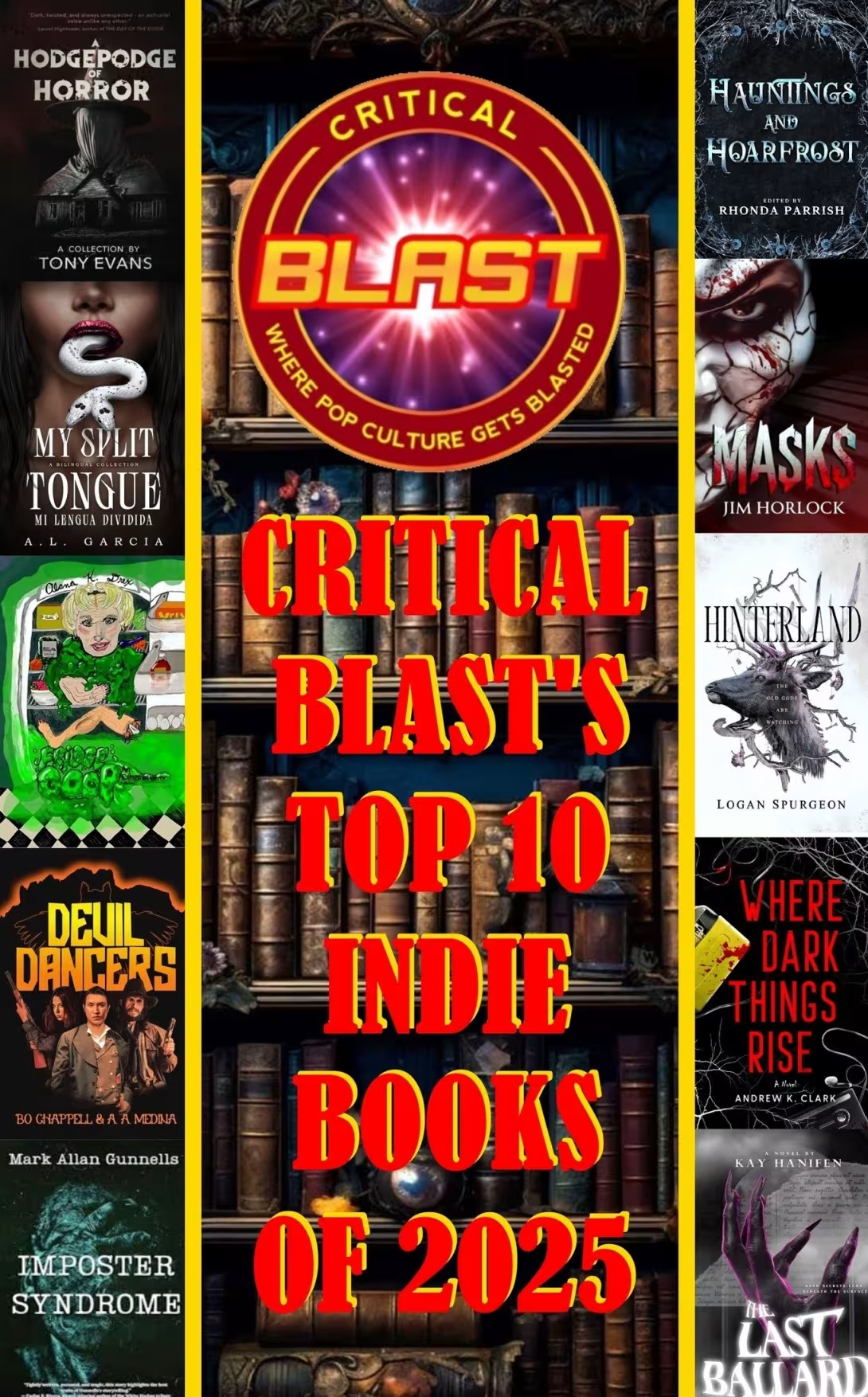
As with any list, some caveats are necessary. First, while it may say ‘Top 10 of 2025’ in the headline, not every book included was necessarily published in this calendar year; some were submitted to us in 2024 but were read and reviewed during 2025, thus making them eligible. Secondly, while we oftentimes review multiple books by a single author in any given twelve month period, in the name of fairness a writer may appear on our list just once, meaning that only their absolute best is chosen. With those things in mind, let our second annual ‘Top 10 Indie Books of the Year’ countdown commence! 10: A Hodgepodge of Horror by Tony Evans (Dark Holler Press): Horror, more than any other genre, pays respect to the lore of old. Urban legends and regional folk tales are modern remnants of the stories told by our ancient ancestors, passed down by word-of-mouth through ensuing generations. In 2025, Kentucky native Tony Evans reaffirmed his position as one of indie horror publishing’s best kept secrets with the Dark Holler Press release of his short story collection, A Hodgepodge of Horror. With rustic tales rooted in Appalachian folklore, stories like ‘Big Daddy’, in which a consultation worker and his partner find themselves literally ass deep in danger when they run afoul of a backwoods bumpkin and his Bigfoot buddies, and ‘Fecesnura: The Demon Lord of Shit’, about a humiliated teen finding an unlikely ally in an infernal scatological monstrosity, perfectly showcase the cackling, ghoulish delight in Evans’ energetic prose in ways that are simultaneously hilarious, horrifying, and gleefully gross. The Crypt Keeper would be proud. 9: My Split Tongue/Mi Lengua Dividida by A.L. Garcia (Quill & Crow Publishing House): Poetry has long examined the innermost truths of the collective human spirit. In 2025, the poet who best explored those shadowy recesses is A. L. Garcia, whose release My Split Tongue/Mi Lengua Dividida is a dual-language descent into the darkest corners of the soul. Intense is the best word to describe Garcia’s work. Others would be raw, passionate, lurid, sensual, ferocious, intelligent, unrestrained; her expressions are drawn deep from the primal essence which all humanity shares, untainted and unencumbered by pretense or conscious stylistic impositions. True to its title, much of the verse in My Split Tongue is presented with alternating English and Spanish iterations, and part of Garcia’s brilliance is that both versions offer insights its translated counterpart does not. Yet ironically it’s one of the book’s three prose pieces, ‘Fly Me To The Moon (Amber)’, that earns My Split Tongue a place on this list. With its Frankenstein vibes and inventive narrative about an insect (‘the fly on the fucking wall’) longing for a female mad scientist who’s intent on assembling the perfect man, ‘Fly Me To The Moon’ distills Garcia’s literary fierceness to its most potent, poignant, and powerful form. 8: Fridge Goop by Alana K. Drex (Independently Published): In June, 1987, good-natured nerd Robbie painfully endures existence at the bottom of his high school pecking order. All that changes the night a mysterious refrigerator appears on the corner of his quiet suburban street. Robbie’s elderly identical twin neighbors, Edna and Ruth Olstadt, are in need of a new fridge, and with dishes for their impending pot luck social going rapidly rancid, Edna moves the abandoned appliance into her kitchen. The refrigerator, however, already has an owner: a sentient, ever-expanding gelatinous mass of (possibly extraterrestrial) goo with an insatiable appetite for human flesh. The Goop God, as she dubs the entity, quickly establishes a telepathic link with Edna, and after learning of its regenerative properties (along with its Julia Child-level culinary prowess), she willingly feeds unsuspecting victims to her new deity in exchange for a fresh lease on youth. Robbie suspects something otherworldly is afoot, and after his alpha jock asshole brother Bill goes missing, he launches an investigation that puts him directly in Edna’s newly vigorous crosshairs—and in danger of being goopified! Fridge Goop is a sloopy, slippity-sloppity literary love letter to the garish ‘80’s VHS era, oozing the subversive dark humor and multicolored mayhem of movies like Street Trash, The Stuff, and The Blob straight onto the printed page. Author Alana K. Drex solidifies her status as the reigning champion of indie splatstick with her offbeat humor, gloriously glooptastic wit, and cast of quirky characters. Easily the horror-comedy of the year. All Hail the Goop God! 7: Devil Dancers by Bo Chappell and A.A. Medina (Acid Rain): The Weird Western has experienced a resurgence in recent times, and the subgenre’s most exciting example in 2025 was undoubtedly Bo Chappell and A.A. Medina’s Devil Dancers. In 1878, headstrong young Julie Ann endures a dull pioneer existence tending the farm of her layabout father Earl just outside the dry-gulch Arizona mining community of Guidance. Julie Ann’s longing for excitement is unexpectedly fulfilled one night by the arrival of Hector, a bantido on the lam from the law with a bagful of gold. When Earl saves Hector from a beating in Guidance’s saloon, he inadvertently incurs the wrath of Jerald, the trigger-happy leader of the gang of violent bank robbers Hector once rode with and the town’s arrogant, greedy Sheriff Appleton, who’s eager to bring in Hector dead or alive for the reward money. With both parties converging on Earl’s farmstead, Julie Ann’s only hope is Jack, Appleton’s disrespected but level-headed Native American-born deputy. Unbeknownst to any of them, however, a primordial evil has been unknowingly awakened in the nearby mountain mine, and what begins as a struggle for law and order escalates into a battle for survival as Guidance’s population is assailed by a demon capable of transforming the living into unearthly flesh-eating monsters. Assailed by such forces, can Jack, Julie Ann, and Hector keep their wits long enough to lead the others to safety, or is it already too late? If Devil Dancers were a movie, it’s high-concept Hollywood pitch would be Tombstone-meets-The Evil Dead. Chappell and Medina deliver a spirited tour de force of action, fisticuffs, and gunplay that proves the Weird Western isn’t about to ride off into the sunset any day soon. 6: Imposter Syndrome by Mark Allan Gunnells (Slashic Horror Press): Mark Allan Gunnells had an impressive publishing year, with the erotic LGBTQ+ novel Triangle and the paranoid paranormal mystery Imposter Syndrome being released. While both were noteworthy, Imposter Syndrome makes the list with its unconventional take on the haunted house story. Maverick ‘Rick’ Justice is the son of internationally renown bestselling author Bentley Justice, whose Senior & Junior Adventures paranormal Young Adult novels achieved unprecedented success. When Bentley dies unexpectedly with a partially finished manuscript on his computer, Rick, a former pseudonymous writer of mass-market horror fiction, is tapped by Bentley’s editor to finish the book. Living in his late father’s small suburban house just as the Covid lockdown begins, Rick’s life quickly spirals out of control. Troubled by his own failed writing career and unhappy with the lackluster plot left among Bentley’s notes, Rick plans to rewrite the book to reflect his own gay lifestyle that his father frowned upon. But someone—or something—is dead set against the book’s new direction, deleting the newly-written chapters from Rick’s computer, dumping his HIV medication into the trash, and destroying copies of his old horror novels. After seeing Bentley’s shadowy shape lurking in the bedroom, Rick is convinced his father’s disgruntled spirit is preventing him from completing the novel. But are the happenings truly a haunting, or symptoms of Rick’s increasingly fragile mental state? Gunnells is a maestro of fostering dread, and confining the story to one location allows a stifling claustrophobia to set in. Rick’s mounting paranoia comes to a head when Gunnells masterfully flips the script at the novel’s climax, ensuring Imposter Syndrome will keep readers guessing until the very end. 5: Hauntings and Hoarfrost; Edited by Rhonda Parrish (Tyche Books): Winter is the season of ending. Those long, somber months blanketed with snow and ice, when spring seems a distant dream. In 2025, Canadian editor Rhonda Parrish invoked winter’s foreboding menace in the year’s most satisfying multi-author anthology, Tyche Books’ Hauntings And Hoarfrost. With twenty-two tales running the gamut from ordinary slice-of-life to high fantasy, slow-burning chillers to outright horror, stories like J.M. Turner’s ‘Neither Rime Nor Reason’, about a man searching for his wayward brother in the frozen wastes of the North, and Beth Goder’s ‘And We All Come To The End, Around, Around’, about a lonely shanty that accumulates souls, perfectly embody the spirit of winter. But it’s the masterfully penned opener, Sarah Von Goetham’s ‘For The Seer, Who Sees In The Snow’, that takes the top spot. A moving meditation on love, loss, memory, and dreams that follows a psychically sensitive woman drawn into a frightening time loop after her mother’s funeral, Von Goetham’s tale may very well be the best short story published all year. 4: Masks by Jim Horlock (Grendel Press): What if every horror movie slasher were members of an elite Suicide Squad-style team used by the government to eliminate its enemies? That’s the rollicking premise of Jim Horlock’s Masks, a novel that grabs readers by the throat on the first page and refuses to let go. Prolific serial killer Edward Stitch has been unwillingly drafted into a clandestine project called the Mask Program. Detained with a group of other infamous mass murderers, Edward—known by his code name ‘Mr. Stitches’—is held in a secret maximum-security facility and released periodically by his captors on ‘missions’ to designated target areas with orders to slaughter whomever he finds. To ensure the compliance of their killers, the Mask Program’s coordinators have outfitted each with personalized face-coverings that, if removed, will detonate bombs hidden within. Having just completed a routine killing spree, Edward is approached by Dr. Leibling, the Program’s morally dubious head psychologist, with an unprecedented offer: to hunt down a fellow inmate, the supercharged, nigh-indestructible maniac Mr. Beast, who has somehow disabled his mask’s explosive, killed the Spectre Team sent to remove him, and escaped into the city. Yet as Edward follows his quarry’s trail of devastation, it’s revealed that Mr. Beast is an ex-military man searching out his former comrades in an underground resistance movement intent on dismantling not only the Mask Program, but the totalitarian regime responsible for its creation. With the clock ticking, can Edward subdue Mr. Beast, or will he join the resistance and gain answers to the questions he’s always had about his own mysterious past? Masks speeds ahead at breakneck pace, rife with gory mayhem, explosions, twists, turns, betrayals and surprising revelations. Horlock shrewdly balances Edward’s violent tendencies with pitch-black humor and a bevvy of self-referential wink-and-nod Easter Eggs. In a year rife with political upheaval and real-world chaos, Masks gives slasher fans a reason to rejoice. 3: Hinterland by Logan Spurgeon (Quill & Crow Publishing House): Cults are scary, and no book proves that more than Logan Spurgeon’s exceptional Quill & Crow Publishing House novel, Hinterland. A young man dubbed Kestrel awakens with amnesia in a remote mountainside forest, surrounded by twelve strangers who indoctrinate him into a horrifying cannibal cult. Headed by the group’s charismatic female leader, Lynx, the cultists have been desperate to fill out their ranks with thirteen members in order to complete the complex rites that, she proclaims, will revive their long-banished primordial gods. Kestrel immediately begins planning his escape, but his attempt is hindered not only by memory loss, constant surveillance, and an isolated locale, but an appetite for human meat awakened during his cannibalistic induction ritual. Compounding Kestrel’s problems are the military hunters on the cult’s trail that Lynx says are trying to prevent their gods’ ascension. But the deeper Kestrel is drawn into the cult, the more determined he becomes to flee; dubbed ‘The Liberator’ after a hallucinogenic vision, he plots to overthrow Lynx with the aid of several other members, but will Ketrel’s plans bear fruit before he’s betrayed? While the high-minded thematic thrust of Hinterland examines the varying facets of religious belief, Spurgeon indulges enough graphic violence and grotesque imagery to make even the most jaded gorehound giggle with glee. His precise prose ensures nothing, however stomach-turning it may be, is left to the imagination, and the result is one of the year’s most visceral, thought-provoking, heart-stopping thrill-rides. 2: Where Dark Things Rise by Andrew K. Clark (Quill & Crow Publishing House): Quill & Crow Publishing House had a particularly strong 2025, with three of their releases on this list alone. Arguably the strongest is Andrew K. Clark’s Where Dark Things Rise, the electrifying sequel to his 2024 debut, Where Dark Things Grow. In 1985, fourteen-year-old Gabe is involved in a car crash that kills both his parents. Sent thereafter to live with his paternal grandparents, crusty retired policeman Leo and free-spirited Lilyfax; two years later he’s still barely adjusted to his new life, but finds a kindred soul in Mina, the cute, quick-witted redhead living in a nearby trailer park. But Mina harbors a secret: ever since childhood, she’s been able to literally control shadows, forming them into a menagerie of grotesque three-dimensional creatures. At first the power manifests when she’s angry or upset, but she quickly discovers the shadow entities can be harnessed by her will and resolves to use them right the wrongs she sees in her everyday life. Unbeknownst to Gabe or Mina, however, Reverend Ezra, an old boyhood chum of Leo’s who helped him and Lilyfax defeat a sinister cult in Where Dark Things Grow, has taken up the mantle of their long-ago enemy. Envious of the power Leo once wielded over the wolf-like shadow wulver, Ezra has finally succeeded in his lifelong quest to attain his own otherworldy avatar. With an ever-expanding evangelical ministry providing the manpower to aid in his maniacal machinations, Ezra has instigated the ritual kidnapping of teenagers throughout the county. When Mina’s friend Erin goes missing after being forced to attend one the Reverend’s annual outdoor Christian rehabilitation camp retreats, it sets up an epic confrontation as old rivalries reemerge. Where Dark Things Rise earnestly studies the cause-and-effect consequences between past and present, the struggle of class division, and the effects of religious trauma. Though Gabe is ostensibly the main character, the true lead of Where Dark Things Rise is Mina. Headstrong, resourceful, intelligent, and loyal, she’s one of the spunkiest fictional protagonists of the year. 1: The Last Ballard by Kay Hanifen (Miravalle Books): With dozens of anthology appearances in recent years, Kay Hanifen has been an author on the rise, and the vivid study of generational sin in her debut Miravalle Books novel The Last Ballard earns her 2025’s top honor. Since before the American Revolution the Ballard family has lived in old-money opulence in the tiny New England town of Cherub Cove. Rhiannon ‘Rhea’ Ballard is the final blood relation of the family’s long lineage; as a child, both her parents were killed in a tragic accident and Rhea was subsequently raised by her authoritarian paternal grandparents, Bert and Astrid. Isolated from her peers due to home-schooling and a victim of constant emotional, mental, and physical abuse, Rhea’s miserable, sequestered existence is complicated by the presence of several ghosts dwelling in the mansion. After running away at sixteen, Rhea scratches out a meager existence for six hardscrabble years, but when she receives word that Bert and Astrid have both died, she’s begrudgingly drawn back to Cherub Cove for their funerals. Shocked to learn that she’s the sole inheritor of the family fortune, Rhea is forced to stay at the mansion while it’s under probate to put her grandparents’ affairs in order. There Rhea hits it off with Morgan Reyes, the Ballard’s cook and her grandparents’ former caretaker; the two become close, but Morgan possesses her own grave secret involving a stalker ex-boyfriend who was found floating in the mansion’s lake years earlier. Delving into her family’s sinister secrets, Rhea inadvertently reawakens the ghosts of the property, and now she, Morgan, and Andy Higgins, the skeptical groundskeeper, have to piece together the mystery of her ancestors’ poisonous crimes before they’re all taken by the vengeful elemental sprite that’s vowed never to rest until the last Ballard is dead. Any fan of detective fiction, ghost stories, or folklore will be delighted by the intrigues in The Last Ballard. As the novel progresses its narrative builds upon the framework of classic Gothic literature (a centuries-old crumbling mansion, a decaying family with murderous secrets, madness, a distressed damsel plagued by spectral ills), and the burgeoning romance between oft-prickly Rhea and the tender-hearted Morgan is by turns sweet, funny, and endearing. Filled with danger, humor, horror, and heart, The Last Ballard is a magnificent novel, a stunning debut, and well-deserving of the title Best Indie Novel of 2025. Here’s to the New Year, and here’s to another twelve months of provocative, thoughtful, inventive fiction told by people with passion and spirit. May there always be one more story to tell!