


Some assignments are too dangerous for the law. Some enemies are too powerful for ordinary men. And some heroes have to die before they can begin.
Andrew Clark's New Novel, Hollow Folk, Provoides Plenty Of Chills
FTC Statement: Reviewers are frequently provided by the publisher/production company with a copy of the material being reviewed.The opinions published are solely those of the respective reviewers and may not reflect the opinions of CriticalBlast.com or its management.
As an Amazon Associate, we earn from qualifying purchases. (This is a legal requirement, as apparently some sites advertise for Amazon for free. Yes, that's sarcasm.)
Submitted by Damascus Mincemeyer on Sun, 09/27/2026 - 09:20
Hotels, by their very nature, represent a paradox. They’re extremely public buildings that, for a while, become a home-away-from-home refuge for visiting strangers. Innumerable lives are lived in hotel rooms: people sleep, and cry, have sex and drink and laugh; in some hotel rooms people have been born, in many others people have died. And every twenty-four hours these intimate areas are sanitized to look completely anonymous, awaiting the next traveler to rent their space. If only those walls could talk, indeed…
The horror genre has bequeathed the world its share of (in)famous hotels. A shy momma’s boy named Norman ran the Bates Motel in both the book and movie iterations of Psycho, and Stephen King gave us perhaps the most celebrated spooky hotel of all: the imposing, haunted Overlook of The Shining, where a writer is driven mad by the souls trapped within its grounds.
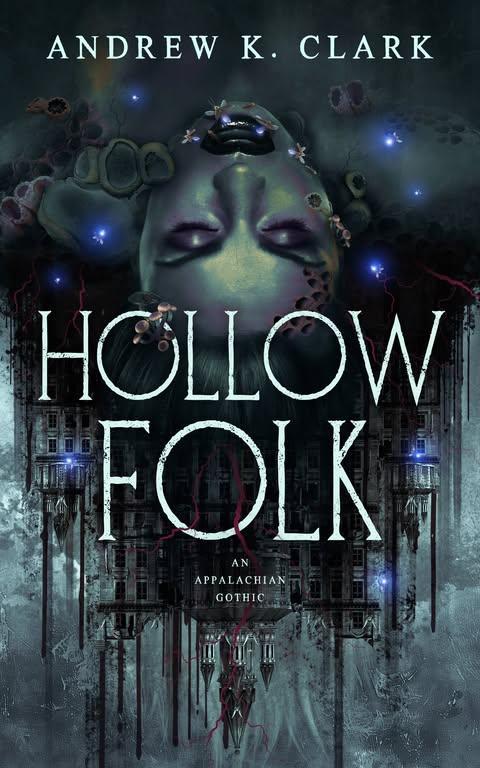
North Carolina native Andrew K. Clark’s new Quill & Crow Publishing House venture, Hollow Folk, now joins the ranks of great horror hotel novels, and its oft-hallucinatory, sometimes erotic escapades are sure to instill countless nightmares in readers everywhere.
In 1993, grad student Ethan Ray is midway through his shift as the night auditor at the aging Holloway mountain resort. The evening commences like any other, dull and quiet, but soon the Appalachian sky outside bleeds reddish-brown light, hard winds whip through the trees without making a sound, and the local wildlife exhibits strange behavior. Then, at 3 a.m., time itself literally stops.
Trapped inside the hotel, Ethan and his two on-duty co-workers—hardheaded rationalist Kal, an Indian immigrant who’s pure Southern Boy due to his upbringing, and snippy, sexy laundry room attendant Teresa, who seems to delight in making Ethan’s life miserable—must uncover the shameful secrets of the Holloway’s century-old founding in order to escape. As the unending night stretches into days, then weeks, then months, however, the trio fall prey to the hotel’s dark mystical energy; Ethan and Teresa’s long-simmering, unspoken feelings for one another consume them, while Kal takes off on his own, searching for a pathway to start the clocks ticking again. Yet the heady visions each of them experience keep drawing them back to one source—the enigmatic Gray Man—and keep telling Ethan that someone in the hotel can’t be trusted.
With its unconventional romance, macabre moodiness, and introspective, sometimes stream-of-consciousness narrative, Hollow Folk evolves as a very different work than Clark’s previous novels, the superb duology Where Dark Things Grow and Where Dark Things Rise. It's a smaller tale, more personal, more nuanced; where the Dark Things books wove a generational tale of overt Good vs Evil utilizing multiple points of view, Hollow Folk features a cast of just three people, and though the audience is given glimpses of other perspectives, this First Person story is firmly entrenched in Ethan’s outlook.
The burgeoning relationship between laid-back Ethan and prickly Teresa is by turns sweet, funny, and endearing; unlike many books where a love affair seems forced, the coupling here progresses so organically it’s impossible not to find charming, and their lively back-and-forth banter provides much of the novel’s best dialogue. As the primary supporting character, Teresa is Ethan’s polar opposite: she’s confident, brash, and caring, but she’s also tough beyond all measure.
That emphasis on romance doesn’t mean the story lacks potent doses terror, however. If anything, Hollow Folk is more chilling than either Grow or Rise; confining the action to one location induces a suffocating claustrophobia, and one harrowing sequence—in which Ethan, Teresa, and Kal attempt to uncover what’s happened to the hotel’s sleeping guests while the building is frozen in stasis—is rendered in such hair-raising, shadowy detail it will leave even the most jaded readers shaking.
Hollow Folk also underscores the ties that bind generations, how events long past can, and often do, reverberate through history, exemplified in the cause-and-effect repercussions the Machiavellian Gray Man (and one must wonder if he is somehow connected to the sinister Blue Man from Where Dark Things Grow) sets in motion with his greedy, land-grabbing schemes. With the Gray Man, Clark doubles down on one of his duology’s most prominent themes: like the aforementioned Blue Man, the Gray Man is misogyny personified, and the author uses him to hammer home how men—particularly powerful men—misuse their influence to control, exploit, and demean women.
Any fan of ghost stories, folklore, or even detective fiction won’t be disappointed by the intrigues present in Hollow Folk. As the novel progresses its narrative builds upon the framework of classic Gothic literature (an isolate rural locale, murderous secrets, madness, unearthly ills), and whether one opens this book for the spectral thrills or quirky romance, they will undoubtedly close it with much to ponder. Once again, Clark has skillfully provided one of the year’s most visceral and thought-provoking novels, and for that I am compelled to grant Hollow Folk a solid 4 (out of 5) on my Fang Scale. With releases like this and many others, Quill & Crow Publishing House has become one of the best—if not the best—small press company out there. Take a bow, everyone. This is how it’s done.
Grade:
4.0 / 5.0


FEATURED ALBUM
Songs of faith, family and moving forward.


